Description
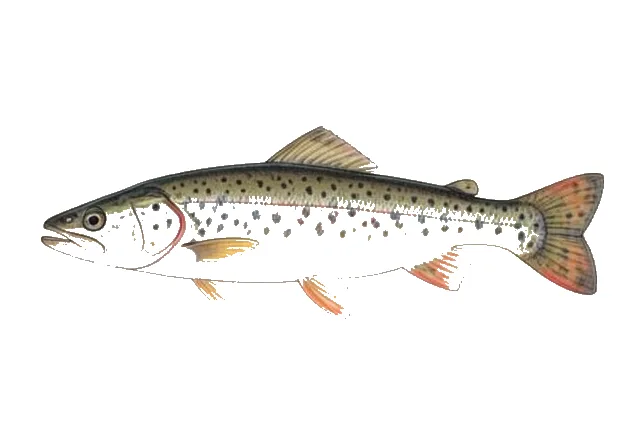
Longfin dace have a bluntly shaped snout and head with a slightly subterminal mouth. The upper jaw contains a small barbel and tends to protrude above the lower jaw. The body is fusiform and covered with small scales. Longfin dace have 70–95 scales along their lateral line, seven to nine anal fin rays, and nine dorsal fin rays. An adult longfin dace has a maximum total length of 4 inches (100 mm), although it rarely reaches 3.2 inches (81 mm). Age estimation with scales and length-based grouping suggested that most longfin dace live less than two years.
Distribution and habitat
Longfin dace are native to the deserts of southwestern North America, notably in the American states of Arizona and New Mexico and northern Mexico states of Sinaloa and Sonora. The longfin dace is tolerant to a wide range of water temperature, and is found in low elevation desert streams to mountain brooks. They prefer streams that have sandy or gravel bottoms, typically with overhanging banks or cover to use as protection. During periods of drought, longfin dace may seek refuge in algae and detritus mats.
Diet
Longfin dace are omnivorous and opportunistic feeders. They can feed on invertebrates, zooplankton, algae, and detritus.
Reproduction
Longfin dace reach sexual maturity within a year and are able to spawn throughout the year, although most spawning occurs in spring and late summer. Longfin dace will create depressions in the sand to deposit their eggs, which provide cover from predators while the eggs develop and hatch. The eggs and juveniles receive no parental care.
Management
In the United States, longfin dace are considered secure but have been reduced in abundance due to habitat change and introduced fishes.
Article text: Wikipedia contributors, Longfin dace (source revision). Licensed under CC BY-SA 4.0. Retrieved 2026-10-11.
Diet and feeding
The FishTraits compilation records these diet categories for this species: algae or phytoplankton; detritus or unidentified plant material; invertebrates or larval fish. These are broad categories, not a claim that every individual consumes every example in a category.
Reported feeding positions include bottom feeding. The compilation combines published observations; diets can vary with age, locality, and available food.
Habitat preferences
Reported habitat associations include streams and small rivers, creeks.
The source records associations with sand, gravel, cobble, boulders, bedrock. An association indicates reported use, rather than an exclusive requirement.
Reproduction and parental care
The compilation reports a representative maturity age of 1 years. Its maturity field summarizes mean, median, or modal estimates, usually for females; male estimates can be used when female data are unavailable. It is not a fixed age at which every fish first breeds.
Batch or serial spawning has been reported somewhere in the species’ range. This does not establish the same spawning pattern for every population.
Recorded spawning months are Jan, Feb, Mar, Apr, May, Jun, Jul, Dec for the source’s reporting region (NM). This is a regional calendar, not a range-wide schedule.
The reproductive-guild classification includes hiding a brood without subsequent guarding.
Size and recorded longevity
FishTraits reports a maximum total length of 10 centimetres. Some entries use an estimated asymptotic length; this value should not be treated as a certified record catch.
Recorded longevity in the compilation is 3 years. Wild observations were preferred, but captive records were accepted where wild records were unavailable, and unspecified records were assumed wild. The value is not a guaranteed wild lifespan or an aquarium life expectancy.
Identification and appearance
Minckley (1973); Sublette et al. (1990); Page and Burr (1991). Another name is Rhinichthys chrysogaster, however ITIS does not recognize this as a synonym.
Native range
Lower Colorado River drainage, New Mexico and Arizona, and south through southern Arizona and Pacific drainages of western Mexico (Page and Burr 1991).
Introduction history
Unknown; probable bait bucket releases. Introduced as early as the 1950s into parts of the Rio Grande basin of New Mexico. The Rio Hondo, Mimbres, and Largo Creek introductions all occurred in the 1960s (Sublette et al. 1990).