Widemouth Blindcat

Satan eurystomus

Ictaluridae · freshwater water fish

2 minute read · Species guide

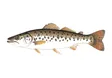
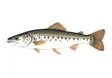
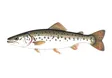
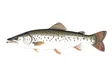
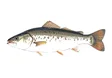
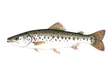
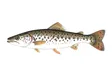
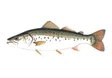
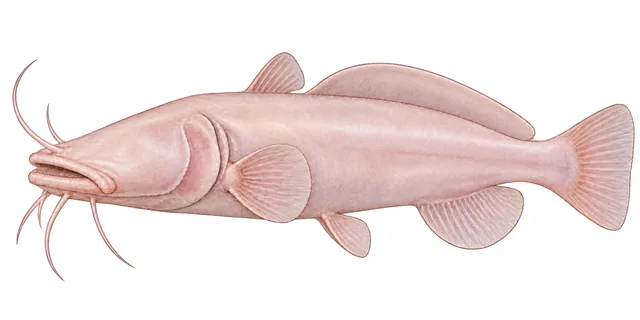
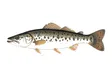
Widemouth Blindcat field guide illustration

About Widemouth Blindcat

The widemouth blindcat (Satan eurystomus) is a species of North American freshwater catfish endemic to Texas in the United States. It is the only species in the genus Satan.

Description

It was first discovered inhabiting a well, and is adapted for a lightless underground environment. Like other cavefish, the widemouth blindcat lacks pigmentation and has no externally visible eyes. The eye remnants are extremely reduced in size with very little or no trace of a retina or lens; the optic tract is present, but always regresses before reaching the brain. The swim bladder in these fish is reduced, and the skull is mostly cartilaginous and not well- ossified, unlike the adults of most larger ictalurids. The lateral line is fragmentary and never reaches past the anterior part of the anal fin. This species also has a few paedomorphic traits (indicated by small size, kidney morphology, and weak ossification of the skeleton). This species grows to about 13.7 cm (5.4 in) TL.

Taxonomy

The widemouth blindcat's closest relative is the much larger flathead catfish (Pylodictis olivaris).

Distribution and habitat

Along with the related toothless blindcat (Trogloglanis pattersoni), this species is distributed in five artesian wells penetrating the San Antonio Pool of the Edwards Aquifer in and near San Antonio, Texas. These fish have been found with crustacean exoskeletons in their stomachs, and may be the top carnivore in their habitat.

Conservation

The widemouth blindcat is a vulnerable species, and is threatened by groundwater pollution. In 2023, the U.S. Fish and Wildlife Service proposed to list the species as endangered under the Endangered Species Act of 1973 along with the sympatric toothless blindcat.

Article text: Wikipedia contributors, Widemouth blindcat (source revision). Licensed under CC BY-SA 4.0. Retrieved 2026-10-11.
Diet and feeding

The FishTraits compilation records these diet categories for this species: invertebrates or larval fish. These are broad categories, not a claim that every individual consumes every example in a category.

Reported feeding positions include bottom feeding. The compilation combines published observations; diets can vary with age, locality, and available food.

Habitat preferences

Reported habitat associations include creeks, springs or subterranean waters.

The species is classified as tolerant of a broad range of salinities. This flag does not specify a salinity range for aquarium care.

Size and recorded longevity

FishTraits reports a maximum total length of 13.7 centimetres. Some entries use an estimated asymptotic length; this value should not be treated as a certified record catch.

Range

Where it lives

Share of 49 GBIF observation records with a state location, across 1 states.
0%
100%
Share of 49 GBIF observation records with a state location, across 1 states.

Share of records by state

Habitat

Water and movement

Water
WoRMS records this species in fresh water.
Migration
Not migratory

Classification

Taxonomy

Kingdom
Animalia
Phylum
Chordata
Superclass
Actinopterygii
Class
Teleostei
Order
Siluriformes
Genus
Satan
Species
Satan eurystomus
ITIS TSN
164031
WoRMS AphiaID
1383543
GBIF key
2341042

Common questions about Widemouth Blindcat

What is the scientific name of Widemouth Blindcat?
The scientific name is Satan eurystomus, in the family Ictaluridae. Classification follows ITIS.
Does Widemouth Blindcat live in fresh water or salt water?
WoRMS records this species in fresh water.
Where has Widemouth Blindcat been recorded in the United States?
GBIF has observations in 1 states, with the most records in Texas. The map shows observation records, which do not establish the complete natural range.

Same family

More Ictaluridae

Black Bullhead46 states
Ameiurus melasIctaluridaeNative and introducedFresh
Black Madtom5 states
Noturus funebrisIctaluridaeNativeFresh
Black River Madtom2 states
Noturus maydeniIctaluridaeNativeFresh
Blue Catfish31 states
Ictalurus furcatusIctaluridaeNative and introducedFreshBrackish
Brindled Madtom16 states
Noturus miurusIctaluridaeNativeFresh
Brown Bullhead44 states
Ameiurus nebulosusIctaluridaeNative and introducedFresh
Brown Madtom6 states
Noturus phaeusIctaluridaeNativeFresh
Caddo Madtom1 states
Noturus tayloriIctaluridaeNativeFresh
Carolina Madtom2 states
Noturus furiosusIctaluridaeNativeFresh
Channel Catfish47 states
Ictalurus punctatusIctaluridaeNative and introducedFresh
Checkered Madtom3 states
Noturus flavaterIctaluridaeNativeFresh
Chucky Madtom1 states
Noturus crypticusIctaluridaeNativeFresh
Elegant Madtom4 states
Noturus elegansIctaluridaeNativeFresh
Flat Bullhead7 states
Ameiurus platycephalusIctaluridaeNative and introducedFresh
Flathead Catfish34 states
Pylodictis olivarisIctaluridaeNative and introducedFresh
Frecklebelly Madtom5 states
Noturus munitusIctaluridaeNativeFresh
Freckled Madtom15 states
Noturus nocturnusIctaluridaeNativeFresh
Headwater Catfish2 states
Ictalurus lupusIctaluridaeNativeFresh
Least Madtom4 states
Noturus hildebrandiIctaluridaeNativeFresh
Margined Madtom21 states
Noturus insignisIctaluridaeNative and introducedFresh
Mountain Madtom15 states
Noturus eleutherusIctaluridaeNativeFresh
Neosho Madtom3 states
Noturus placidusIctaluridaeNativeFresh
Northern Madtom9 states
Noturus stigmosusIctaluridaeNativeFresh
Orangefin Madtom3 states
Noturus gilbertiIctaluridaeNative and introducedFresh

All 42 species in Ictaluridae