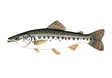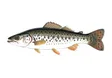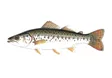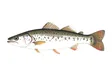
Tessellated Darter

Etheostoma olmstedi

Percidae · freshwater water fish

4 minute read · Species guide

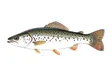
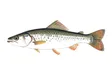
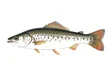
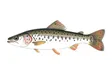
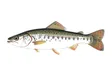
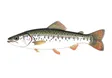
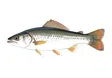
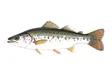
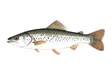
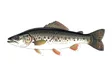
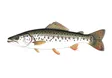
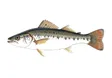
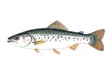
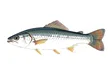
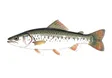
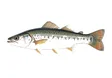
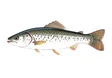
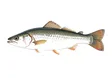
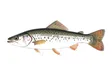
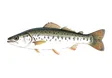
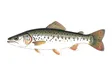
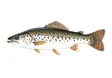
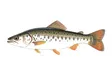
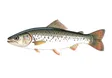
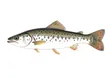
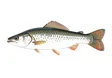
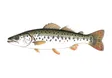
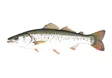
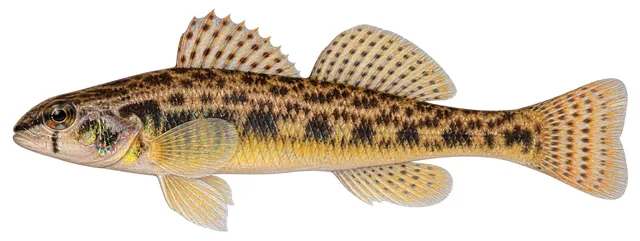
Tessellated Darter field guide illustration

About Tessellated Darter

The tessellated darter (Etheostoma olmstedi) is a species of freshwater ray-finned fish, a darter from the subfamily Etheostomatinae, part of the family Percidae, which also contains the perches, ruffes and pikeperches. It is native to Canada and the United States. It was formerly considered a subspecies of the johnny darter, which it greatly resembles in general appearance.

Description

Adults are usually 2 to 3 inches long, occasionally reaching 4 inches. Both the tessellated darter and johnny darter are rather pale with small, X- or W-shaped markings on the back and upper sides. Both have only a single anal fin spine whereas all other darters in their range have two. Tessellated darters have somewhat sharper snouts than johnny darters, more dorsal soft rays, and more pectoral fin rays. The suborbital sensory canal is complete in most tessellated darters, usually broken into two sections in johnny darters. Their nape is usually naked, and their cheeks are partly too completely scaled. The breast is usually naked and the belly partly scaled. The body of the tessellated darter is elongate, but a little compressed. In breeding males, the spines have fleshy knobs although they are not as well developed as in the fantail darter. They are a pale, sandy color shading to whitish along the body ventrally. Some scales of the upper sides have dark margins forming wavy bars of varying lengths and different angles. Their sides have X- and W-shaped marks, of which 9 to 11 are prominent along the midside. Dorsal fins have a dark pigment spot on the first interradial membrane, and the rest of the fin is clear or slightly dusky. the snout has a dark line from each eye to the nostrils. Juveniles and breeding adults develop 12 or 13 rather even vertical bands along their sides while losing the wavy lines and X-shaped markings as the scales of the upper sides become quite dark with pale tips on the pectoral and pelvic fins. The unpigmented areas of the second dorsal, anal, and caudal fins stand out so that the fin has the appearance of having white bands on a dark background, which is a reversal of the appearance in non-breeding adults. In this color phase, they are sometimes mistaken for a species of Percina.

Ecology

Tessellated darters eat crustaceans and small insects when they are small, gradually shifting to larger insects as the fish get bigger. Male tessellated darters guard nests of fertilized eggs until the fry (young) are free-swimming, and have been observed to engage in alloparental (adoptive) care of previous nest inhabitants' eggs. Alloparental care is associated with increased male reproductive success in this species. Males frequently engage in filial cannibalism (consumption of their own offspring).

Taxonomy and etymology

The tessellated darter was first formally described in 1842 by the American ichthyologist David Humphreys Storer with the type locality given as the Connecticut River at Hartford, Connecticut. The specific name honors the collector of the type, Charles H. Olmsted who was president of the Hartford Natural History Society. It is closely related to the Johnny darter E. nigrum and has been considered synonymous with it.

Article text: Wikipedia contributors, Tessellated darter (source revision). Licensed under CC BY-SA 4.0. Retrieved 2026-10-11.
Diet and feeding

The FishTraits compilation records these diet categories for this species: invertebrates or larval fish. These are broad categories, not a claim that every individual consumes every example in a category.

Reported feeding positions include bottom feeding. The compilation combines published observations; diets can vary with age, locality, and available food.

Habitat preferences

Reported habitat associations include medium to large rivers, streams and small rivers, creeks.

The source records associations with clay or silt, sand, gravel, cobble, organic debris. An association indicates reported use, rather than an exclusive requirement.

Reproduction and parental care

The compilation reports a representative maturity age of 1 years. Its maturity field summarizes mean, median, or modal estimates, usually for females; male estimates can be used when female data are unavailable. It is not a fixed age at which every fish first breeds.

Batch or serial spawning has been reported somewhere in the species’ range. This does not establish the same spawning pattern for every population.

Recorded spawning months are Mar, Apr, May for the source’s reporting region (NC). This is a regional calendar, not a range-wide schedule.

The reproductive-guild classification includes guarding eggs or young at a spawning substrate or nest.

Size and recorded longevity

FishTraits reports a maximum total length of 11 centimetres. Some entries use an estimated asymptotic length; this value should not be treated as a certified record catch.

Recorded longevity in the compilation is 3 years. Wild observations were preferred, but captive records were accepted where wild records were unavailable, and unspecified records were assumed wild. The value is not a guaranteed wild lifespan or an aquarium life expectancy.

Native range

Atlantic drainages from St. Lawrence River, Quebec and Ontario (absent in Maine) to Altamaha River, Georgia; St. Johns River drainage, Florida; Lake America drainage, New York; mostly restricted to Coastal Plain in Virginia (Page and Burr 1991).

Range

Where it lives

Share of 10,096 GBIF observation records with a state location, across 28 states. The orange dots are USGS stream-survey sites where this species was caught.
0%
28.6%
Share of 10,096 GBIF observation records with a state location, across 28 states. The orange dots are USGS stream-survey sites where this species was caught.

A blank area on the dot layer usually means nobody sampled there, not that the fish is absent. Turn on “every survey site” to see where the survey looked.

The USGS stream survey caught it at 2,759 of its sites, in 16 states. That survey and the GBIF records are two different counts of two different things, so the site keeps them apart.

Habitat

Water and movement

Water
WoRMS records this species in fresh water.
USGS NAS habitat
Freshwater
US status
Native transplant — native to part of the United States, moved to other waters inside it.
Migration
Undetermined

Classification

Taxonomy

Kingdom
Animalia
Phylum
Chordata
Superclass
Actinopterygii
Class
Teleostei
Order
Perciformes
Family
Percidae
Genus
Etheostoma
Species
Etheostoma olmstedi
ITIS TSN
168360
WoRMS AphiaID
723264
GBIF key
2382257
Outside the US
ITIS also files it in Canada.

Common questions about Tessellated Darter

What is the scientific name of Tessellated Darter?
The scientific name is Etheostoma olmstedi, in the family Percidae. Classification follows ITIS.
Does Tessellated Darter live in fresh water or salt water?
WoRMS records this species in fresh water.
Where has Tessellated Darter been recorded in the United States?
GBIF has observations in 28 states, with the most records in New York, Maryland, New Jersey. The map shows observation records, which do not establish the complete natural range.

Closest relatives

Other Etheostoma species

Same family

More Percidae

All 229 species in Percidae