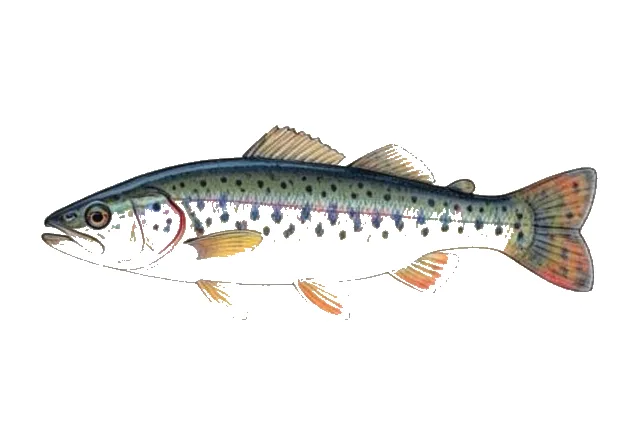
Rainbow Darter

Etheostoma caeruleum

Percidae · freshwater water fish

6 minute read · Species guide

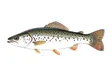
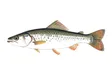
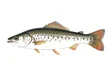
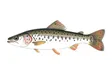
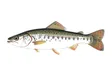
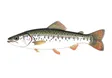
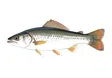
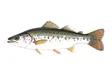
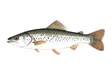
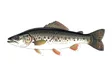
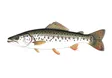
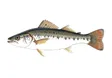
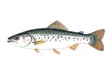
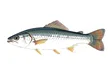
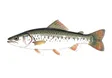
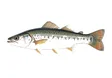
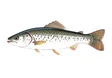
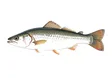
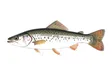
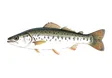
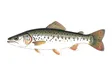
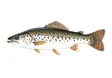
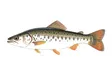
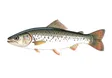
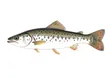
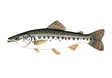
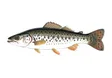
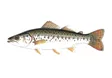
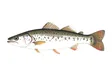
Rainbow Darter field guide illustration

About Rainbow Darter

The rainbow darter (Etheostoma caeruleum) is a small species of freshwater ray-finned fish, a darter from the subfamily Etheostomatinae, part of the family Percidae, which also contains the perches, ruffes and pikeperches. It is native to North America where it is found in small, fast-moving streams and small to medium-sized rivers. It grows to 2 to 3 inches (51 to 76 mm) in length. The species is very sensitive to pollution and silt, staying in clean, pollution-free water. The rainbow darter is easily identified by three dark spots on the back, and blue and orange in the dorsal and anal fins.

Life

The rainbow darter lives in clean, rocky riffles from March through June. It has a lifespan of about 4 years. The males can grow up to 48 mm long, while the largest female reaches just under 43 mm. The male form is resplendent in bright oranges and iridescent blue spots, stripes, and checks.

Distribution

The rainbow darter is a small, benthic freshwater fish found in many creeks and small to medium-sized rivers throughout North America. In particular, it is common throughout the eastern United States, specifically throughout the Great Lakes and Ohio River Valley regions. Its distribution extends south to northern parts of Alabama and as far west as Missouri and Arkansas. This distribution has been suggested to be due to once existing glaciers and to its intolerance of brackish water. One study to examine the phylogeography of E. caeruleum and its colonization patterns found its distribution is greatly due to historic glaciations, and furthermore, due to distributions from drainages which have since then resulted in the current morphological diversity of the rainbow darter. Geographically, the rainbow darter is one of the most abundant and common darter species. Current distribution shown may be outdated and should be verified with state agencies.

Ecology

The rainbow darter is classified as insectivorous, feeding on small invertebrates such as insects and crayfish, but it has also been known to feed on some fly larvae. In Four-Mile Creek in Ohio, the rainbow darter lives primarily on trichopterans (i.e. caddisflies), having two feeding peaks: one in the morning and a second in the late afternoon or early evening.

The primary predators of the rainbow darter are larger freshwater fish, such as burbots (Lota lota), stonecats (Noturus flavus), and smallmouth bass (Micropterus dolomieu). Like many other darter species, it has the ability to maintain position on the substrate in flowing water. This unique characteristic plays a key role in its microhabitat preference. E. caeruleum has been shown to prefer creeks and rivers with rocky substrates and swift-moving riffles. This microhabitat preference has been suggested to be due to oxygen levels in the water during season changes or other factors, such as feeding or shelter-related habitat preferences. Because E. caeruleum has such a low tolerance for brackish water, human-induced changes such as pollution or sewer drainage has the potential to cause a significant negative impact on its abundance.

Life history

Darters have a wide range of life histories, but size correlates with most life history characteristics. For example, larger darters grow faster, live longer, produce bigger clutches, and have longer reproductive spans. Mate selection by female darters is assumed to be common. When examining the rainbow darter, life history traits were: average size 45 mm, growth 32 mm, maximum age four years, and clutch size 82. E. caeruleum mates during the spring, typically when water temperature is between 17 and 18 °C, and they will leave their normal microhabitat in the rapids to congregate on pebbles, where the stream leaves a pool, to mate. Once mates are selected, the fish mate repeatedly for several days until the female lays about 800 eggs. This darter also displays group spawning, and the males tend to exhibit territorial behavior during the breeding season.

Current management

Currently, the largest threat to E. caeruleum is run-off and pollution due to the population shift from rural to urban areas. One study found the development of an interstate highway negatively affected the abundance of several fish species, including E. caeruleum, because of decreasing quality of water of the nearby creek. Currently, management plans consist of reducing nutrient, pesticide, and sediment loadings within such streams. This same study suggests conservation practices should be a combination of both physical habitat monitoring and water chemistry monitoring, because it would benefit fish communities within headwater streams more than just implementing one conservation practice or the other. Although broad management plans are in place for many rivers and streams and their fish communities as a whole, no current management plans in place are specifically designed for E. caeruleum.

Article text: Wikipedia contributors, Rainbow darter (source revision). Licensed under CC BY-SA 4.0. Retrieved 2026-10-11.
Diet and feeding

The FishTraits compilation records these diet categories for this species: invertebrates or larval fish; fish or frog eggs. These are broad categories, not a claim that every individual consumes every example in a category.

Reported feeding positions include bottom feeding. The compilation combines published observations; diets can vary with age, locality, and available food.

Habitat preferences

Reported habitat associations include medium to large rivers, streams and small rivers, creeks.

The source records associations with sand, gravel, cobble. An association indicates reported use, rather than an exclusive requirement.

Reproduction and parental care

The compilation reports a representative maturity age of 1 years. Its maturity field summarizes mean, median, or modal estimates, usually for females; male estimates can be used when female data are unavailable. It is not a fixed age at which every fish first breeds.

Batch or serial spawning has been reported somewhere in the species’ range. This does not establish the same spawning pattern for every population.

Recorded spawning months are Apr, May, Jun for the source’s reporting region (WI). This is a regional calendar, not a range-wide schedule.

The reproductive-guild classification includes hiding a brood without subsequent guarding.

Size and recorded longevity

FishTraits reports a maximum total length of 7.7 centimetres. Some entries use an estimated asymptotic length; this value should not be treated as a certified record catch.

Recorded longevity in the compilation is 4 years. Wild observations were preferred, but captive records were accepted where wild records were unavailable, and unspecified records were assumed wild. The value is not a guaranteed wild lifespan or an aquarium life expectancy.

Identification and appearance

Becker (1983); Page (1983); Page and Burr (1991); Etnier and Starnes (1993); Jenkins and Burkhead (1994). Similar to orangethroat darter Etheostoma spectabile, redline darter E. luteovinctum, and mud darter E. asprigine, but these three species lack red color on anal fin that is present in E. caeruleum.

Native range

Great Lakes and Mississippi River basins from southern Ontario and western New York to Minnesota, and south to northern Alabama and Arkansas. Isolated populations in southwestern Mississippi and eastern Louisiana, and in upper Potomac River drainage (Atlantic Slope), West Virginia (Page and Burr 1991).

Introduction history

Unknown. Dispersed throughout the Potomac River drainage (Cessna et al. 2014).

Range

Where it lives

Share of 16,319 GBIF observation records with a state location, across 24 states. The orange dots are USGS stream-survey sites where this species was caught.
0%
20.7%
Share of 16,319 GBIF observation records with a state location, across 24 states. The orange dots are USGS stream-survey sites where this species was caught.

A blank area on the dot layer usually means nobody sampled there, not that the fish is absent. Turn on “every survey site” to see where the survey looked.

The USGS stream survey caught it at 4,484 of its sites, in 19 states. That survey and the GBIF records are two different counts of two different things, so the site keeps them apart.

Habitat

Water and movement

Water
WoRMS records this species in fresh water.
USGS NAS habitat
Freshwater
US status
Native transplant — native to part of the United States, moved to other waters inside it.
Migration
Migratory
Pattern

Classification

Taxonomy

Kingdom
Animalia
Phylum
Chordata
Superclass
Actinopterygii
Class
Teleostei
Order
Perciformes
Family
Percidae
Genus
Etheostoma
Species
Etheostoma caeruleum
ITIS TSN
168378
WoRMS AphiaID
1022036
GBIF key
2382341
Outside the US
ITIS also files it in Canada.

Common questions about Rainbow Darter

What is the scientific name of Rainbow Darter?
The scientific name is Etheostoma caeruleum, in the family Percidae. Classification follows ITIS.
Does Rainbow Darter live in fresh water or salt water?
WoRMS records this species in fresh water.
Where has Rainbow Darter been recorded in the United States?
GBIF has observations in 24 states, with the most records in Ohio, Kentucky, Missouri. The map shows observation records, which do not establish the complete natural range.

Closest relatives

Other Etheostoma species

Same family

More Percidae

All 229 species in Percidae