Pink Salmon

Oncorhynchus gorbuscha

Salmonidae · freshwater and saltwater and brackish water fish

15 minute read · Species guide

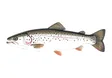
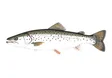
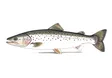
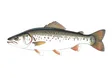
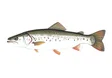
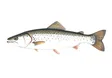
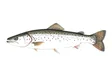
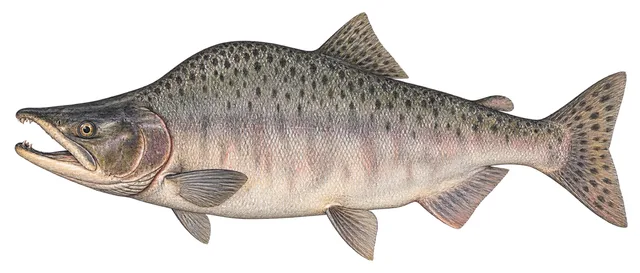
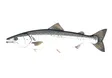
Pink Salmon field guide illustration

About Pink Salmon

Pink salmon or humpback salmon (Oncorhynchus gorbuscha) is a species of euryhaline ray-finned fish in the family Salmonidae. It is the type species of the genus Oncorhynchus (Pacific salmon), and is the smallest and most abundant of the seven officially recognized species of salmon. The species' scientific name is based on the Russian common name for this species gorbúša (горбуша), which literally means humpie.

Description

In the ocean, pink salmon are bright silver fish. After returning to their spawning streams, their coloring changes to pale grey on the back with yellowish-white belly (although some turn an overall dull green color). As with all salmon, in addition to the dorsal fin, they also have an adipose fin. The fish is characterized by a white mouth with black gums, no teeth on the tongue, large oval-shaped black spots on the back, a v-shaped tail, and an anal fin with 13–17 soft rays. During their spawning migration, males develop a pronounced humped back, hence their nickname "humpies". Pink salmon average 4.8 pounds (2.2 kg) in weight. The maximum recorded size was 30 inches (76 cm) and 15 pounds (6.8 kg).

Distribution

The native range of the species is in the Pacific and Arctic coastal waters and rivers, from the Sacramento River in northern California to the Mackenzie River in Canada; and in the west from the Lena River in Siberia to Korea and Honshu in Japan. In North America, pink salmon spawn from the Mackenzie River in the Arctic to as far south as tributaries of Puget Sound, Washington, although they were also reported in the San Lorenzo River near Santa Cruz, California, in 1915, and the Sacramento River in northern California in the 1950s. In 2013, a new record for the southernmost extent of spawning pink salmon was published for the Salinas River. In the fall of 2017, a dozen pink salmon were counted in Lagunitas Creek about 25 miles (40 km) north of San Francisco, California. Populations were also stocked on the coast of Maine and Maryland, but disappeared by 1973.

Pink salmon were introduced into the Great Lakes of North America. The first recorded release was of about 100 salmon in 1956, which escaped into Thunder Bay of Lake Superior while being transported via seaplane to a hatchery. A population of about 21,000 fingerlings from a hatchery at Port Arthur, Ontario, were also released as surplus in the Current River, a tributary of the lake. Second-generation fish were first caught in 1959, showing that reproduction was occurring. The lake's population is self-sustaining and has adapted to tolerate freshwater over their entire lives, spending their adult phase in the open lake and swimming into its tributaries to spawn. Pink salmon were first recorded in a tributary of Lake Huron in 1969, reached northern Lake Michigan in 1975, and were first caught in Wisconsin in 1971 in Bayfield County. By 1979, the species had spread throughout the Great Lakes. While most salmon return to their birth streams to spawn, adults wander extensively during the open water phase and some adopt new streams. This habit led to the species spreading across the lakes within two decades.

Pink salmon have been introduced in Iran. In Europe, pink salmon have been periodically introduced to rivers of the White Sea and Barents Sea basins in Russia since 1956. Stray fish from these rivers have been encountered ascending to rivers also in Norway, Sweden, Ireland, Great Britain, and Iceland; and, in Norway, even self-sustaining populations have been observed. In 2017, larger numbers than usual of this species were caught in rivers in Scotland and spawning was recorded. In 2021, they were reported to have invaded Akerselva in downtown Oslo, the capital of Norway.

Taxonomy

The closest genetic relative of the pink salmon is the chum salmon (Oncorhynchus keta) which they frequently hybridize with, creating "chumpy" salmon. Some marine biologists consider the pink salmon to contain two cryptic species, O. gorbuscha (the pink salmon) which spawns during even years and O. gorbuschka (the rosy salmon) which spawns during odd years.

Habitat

Pink salmon are coldwater fish with a preferred temperature range of 5.6 to 14.6 °C, an optimal temperature of 10.1 °C, and an upper incipient lethal temperature of 25.8 °C.

Reproduction

Pink salmon in their native range have a strict two year life cycle, thus odd and even-year populations do not interbreed. In the state of Washington, pink salmon runs occur on odd years. Adult pink salmon enter spawning streams from the ocean, usually returning to the stream where they originated. Spawning occurs between late June and mid-October, in coastal streams and some longer rivers, and in the intertidal zone or at the mouth of streams if hyporheic freshwater is available. Using her tail, the female digs a trough-shaped nest, called a redd or rede (Scandinavian word for "nest"), in the gravel of the stream bed, where she deposits her eggs. As she expels the eggs, she is approached by one or more males, which fertilize them as they fall into the redd. Subsequently, the female covers the newly deposited zygotes, again with thrusts of her tail, against the gravel at the top of the redd. The female lays from 1,000 to 2,000 eggs in several clutches within the redd, often fertilized by different males. Females guard their redds until death, which comes within days of spawning. In dense populations, a major source of mortality for embryos is a superposition of redds by later-spawning fish. The eggs hatch from December to February, depending on water temperature, and the juveniles emerge from the gravel during March and April and quickly migrate downstream to estuaries, at about one-quarter gram in weight. The fish achieve sexual maturity in their second year of life. They return to freshwater in the summer or autumn as two-year-old adults.

Diet

In their freshwater stage, juvenile pink salmon consume invertebrates and zooplankton. In the ocean, they feed on a variety of plankton, invertebrates, and small fish. Adults do not feed as they return to freshwater to spawn.

Predators and trophic interactions

Many different animals feed on pink salmon throughout their life cycle, from small fish, birds, and mammals in freshwater ecosystems when the salmon are eggs or fry, through large fish, seabirds, and marine mammals when they are in the ocean.

Eggs and the carcasses of spawned salmon adults can provide substantial nutrient subsidies to freshwater food webs. Where pink salmon are expanding into subarctic Norwegian rivers, their eggs are consumed by native salmonids. In the Keogh River in Canada, higher numbers of pink salmon eggs were shown to reduce competition among other fish species relying on this food source. Bears feed on adult migrating salmon, and choose to prey on salmon which have not yet spawned and thus are more nutritious, when they have a choice. Many of the pink salmon that are caught by bears in Alaska are transported away from the water into riparian areas and forests, and nutrients from the carcasses end up in plants and trees. Carcasses of pink salmon that successfully spawn decompose rapidly, and are colonized by aquatic invertebrates in the process. These resource subsidies to stream habitats can increase the growth of other salmonid species in the streams.

Conservation status

NatureServe lists the pink salmon as critically imperiled in California, and imperiled in Washington. In Alaska and British Columbia, they are considered secure. No pink salmon Evolutionary Significant Units are listed under the Endangered Species Act.

Iceland

As of 2025, the Eyjafjörður River in northern Iceland became part of research on the ecological impact of pink salmon (Oncorhynchus gorbuscha) as part of the PHAROS project Iceland demonstration. The studies aim to evaluate the effects of this invasive species on the river's ecosystem using advanced genetic technologies and specialized monitoring equipment, reportedly unique in Europe.

The project is led by Icelandic research company Blár Akur in collaboration with the Technical University of Denmark (DTU). According to project coordinator Þorleifur, the choice of Eyjafjörður River was influenced by strong local partnerships with fishing associations, landowners, and other stakeholders in Akureyri and surrounding regions. The species was first recorded in Icelandic rivers around 1960, with sightings and catches increasing in recent decades.

Classified as an invasive species in Iceland, pink salmon poses potential ecological risks by competing with native salmonids, spreading diseases, and altering freshwater food webs.

United Kingdom

In 2019 and 2021, multiple catches of pink salmon were reported across the United Kingdom, and were found across North England, Cornwall, South Scotland, and Ireland.

In 2025, the Environment Agency warned anglers to report any catches or sighting of pink salmon.

Fisheries and use

The commercial harvest of pink salmon is a mainstay of fisheries of both the eastern and western North Pacific. In 2010, the total harvest was some 260 million fish, corresponding to 400,000 tonnes. Of this, 140 million fish were from Russian fisheries and 107 million from the USA (Alaska). Pink salmon account for 69% of the total Russian salmon fisheries. The majority of pink salmon are harvested using coastal set net traps, and the fisheries are concentrated on the east coast of Sakhalin (average 110,000 tonnes per year).

In North America, beginning in the late 19th century fish traps were used to supply fish for commercial canning and salting. The industry expanded steadily until 1920. During the 1940s and 1950s, pink salmon populations declined drastically. Fish traps were prohibited in Alaska in 1959. Now, most pink salmon are taken with purse seines, drift nets or gillnets. Populations and harvests increased rapidly after the mid-1970s and have been at record high numbers since the 1980s.

More than 20 million harvested pink salmon are produced by fishery-enhancement hatcheries, particularly in the northern Gulf of Alaska. Pink salmon are not grown in significant numbers in fish farms. The fish are often canned, smoked or salted. Pink salmon roe is also harvested for caviar, a particularly valuable product in Asia. There is some evidence the pink salmon fishery industry may be having an impact on the size of pink salmon and other salmon species as well as the abundance of species that compete for and serve as their food sources.

Article text: Wikipedia contributors, Pink salmon (source revision). Licensed under CC BY-SA 4.0. Retrieved 2026-10-11.
Diet and feeding

The FishTraits compilation records these diet categories for this species: invertebrates or larval fish; larger animal prey (a source category covering fish, crayfish, crabs, or frogs). These are broad categories, not a claim that every individual consumes every example in a category.

Reported feeding positions include surface or water-column feeding. The compilation combines published observations; diets can vary with age, locality, and available food.

Habitat preferences

Reported habitat associations include medium to large rivers, streams and small rivers.

The source records associations with gravel, open water. An association indicates reported use, rather than an exclusive requirement.

The species is classified as tolerant of a broad range of salinities. This flag does not specify a salinity range for aquarium care.

Reproduction and parental care

The compilation reports a representative maturity age of 2.5 years. Its maturity field summarizes mean, median, or modal estimates, usually for females; male estimates can be used when female data are unavailable. It is not a fixed age at which every fish first breeds.

Recorded spawning months are Jul, Aug, Sep, Oct for the source’s reporting region (CA). This is a regional calendar, not a range-wide schedule.

The reproductive-guild classification includes hiding a brood without subsequent guarding.

Size and recorded longevity

FishTraits reports a maximum total length of 76 centimetres. Some entries use an estimated asymptotic length; this value should not be treated as a certified record catch.

Recorded longevity in the compilation is 3 years. Wild observations were preferred, but captive records were accepted where wild records were unavailable, and unspecified records were assumed wild. The value is not a guaranteed wild lifespan or an aquarium life expectancy.

Spawning movements

The compilation records significant spawning-related movement. Its combined migration flag covers movements within fresh water as well as between rivers and the sea; this flag alone does not establish which migration pattern applies.

Identification and appearance

Oncorhynchus gorbuscha has two dorsal fins including one adipose fin with 13–17 rays in its anal fins. It has a dark mouth and gums and is mostly silver overall, with large oval black spots on the tail and back (Michigan DNR 2003). During spawning, its sides and back are pinkish, giving this species its common name (Halpern et al. 2002). Males also develop a prominent hump (Langan, pers. comm. 2026). See also: Moyle (1976a); Scott and Crossman (1973); Wydoski and Whitney (1979); Morrow (1980); Eschmeyer et al. (1983); Page and Burr (1991).

Native range

Arctic and Pacific drainages from Mackenzie River delta, Northwest Territories, to Sacramento River drainage, California; occasionally as far south as La Jolla, southern California. Also in northeastern Asia (Page and Burr 1991).

Habitat and ecology

In the Great Lakes, pink salmon move from open lake into rivers to spawn in late summer or early autumn and not all return to their natal river (Kwain and Rose 1986). With a life span of only two or sometimes three years, pink salmon typically spawn biennially (Kocik et al. 1991). After spawning, the female guards the nest and dies within a few days or weeks. Spawning males defend territories, and adults die soon after spawning. Eggs hatch from late December to late February depending on water temperatures. When the young mature enough to leave their gravel nest in late April or early May, they journey downstream in large schools. The young salmon reach adulthood in about 18 months with a size of two to seven pounds and 17 to 19 inches in length (Michigan DNR 2003).

Introduction history

This species was introduced accidentally into the Canadian side of Lake Superior in Thunder Bay in 1956, when about 100 salmon escaped while being transferred from a hatchery to a seaplane (Schumacher and Eddy 1960; Eddy and Underhill 1974). Another reference states that about 21,000 surplus fingerlings from the hatchery at Port Arthur, Ontario, were disposed of into the Current River, a tributary of Lake Superior (Becker 1983). The hatchery was raising them to stock in Hudson Bay (Eddy and Underhill 1974). The first evidence of reproduction was noted in 1959, when two second-generation fish were caught in Lake Superior, Minnesota (Schumacher and Eddy 1960; Schumacher and Hale 1962; Eddy and Underhill 1974). The species was first observed in a northern tributary of Lake Huron in 1969 (Parsons 1973). By 1979, it had spread throughout the Great Lakes (Cooper 1983). Emery (1981) gave an account of their spread through the Great Lakes and included a map showing the dispersal. The species was also intentionally stocked on the coasts of Maine and Maryland (Morrow 1980). Also see Schumacher and Eddy (1960), Schumacher and Hale (1962), Parsons (1973), Wagner (1976), Emery (1981), and Kwain and Lawrie (1981).

Ecological impacts

Pink salmon may displace native chubs by way of food competition. The introduced salmon also may compete with lake herring (Becker 1983). Individuals over one year old feed heavily on rainbow smelt and alewife, which are important components of the diets of other Great Lakes salmonids (Kocik et al. 1991).

NOAA Fisheries

Life history and status

NOAA management region
Alaska, West Coast

About the species

U.S. wild-caught pink salmon is a smart seafood choice because it is sustainably managed and responsibly harvested under U.S. regulations.

NOAA Fisheries works in cooperation with federal, state, tribal, and Canadian officials to manage these commercial, recreational, and tribal harvest of salmon and steelhead in ocean and inland waters of the West Coast and Alaska. To learn more about management of these fisheries, visit our West Coast and Alaska fisheries management pages.

Appearance

  • Pink salmon are the smallest of the Pacific salmon found in North America, weighing between 3.5 and 5 pounds, with an average length of 20 to 25 inches.
  • Pink salmon can be distinguished from other Pacific salmon by the large dark oval spots on their back and entire tail fin as well as their general coloring and form.
  • In the sea, pink salmon are steel blue to blue-green on the back, silver on the sides, and white on the belly.
  • Breeding males become dark on the back and red with brownish green blotches on the sides.
  • Males also develop a hump on their back, which is why they are often called “humpback” salmon.
  • Breeding females are similar but lack a dorsal hump and are less distinctly colored.

Biology

  • Pink salmon are anadromous – they hatch in freshwater streams and rivers then migrate out to the saltwater environment of the ocean to feed and grow.
  • Unlike coho , Chinook , or sockeye salmon, pink salmon do not reside in fresh water for an extended period.
  • Young pink salmon (fry) typically migrate directly to estuarine and marine waters soon after they are born.
  • Once they reach the ocean, they feed voraciously and grow rapidly. In fact, they’re among the fastest growing of the Pacific salmon species.
  • After about 1½ years of feeding and growing in the ocean, maturing pink salmon return to fresh water to spawn, usually from August to October.
  • Females construct nests (redds) in the riverbed by turning on their sides and vigorously flexing their bodies and tails, digging a shallow hole.
  • Females deposit between 1,200 and 1,900 eggs in the redds, which the males then fertilize.
  • The female stays and defends her redd from other females until she dies, usually within two weeks.
  • All pink salmon die after they spawn.
  • They typically spawn at the age of 2.
  • Because the pink salmon life cycle is so regular, independent populations spawn in even and odd years. For example, in the southern part of their range, they usually spawn in odd years in most river systems. However, pink salmon do spawn in even years in some Puget Sound rivers.
  • Throughout most of Alaska, there is no dominant year, except in the northwestern part of Alaska where even-year runs predominate.
  • Pink salmon feed on small crustaceans, zooplankton (tiny floating animals), squid, and small fish.
  • In fresh water, aquatic invertebrates, other fishes, birds, and small mammals prey on pink salmon eggs, alevins, and fry.
  • In the ocean, other fishes (including other Pacific salmon) and coastal seabirds prey on pink salmon fry and juveniles.
  • Marine mammals, sharks, other fishes (such as Pacific halibut ), and humpback whales feed on adult pink salmon.
  • In freshwater spawning habitats, bears are predators of adult pink salmon. Wolves, river otters, and bald eagles will also occasionally eat pre-spawning adult pinks.
  • After salmon spawn and die, salmon carcasses are a valuable source of energy and nutrients to the river ecosystem. Carcasses have been shown to improve newly hatched salmon growth and survival by contributing nitrogen and phosphorous compounds to streams.

Where they live

  • Freshwater streams, estuaries, and associated wetlands provide vital nursery grounds for pink salmon.
  • Adult salmon leave the ocean, enter fresh water, and migrate upstream to spawn, usually in the stream of their birth.
  • Pink salmon spawn in rivers closer to tidewater than most other Pacific salmon species, generally within 30 miles of a river mouth.

Science

NOAA Fisheries conducts various research activities on the biology, behavior, and ecology of pink salmon. The results of this research are used to inform management decisions for this species.

For detailed information about stock status, management, assessments, and resource trends, you can search for pink salmon and any other species of interest using NOAA's StockSMART web tool .

Pink Salmon Research in Alaska

Our work to forecast salmon harvests, assess the impact of commercial fisheries on salmon, and evaluate how salmon populations respond to environmental changes enable us to estimate abundance and trends for pink salmon in Alaska.

More on salmon research in Alaska

Pink Salmon Research in the Pacific Northwest

Our research on Pacific salmon covers several topics including bycatch, salmon harvest forecasts, ecotoxicology, genetics, marine survival, and responses to climate change.

More on pink salmon research in the Pacific Northwest

Record fish

State records in 2 states

  • Wisconsin6 lbs. 1.9 oz.

    Lake Michigan · Kewaunee · 08/10/1999

  • Minnesota4 lb 8 oz

    Cascade River · Cook · 9/9/1989

Each figure is the state agency’s own certified record. The site holds record tables for 11 states so far, so a state missing here has not been read yet. It is not a state where this fish holds no record.

Range

Where it lives

Share of 7,047 GBIF observation records with a state location, across 12 states.
0%
43.2%
Share of 7,047 GBIF observation records with a state location, across 12 states.

Habitat

Water and movement

Water
WoRMS records this species in fresh water, brackish water and the sea.
USGS NAS habitat
Freshwater;Marine
US status
Native transplant — native to part of the United States, moved to other waters inside it.
Migration
Migratory
Pattern
Disagreement
10 published references do not agree on the pattern: Anadromous, Potamodromous. The site shows every assignment rather than picking one.

Classification

Taxonomy

Kingdom
Animalia
Phylum
Chordata
Superclass
Actinopterygii
Class
Teleostei
Order
Salmoniformes
Genus
Oncorhynchus
Species
Oncorhynchus gorbuscha
ITIS TSN
161975
WoRMS AphiaID
127182
GBIF key
5204037
Outside the US
ITIS also files it in Canada.

Common questions about Pink Salmon

What is the scientific name of Pink Salmon?
The scientific name is Oncorhynchus gorbuscha, in the family Salmonidae. Classification follows ITIS.
Does Pink Salmon live in fresh water or salt water?
WoRMS records this species in fresh water, brackish water and the sea.
Where has Pink Salmon been recorded in the United States?
GBIF has observations in 12 states, with the most records in Michigan, California, Alaska. The map shows observation records, which do not establish the complete natural range.

Closest relatives

Other Oncorhynchus species

Same family

More Salmonidae

Alaska Whitefish1 states
Coregonus nelsoniiSalmonidaeNativeFresh
Apache Trout5 states
Oncorhynchus apacheSalmonidaeNativeFresh
Arctic Char8 states
Salvelinus alpinusSalmonidaeNative and introducedFreshSaltBrackish
Arctic Cisco1 states
Coregonus autumnalisSalmonidaeNativeFreshSaltBrackish
Arctic Grayling16 states
Thymallus arcticusSalmonidaeNative and introducedFresh
Atlantic Salmon26 states
Salmo salarSalmonidaeNative and introducedFreshSaltBrackish
Bear Lake Whitefish2 states
Prosopium abyssicolaSalmonidaeNativeFresh
Bering Cisco1 states
Coregonus laurettaeSalmonidaeNativeFreshSaltBrackish
Blackfin Cisco6 states
Coregonus nigripinnisSalmonidaeNativeFresh
Bloater6 states
Coregonus hoyiSalmonidaeNativeFresh
Bonneville Cisco2 states
Prosopium gemmiferSalmonidaeNativeFresh
Bonneville Whitefish2 states
Prosopium spilonotusSalmonidaeNativeFresh
Broad Whitefish1 states
Coregonus nasusSalmonidaeNativeFreshBrackish
Brook Trout40 states
Salvelinus fontinalisSalmonidaeNative and introducedFreshSaltBrackish
Brown Trout41 states
Salmo truttaSalmonidaeIntroducedFreshSaltBrackish
Bull Trout8 states
Salvelinus confluentusSalmonidaeNativeFreshBrackish
Chinook Salmon18 states
Oncorhynchus tshawytschaSalmonidaeNative and introducedFreshSaltBrackish
Chum Salmon5 states
Oncorhynchus ketaSalmonidaeNativeFreshSaltBrackish
Cisco11 states
Coregonus artediSalmonidaeNative and introducedFreshSaltBrackish
Coho Salmon22 states
Oncorhynchus kisutchSalmonidaeNative and introducedFreshSaltBrackish
Cutthroat Trout18 states
Oncorhynchus clarkiiSalmonidaeNative and introducedFreshSaltBrackish
Deepwater Cisco3 states
Coregonus johannaeSalmonidaeNativeFresh
Dolly Varden9 states
Salvelinus malmaSalmonidaeNativeFreshSaltBrackish
Gila Trout2 states
Oncorhynchus gilaeSalmonidaeNative and introducedFresh

All 44 species in Salmonidae