Mud Darter

Etheostoma asprigene

Percidae · freshwater water fish

5 minute read · Species guide

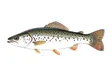
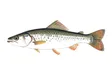
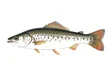
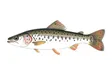
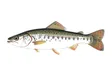
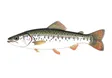
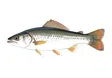
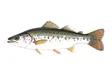
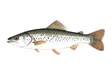
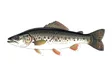
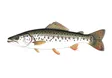
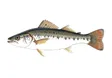
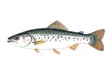
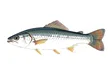
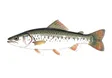
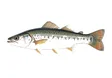
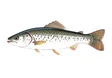
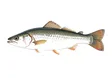
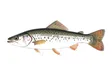
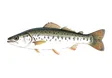
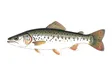
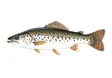
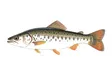
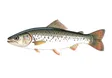
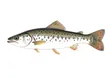
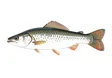
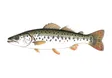
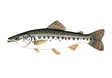
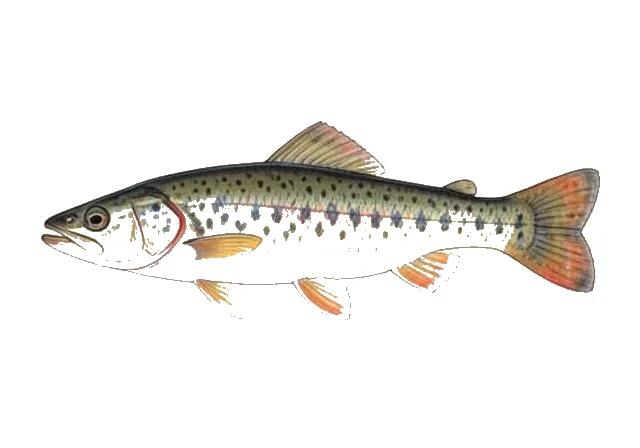
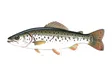
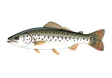
Mud Darter field guide illustration

About Mud Darter

The mud darter (Etheostoma asprigene) is a species of freshwater ray-finned fish, a darter from the subfamily Etheostomatinae, part of the family Percidae, which also contains the perches, ruffes and pikeperches. It is endemic to the lowlands of the Mississippi River basin from Wisconsin and Minnesota south to Louisiana and East Texas. It is also found in the drainages of the Sabine and Neches Rivers of Texas and Louisiana. It can be found in slow-moving waters on riffles in rivers, as well as in creeks, swamps, lakes, and reservoirs. It mostly consumes the larvae of midges and blackflies. This species can reach a length of 7.1 cm (2.8 in), though most only reach a length of 5 cm (2.0 in).

Taxonomy

Stephen Alfred Forbes described the mud darter in 1878. The genus name Etheostoma comes from the Greek words etheo, meaning "strain"and stoma, meaning"mouth". The species name asprigene means "rough cheek", referring to the fully scaled cheek and opercle.

Description

The mud darter has a terminal mouth with small teeth on its jaws. The back is olive or brown with 8–11 dark blotches, or saddles, across the back. The side has 9–12 dark brown irregular vertical bars and the base of the tail has three spots arranged vertically. The belly is typically a cream or light olive color. They can reach a length of 7.1 cm (2.8 in), though most only reach a length of 5 cm (2.0 in).

The caudal fin is typically rounded or square in the mud darter. Its dorsal fin has two lobes, the first with 10–12 spines and the second with 10–14 rays. The mud darter does not have an adipose fin. The anal fin typically has 2 spines and 8–9 rays.

Distribution and habitat

The mud darter is distributed throughout the Mississippi River Basin lowlands in North America. It is found from Wisconsin and Minnesota to Louisiana and eastern Texas. It also found on the Gulf Slope in the Sabine River and Neches River drainages in Louisiana and Texas.

The mud darter is found in river mouths and overflow areas of large rivers. In these areas, it is typically found over mud covered with sand or other fine detritus. They can also be found over muddy bottoms in oxbow lakes or in slow riffles of streams. Large numbers of mud darters have been seen in the finely divided tree roots along the shores of large rivers. The juvenile fish are more often found in quieter areas than slow riffles.

Diet

The mud darter mainly feeds on invertebrates. The typical diet consists of midge and blackfly larvae, but some small fish were seen to have micro-crustaceans in their diet as well.

Life cycle

Mud darters do not live over three years of age. After hatching, the fish rapidly grow to half of the total length for year 1 in ten weeks. By the end of year one, most fish averaged between 3.3 and 4.4 cm (1.3 and 1.7 in) and by the end of years two and three, most fish averaged between 4.3 and 5.5 cm (1.7 and 2.2 in). Survivorship from years 1–2 was 75% for males and 81% for females, but this drastically declines, with survivorship from years 2–3 dropping to 14.5% for males and 12.1% for females.

Reproduction

Spawning season for mud darters lasts from early March to early or mid May, with females reaching sexual maturity at one year. During spawning season, males do not establish territories, but are more aggressive toward other males. During courtship, the male swims around a female with his dorsal fin erect, sometimes resting his head on her nape. The spawning site is selected by the female, while the male follows behind. The female enters the vegetation vertically and the male then positions himself over the female, curving his body into an S-shape. The pair will vibrate for a couple of seconds. The females will release between 5 and 10 eggs, which fall onto the substrate or plant. The pair will repeat this process multiple times, resting for anywhere from a few minutes to one half-hour.

Article text: Wikipedia contributors, Mud darter (source revision). Licensed under CC BY-SA 4.0. Retrieved 2026-10-11.
Diet and feeding

The FishTraits compilation records these diet categories for this species: invertebrates or larval fish; fish or frog eggs. These are broad categories, not a claim that every individual consumes every example in a category.

Reported feeding positions include bottom feeding. The compilation combines published observations; diets can vary with age, locality, and available food.

Habitat preferences

Reported habitat associations include medium to large rivers, streams and small rivers.

The source records associations with muck, clay or silt, sand, gravel. An association indicates reported use, rather than an exclusive requirement.

Reproduction and parental care

The compilation reports a representative maturity age of 1 years. Its maturity field summarizes mean, median, or modal estimates, usually for females; male estimates can be used when female data are unavailable. It is not a fixed age at which every fish first breeds.

Recorded spawning months are Apr, May for the source’s reporting region (IL). This is a regional calendar, not a range-wide schedule.

The reproductive-guild classification includes guarding eggs or young at a spawning substrate or nest.

Size and recorded longevity

FishTraits reports a maximum total length of 7.1 centimetres. Some entries use an estimated asymptotic length; this value should not be treated as a certified record catch.

Recorded longevity in the compilation is 3 years. Wild observations were preferred, but captive records were accepted where wild records were unavailable, and unspecified records were assumed wild. The value is not a guaranteed wild lifespan or an aquarium life expectancy.

Range

Where it lives

Share of 1,404 GBIF observation records with a state location, across 15 states. The orange dots are USGS stream-survey sites where this species was caught.
0%
32.2%
Share of 1,404 GBIF observation records with a state location, across 15 states. The orange dots are USGS stream-survey sites where this species was caught.

A blank area on the dot layer usually means nobody sampled there, not that the fish is absent. Turn on “every survey site” to see where the survey looked.

The USGS stream survey caught it at 47 of its sites, in 9 states. That survey and the GBIF records are two different counts of two different things, so the site keeps them apart.

Habitat

Water and movement

Water
WoRMS records this species in fresh water.
Migration
Migratory
Pattern

Classification

Taxonomy

Kingdom
Animalia
Phylum
Chordata
Superclass
Actinopterygii
Class
Teleostei
Order
Perciformes
Family
Percidae
Genus
Etheostoma
Species
Etheostoma asprigene
ITIS TSN
168372
WoRMS AphiaID
1045010
GBIF key
2382313

Common questions about Mud Darter

What is the scientific name of Mud Darter?
The scientific name is Etheostoma asprigene, in the family Percidae. Classification follows ITIS.
Does Mud Darter live in fresh water or salt water?
WoRMS records this species in fresh water.
Where has Mud Darter been recorded in the United States?
GBIF has observations in 15 states, with the most records in Illinois, Texas, Kentucky. The map shows observation records, which do not establish the complete natural range.

Closest relatives

Other Etheostoma species

Same family

More Percidae

All 229 species in Percidae