Lost River Sucker

Deltistes luxatus

Catostomidae · freshwater water fish

5 minute read · Species guide

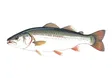
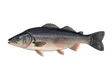
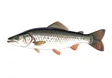
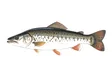
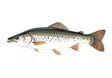
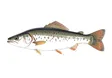
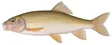
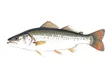
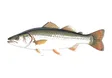
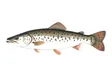
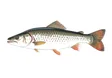
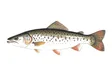
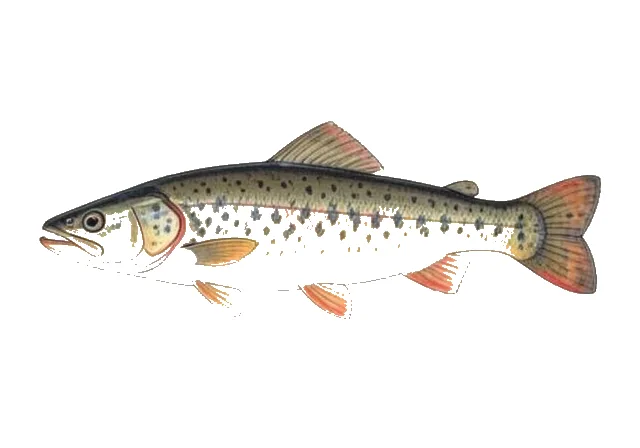
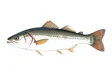
Lost River Sucker field guide illustration

About Lost River Sucker

The Lost River sucker (Deltistes luxatus), known as the c'waam (pronounced / tʃ w ɑː m / CHWAHM) by the Klamath Tribes, is a species of ray-finned fish in the family Catostomidae. It is the only living member of the genus Deltistes. It is found only in California and Oregon. Its population is much reduced from historical numbers for a number of reasons. It is federally listed as an endangered species of the United States.

Description

This fish is one of the largest suckers, capable of reaching 86 cm (34 in) in length. It can be identified by its long snout with a small hump on top. It is dark on the back and sides and whitish or yellowish on the belly. Its lifespan can exceed 40 years. It does not reach sexual maturity until six to fourteen years of age, most maturing around age nine.

Distribution and habitat

The sucker prefers deep lakes and pools and fast currents. It goes to the shoreline to obtain food and shelter in the vegetation. It spawns in streams with riffles and substrates of gravel and cobble. Spawning occurs in March, April, and May. The female contains many eggs, up to 235,000, and spawns with several males. The fish spawns several times during its life. The eggs incubate on the stream bottoms for two or three weeks and the larval stage is 40 to 50 days long. The larvae find shelter in emergent vegetation near the shore. The sucker eats a variety of animal material, including zooplankton, various other invertebrates, and periphyton.

This fish is endemic to the Upper Klamath Basin straddling the border between southern Oregon and northern California. Its distribution included Upper Klamath Lake, its tributaries, and most of the creeks that drain into it, as well as the Lost River, Tule Lake, Lower Klamath Lake, Sheepy Lake, and Clear Lake. It was historically abundant in the basin. It was the most common food fish in the area, providing food for the Klamath and Modoc people, as well as local settlers, who also fed it to their livestock. It supported a cannery, which processed it for food and oil.

Today, the fish can be found in Upper Klamath Lake and its tributaries, Clear Lake and its tributaries, Tule Lake, part of the Lost River below the Anderson-Rose Dam, and part of the Klamath River. Its range declined as dams were built, flows were diverted, marshes were dredged and drained, and exotic species were introduced to the area. The landscape changed as it was altered for agriculture, livestock were transported in, trees were taken for timber, and riparian vegetation was cleared. Eutrophication occurred in Upper Klamath Lake, a major cause of the decline of this and other local fish, and a major reason why the sucker is not recovering.

Conservation

Much of the sucker's spawning habitat was destroyed when the first dams were built. Dams also created habitat fragmentation and restricted the movement of the fish, isolating populations from one another. A number of water diversion projects reduced river flows, causing streams to become shallower and causing stagnation in some areas, possibly having a negative effect on the fish. Irrigation canals have been known to trap suckers, and their pumps can cause mortality. Fish larvae also become trapped.

About 70% of the wetlands surrounding Upper Klamath Lake have been impounded and drained, eliminating much of the habitat used by juvenile suckers during their development. Healthy wetlands also absorb contaminants such as phosphorus, which in excessive amounts causes blooms of organisms, especially the cyanobacterium Aphanizomenon flos-aquae. These blooms have led to sucker die-offs because the blooms deplete the dissolved oxygen in the water. The water quality in Upper Klamath Lake is poor, especially during the summer. While the sucker is relatively tolerant of poor water quality, compared to other fish, there is a history of multiple sucker die-offs.

Introduced fish species in the area include brown bullhead, fathead minnow, yellow perch, Sacramento perch, pumpkinseed, bluegill, green sunfish, largemouth bass, and brown trout. A number of these species readily feed upon juvenile suckers, especially the fathead minnow and yellow perch. These species may also compete with the sucker for food and space.

Pathogens may cause morbidity and mortality in the fish. Many have been observed with columnaris or "gill rot", a disease featuring lesions on the gills caused by Flavobacterium columnare. This is believed to be associated with lowered resistance to the bacterium from the fish, caused by ammonia-contaminated waters. Parasitism by a copepod in genus Lernea is becoming more common. This copepod feeds upon the living fish, causing wounds.

Conservation efforts include habitat restoration projects, hundreds of which have been started in the Upper Klamath Basin. It is too early to know whether these interventions will increase populations of the sucker.

Article text: Wikipedia contributors, Lost River sucker (source revision). Licensed under CC BY-SA 4.0. Retrieved 2026-10-11.
Diet and feeding

The FishTraits compilation records these diet categories for this species: algae or phytoplankton; detritus or unidentified plant material; invertebrates or larval fish. These are broad categories, not a claim that every individual consumes every example in a category.

Reported feeding positions include bottom feeding. The compilation combines published observations; diets can vary with age, locality, and available food.

Habitat preferences

Reported habitat associations include streams and small rivers, still-water habitats.

The source records associations with sand, gravel. An association indicates reported use, rather than an exclusive requirement.

Reproduction and parental care

The compilation reports a representative maturity age of 8 years. Its maturity field summarizes mean, median, or modal estimates, usually for females; male estimates can be used when female data are unavailable. It is not a fixed age at which every fish first breeds.

Recorded spawning months are Apr, May, Jun for the source’s reporting region (OR). This is a regional calendar, not a range-wide schedule.

The reproductive-guild classification includes spawning on open substrates without guarding the brood.

Size and recorded longevity

FishTraits reports a maximum total length of 74 centimetres. Some entries use an estimated asymptotic length; this value should not be treated as a certified record catch.

Recorded longevity in the compilation is 43 years. Wild observations were preferred, but captive records were accepted where wild records were unavailable, and unspecified records were assumed wild. The value is not a guaranteed wild lifespan or an aquarium life expectancy.

Spawning movements

The compilation records significant spawning-related movement. Its combined migration flag covers movements within fresh water as well as between rivers and the sea; this flag alone does not establish which migration pattern applies.

Range

Where it lives

Share of 293 GBIF observation records with a state location, across 2 states.
0%
94.9%
Share of 293 GBIF observation records with a state location, across 2 states.

Share of records by state

Habitat

Water and movement

Water
WoRMS records this species in fresh water.
Migration
Migratory
Pattern

Classification

Taxonomy

Kingdom
Animalia
Phylum
Chordata
Superclass
Actinopterygii
Class
Teleostei
Order
Cypriniformes
Genus
Deltistes
Species
Deltistes luxatus
ITIS TSN
163970
WoRMS AphiaID
1020084
GBIF key
2358958

Common questions about Lost River Sucker

What is the scientific name of Lost River Sucker?
The scientific name is Deltistes luxatus, in the family Catostomidae. Classification follows ITIS.
Does Lost River Sucker live in fresh water or salt water?
WoRMS records this species in fresh water.
Where has Lost River Sucker been recorded in the United States?
GBIF has observations in 2 states, with the most records in Oregon, California. The map shows observation records, which do not establish the complete natural range.

Same family

More Catostomidae

Alabama Hog Sucker6 states
Hypentelium etowanumCatostomidaeNative and introducedFresh
Bigeye Jumprock3 states
Moxostoma ariommumCatostomidaeNativeFresh
Bigmouth Buffalo26 states
Ictiobus cyprinellusCatostomidaeNative and introducedFresh
Black Buffalo26 states
Ictiobus nigerCatostomidaeNative and introducedFresh
Black Redhorse
Moxostoma duquesneiCatostomidaeNativeFresh
Blackfin Sucker2 states
Thoburnia atripinnisCatostomidaeNativeFresh
Blacktail Redhorse9 states
Moxostoma poecilurumCatostomidaeNativeFresh
Blacktip Jumprock7 states
Moxostoma cervinumCatostomidaeNative and introducedFresh
Blue Sucker22 states
Cycleptus elongatusCatostomidaeNativeFresh
Bluehead Sucker7 states
Pantosteus discobolusCatostomidaeNativeFresh
Bridgelip Sucker5 states
Catostomus columbianusCatostomidaeNativeFresh
Creek Chubsucker31 states
Erimyzon oblongusCatostomidaeNativeFresh
Cui-ui2 states
Chasmistes cujusCatostomidaeNativeFresh
Desert Sucker9 states
Pantosteus clarkiiCatostomidaeNativeFresh
Flannelmouth Sucker8 states
Catostomus latipinnisCatostomidaeNativeFresh
Golden Redhorse29 states
Moxostoma erythrurumCatostomidaeNative and introducedFresh
Gray Redhorse2 states
Moxostoma congestumCatostomidaeNative and introducedFresh
Greater Jumprock4 states
Moxostoma lachneriCatostomidaeNative and introducedFresh
Greater Redhorse11 states
Moxostoma valenciennesiCatostomidaeNativeFresh
Green Sucker4 states
Pantosteus virescensCatostomidaeNativeFresh
Highfin Carpsucker23 states
Carpiodes veliferCatostomidaeNative and introducedFresh
June Sucker1 states
Chasmistes liorusCatostomidaeNativeFresh
Klamath Largescale Sucker2 states
Catostomus snyderiCatostomidaeNativeFresh
Klamath Smallscale Sucker2 states
Catostomus rimiculusCatostomidaeNativeFresh

All 67 species in Catostomidae