Johnny Darter

Etheostoma nigrum

Percidae · freshwater water fish

5 minute read · Species guide

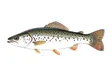
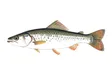
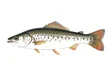
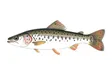
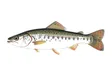
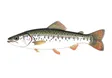
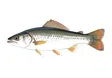
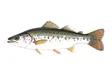
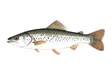
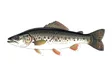
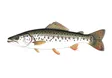
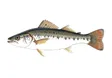
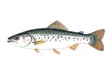
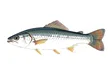
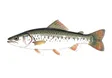
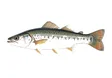
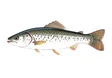
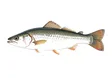
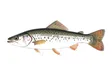
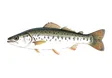
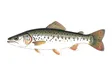
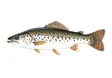
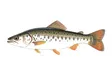
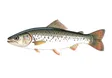
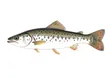
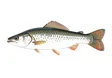
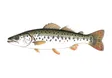
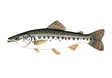
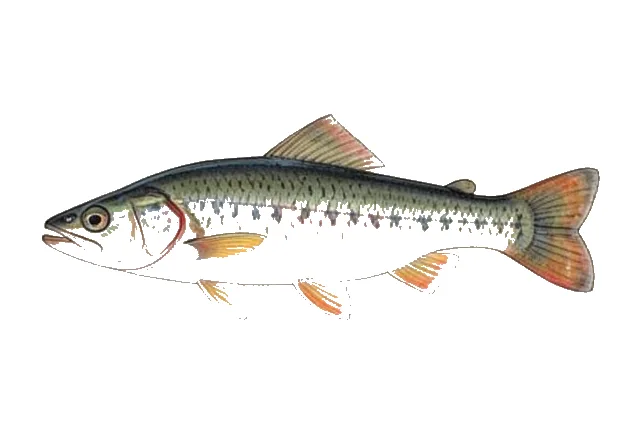
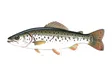
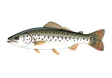
Johnny Darter field guide illustration

About Johnny Darter

The johnny darter (Etheostoma nigrum) is a species of freshwater ray-finned fish, a darter from the subfamily Etheostomatinae, part of the family Percidae, which also contains the perches, ruffes and pikeperches. It is native to shallow waters throughout North America east of the Rocky Mountains.

Etymology

The johnny darter's Latin name comes from the Greek root words etheo, meaning to filter, stoma, meaning mouth, and nigrum, meaning black.

Geographic distribution

The johnny darter is found from Saskatchewan and Colorado to the Atlantic seaboard and from Hudson Bay south to the Gulf Coast drainage systems. They are the most common darter in Minnesota and Ohio.

Description

The johnny darter can reach a length of 7.2 centimetres (2.8 in) TL though most only reach about 3.9 centimetres (1.5 in). Males weigh a little over 2.0 grams, and the females weigh about 1.6 grams. These small, slender fish have brown to yellow scales, paler sides, and whitish bellies. They have no bright colors and generally just have brown or black markings on a lighter tan background. These markings are usually a series of black "w"or"x" shapes along their sides running along their lateral lines. On the fish, the opercles (or bony areas forming the gill covers) have scales, whereas the preopercles (bone at the start of the cheek), napes, and breasts are scaleless. The johnny darter has two dorsal fins, the first has hard (spinous) rays, while the second is soft-rayed (flexible). The pectoral and pelvic fins are close to each other behind the gills. The pectorals are large and fan-like and are situated on the lower sides of the fish. The pelvic fins are small and round and situated in the ventral side of the fish. They have a rounded tail fin on the ventral side, as well.

Habitat, diet, and predators

Johnny darters prefer clear water with sandy and gravelly bottoms. They like slow-moving water, but can be found in moderately cloudy, moving water, as well. They are bottom dwellers and stay on rocks at the bottoms of small ponds and streams with their heads facing into the current. Of all the darter species, the johnny darter is the most tolerant of diverse conditions. Since this darter is a benthic, its mouth is a subterminal where the nose is only slightly beyond the mouth and is situated in an inferior position that makes it easy for it to eat and catch food. Its diet is varied, but as young fish, it tends to eat copepods, small crustaceans, and waterfleas. As it grows, the fish start eating larger waterfleas, different types of larvae, including midges, mayflies, and caddisflies, and the occasional sideswimmer. These darters are generally eaten by larger predatory fish, such as burbots, lake trout, smallmouth bass, walleyes, and yellow perch.

Breeding

The spawning season is May and most of June, when the water temperatures are between 12 and 24 °C. Males arrive first to establish territories throughout the pond, lake, or stream. Spawning occurs in the shallow water, pools and slow runs, with large rocks, logs, cans, shells, or other debris. When a female approaches the nest, the male darts at her and chases her out of the territory. However, when she approaches the nest upside down and tries to enter, the male will accept her. They then both turn upside down and the female will lay between 30 and 200 eggs on the underside of the debris. Johnny darters are not monogamous and the female and male will spawn with other fish. A single nest may hold up to 1000 developing eggs. The male will guard the nest and keep them oxygenated and will eat the ones that develop fungus until the embryos hatch, which is after about six to 10 days.

Conservation status

These fish are not considered threatened throughout most of their range. They are considered vulnerable only in Arkansas, Kentucky, Oklahoma, Kansas, and Nebraska. In Minnesota, they have no special conservation status, but are protected by state law.

Article text: Wikipedia contributors, Johnny darter (source revision). Licensed under CC BY-SA 4.0. Retrieved 2026-10-11.
Diet and feeding

The FishTraits compilation records these diet categories for this species: invertebrates or larval fish. These are broad categories, not a claim that every individual consumes every example in a category.

Reported feeding positions include bottom feeding. The compilation combines published observations; diets can vary with age, locality, and available food.

Habitat preferences

Reported habitat associations include medium to large rivers, streams and small rivers, creeks, still-water habitats.

The source records associations with clay or silt, sand, gravel, cobble, vegetation, organic debris. An association indicates reported use, rather than an exclusive requirement.

Reproduction and parental care

The compilation reports a representative maturity age of 1 years. Its maturity field summarizes mean, median, or modal estimates, usually for females; male estimates can be used when female data are unavailable. It is not a fixed age at which every fish first breeds.

Recorded spawning months are Apr, May for the source’s reporting region (NC). This is a regional calendar, not a range-wide schedule.

The reproductive-guild classification includes guarding eggs or young at a spawning substrate or nest.

Size and recorded longevity

FishTraits reports a maximum total length of 7.2 centimetres. Some entries use an estimated asymptotic length; this value should not be treated as a certified record catch.

Recorded longevity in the compilation is 4 years. Wild observations were preferred, but captive records were accepted where wild records were unavailable, and unspecified records were assumed wild. The value is not a guaranteed wild lifespan or an aquarium life expectancy.

Native range

St. Lawrence-Great Lakes, Hudson Bay, and Mississippi River basins from Hudson Bay to southern Mississippi, and from Quebec and Virginia to Saskatchewan and Colorado; on Atlantic Slope in James, Roanoke, Tar, and Neuse River drainages, Virginia and North Carolina; on Gulf Slope in Mobile Bay drainage, Alabama and Mississippi. Absent in White River drainage (Arkansas and Missouri), most of Arkansas River drainage, upper Tennessee River drainage, and middle Cumberland River drainage (Page and Burr 1991).

Habitat and ecology

Occupies sandy, muddy, or rocky areas of small and large streams, creeks, pools, reservoirs, and lakes (Propst and Carlson 1989; Page and Burr 1991). Prefers slow water over sand/gravel substrates, but has a wide range of environmental tolerances (Propst and Carlson 1989). Primarily consumes chironimid and other insect larvae (Propst and Carlson 1989).

Record fish

The Wisconsin state record

  • Wisconsin0 lbs. 0.16 oz.

    Menomonee River · Waukesha · 08/29/2020

Each figure is the state agency’s own certified record. The site holds record tables for 11 states so far, so a state missing here has not been read yet. It is not a state where this fish holds no record.

Range

Where it lives

Share of 20,892 GBIF observation records with a state location, across 37 states. The orange dots are USGS stream-survey sites where this species was caught.
0%
14.3%
Share of 20,892 GBIF observation records with a state location, across 37 states. The orange dots are USGS stream-survey sites where this species was caught.

A blank area on the dot layer usually means nobody sampled there, not that the fish is absent. Turn on “every survey site” to see where the survey looked.

The USGS stream survey caught it at 7,854 of its sites, in 27 states. That survey and the GBIF records are two different counts of two different things, so the site keeps them apart.

Habitat

Water and movement

Water
WoRMS records this species in fresh water.
USGS NAS habitat
Freshwater
US status
Native transplant — native to part of the United States, moved to other waters inside it.
Migration
Migratory
Pattern

Classification

Taxonomy

Kingdom
Animalia
Phylum
Chordata
Superclass
Actinopterygii
Class
Teleostei
Order
Perciformes
Family
Percidae
Genus
Etheostoma
Species
Etheostoma nigrum
ITIS TSN
168369
WoRMS AphiaID
590491
GBIF key
2382319
Outside the US
ITIS also files it in Canada.

Common questions about Johnny Darter

What is the scientific name of Johnny Darter?
The scientific name is Etheostoma nigrum, in the family Percidae. Classification follows ITIS.
Does Johnny Darter live in fresh water or salt water?
WoRMS records this species in fresh water.
Where has Johnny Darter been recorded in the United States?
GBIF has observations in 37 states, with the most records in Illinois, Ohio, Minnesota. The map shows observation records, which do not establish the complete natural range.

Closest relatives

Other Etheostoma species

Same family

More Percidae

All 229 species in Percidae