Greenside Darter

Etheostoma blennioides

Percidae · freshwater water fish

6 minute read · Species guide

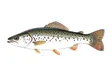
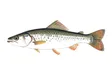
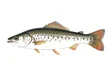
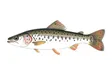
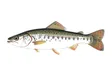
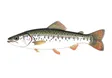
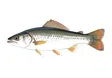
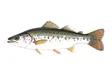
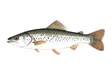
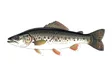
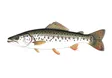
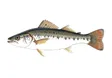
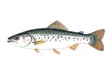
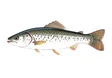
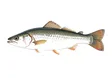
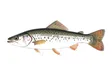
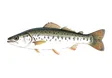
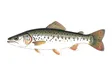
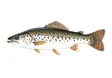
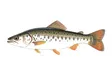
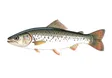
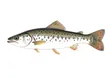
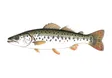
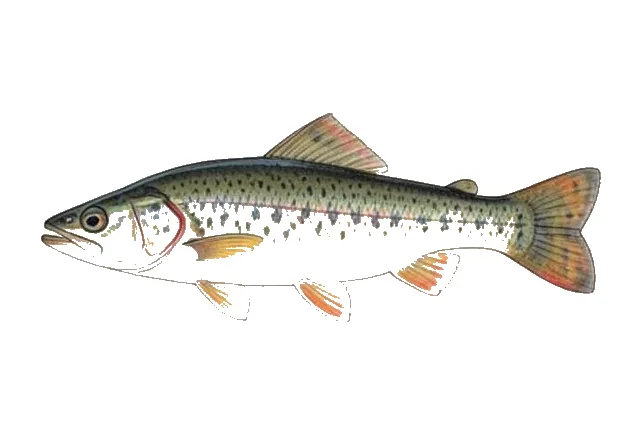
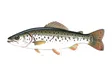
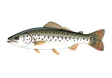
Greenside Darter field guide illustration

About Greenside Darter

The greenside darter (Etheostoma blennioides) is a species of freshwater ray-finned fish, a darter from the subfamily Etheostomatinae, part of the family Percidae, which also contains the perches, ruffes and pikeperches. It inhabits swift riffles in the eastern United States and southern Ontario.

Biology

Greenside darters typically live for three to five years, grow to a maximum of 5.2 inches (132 mm) standard length and sexually mature at one to two years of age. Greenside darters are reproductively active from February to April in the Midwest and Southeastern United States. Spawning occurs over algae - or moss -covered rocks in deep, swift riffles that are guarded by males who vigorously defend against intruders. Females linger in pools below the riffle and move into a male's territory when ready to spawn. Eggs are viscous and stick together in small clumps on green algae (Cladophora), moss (Fontinalis), and riverweed (Podostemaceae). E. blennioides is insectivorous, with analyzed gut contents containing Nematocera larvae, more specifically black fly and midge (Chironomidae) larvae. Significant numbers of mayfly (Ephemeroptera) and caddisfly (Trichoptera) nymphs were also found.

Description

The greenside darters have an elongated body with a long and rounded snout. The dorsum is greenish-brown, with six or seven dark quadrate saddles and the sides with five to eight dark green, typically U- or W-shaped blotches. The nape, cheeks, opercle, and belly are completely scaled, with the breast naked. The anal fin has six to 10 rays (usually eight) and 13 to 16 pectoral fin rays, and both are bright green in breeding males; caudal fins are yellowish to clear; dorsal fin rays number 12 to 15, with red basal bands; breeding males have intensely bluish-green nasal and oral areas and sometimes black on the head.

Conservation

E. blennioides is currently secure throughout its range, except in Mississippi where its habitat was altered by the Tennessee–Tombigbee Waterway.

Distribution

The E. blennioides subspecies are believed to have diverged in separate drainage systems and glacial refugia during the Pleistocene ice ages, which destroyed older connections and shaped new river systems.

Habitat

Greenside darters inhabit gravel riffles of large creeks to medium rivers and often are found in swift waters over large boulders and large rubble.

Systematics

The greenside darter was first formally described in 1819 by the French naturalist Constantine Samuel Rafinesque (1783–1840) with the type locality given as the Ohio River. Rafinesque placed the new species in a new genus Etheostoma and it was subsequently designated as the type species of that genus by Louis Agassiz in 1854. Rafinesque gave the species the specific name blennoidies because of its resemblance to the blennies.

As previously stated, Miller (1968) concluded the E. blennioides complex consists of the four subspecies above. Unpublished studies by Richard L. Mayden and colleagues indicate E. b. newmanii from the Cumberland and Tennessee Rivers may be a valid species and distinct from other members of the complex. The former subspecies, E. b. gustelli has recently been re-elevated to species status, Etheostoma gustelli (Tuckasegee darter) based on lack of hybridization.

Etheostoma blennioides belongs to the subgenus Etheostoma that contains these species:

Etheostoma blennioides is further nested within the greenside darter group that contains E. blennius, E. gutselli, E. inscriptum, E. swannanoa, and E. thalassinum.

Article text: Wikipedia contributors, Greenside darter (source revision). Licensed under CC BY-SA 4.0. Retrieved 2026-10-11.
Diet and feeding

The FishTraits compilation records these diet categories for this species: invertebrates or larval fish. These are broad categories, not a claim that every individual consumes every example in a category.

Reported feeding positions include bottom feeding. The compilation combines published observations; diets can vary with age, locality, and available food.

Habitat preferences

Reported habitat associations include medium to large rivers, streams and small rivers, creeks.

The source records associations with cobble, boulders, vegetation. An association indicates reported use, rather than an exclusive requirement.

Reproduction and parental care

The compilation reports a representative maturity age of 1.5 years. Its maturity field summarizes mean, median, or modal estimates, usually for females; male estimates can be used when female data are unavailable. It is not a fixed age at which every fish first breeds.

Batch or serial spawning has been reported somewhere in the species’ range. This does not establish the same spawning pattern for every population.

Recorded spawning months are Mar, Apr for the source’s reporting region (NC). This is a regional calendar, not a range-wide schedule.

The reproductive-guild classification includes spawning on open substrates without guarding the brood.

Size and recorded longevity

FishTraits reports a maximum total length of 17 centimetres. Some entries use an estimated asymptotic length; this value should not be treated as a certified record catch.

Recorded longevity in the compilation is 5 years. Wild observations were preferred, but captive records were accepted where wild records were unavailable, and unspecified records were assumed wild. The value is not a guaranteed wild lifespan or an aquarium life expectancy.

Native range

Great Lakes and Mississippi River basins from New York and Maryland to eastern Kansas and Oklahoma, and from Ontario south to Georgia, Alabama, and Arkansas; Atlantic Slope in Mohawk drainage, New York (Page and Burr 1991).

Habitat and ecology

Greenside Darters inhabit riffles and vegetated areas of small to medium rivers; occassionally along shorelines of large lakes (Cooper 1983; Page and Burr 1991). Feeds on aquatic crustaceans and insect larvae throughout its lifecycle (Cooper 1983; Jenkins and Burkhead 1994). Spawning occurs in spring and early summer (February to June) in water temperatures of 11-23°C. Males will guard a small territory, and eggs are deposited under rocks or at the base of aquatic vegetation. No other parental care is given (Cooper 1983; Jenkins and Burkhead 1994). Maturity is generally reached by age 1-2, and the average lifespan is 3-4 years (maximum reported age of 5 years) (Cooper 1983; Jenkins and Burkhead 1994).

Introduction history

The origin of introduced populations in the Susquehanna and Potomac River drainages has been widely debated. Schwartz (1965) suggested that E. blennioides entered the Potomac drainage through crossovers events near the headwaters of the Potomac in West Virginia, and Stauffer et al. (1995) list it as native for the drainage. Denoncourt et al. (1977) suggest that stream capture from the Allegheny River drainage is the source of the population in the Susquehanna River drainage, and that it has been present since relatively recent geological times but not previously sampled due to lack of sampling effort in the region. Cooper (1983) regards the species as native to Pennsylvania and classifies it as a recent immigrant. Jenkins and Burkhead (1994), Neely and George (2006), and Starnes et al. (2011) argue that the lack of collection data (despite widespread sampling in these regions) prior to first reports and rapid spread throughout the watersheds is indicative of recent introduction and expansion. Neely and George (2006) speculated bait-bucket transfer of individuals was responsible for the introduction.

Ecological impacts

Unknown. Neely and George (2006) suggest that Greenside Darters could impact the critically endangered Maryland darter (E. sellare) in the lower Susquehanna drainage due to overlap in preferred habitats and diet.

Range

Where it lives

Share of 12,811 GBIF observation records with a state location, across 23 states. The orange dots are USGS stream-survey sites where this species was caught.
0%
19.5%
Share of 12,811 GBIF observation records with a state location, across 23 states. The orange dots are USGS stream-survey sites where this species was caught.

A blank area on the dot layer usually means nobody sampled there, not that the fish is absent. Turn on “every survey site” to see where the survey looked.

The USGS stream survey caught it at 4,413 of its sites, in 18 states. That survey and the GBIF records are two different counts of two different things, so the site keeps them apart.

Habitat

Water and movement

Water
WoRMS records this species in fresh water.
USGS NAS habitat
Freshwater
US status
Native transplant — native to part of the United States, moved to other waters inside it.
Migration
Migratory
Pattern

Classification

Taxonomy

Kingdom
Animalia
Phylum
Chordata
Superclass
Actinopterygii
Class
Teleostei
Order
Perciformes
Family
Percidae
Genus
Etheostoma
Species
Etheostoma blennioides
ITIS TSN
168375
WoRMS AphiaID
954589
GBIF key
2382397
Outside the US
ITIS also files it in Canada.

Common questions about Greenside Darter

What is the scientific name of Greenside Darter?
The scientific name is Etheostoma blennioides, in the family Percidae. Classification follows ITIS.
Does Greenside Darter live in fresh water or salt water?
WoRMS records this species in fresh water.
Where has Greenside Darter been recorded in the United States?
GBIF has observations in 23 states, with the most records in Ohio, Kentucky, Tennessee. The map shows observation records, which do not establish the complete natural range.

Closest relatives

Other Etheostoma species

Same family

More Percidae

All 229 species in Percidae