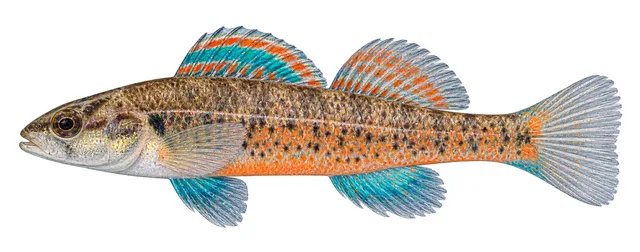
Watercress Darter

Etheostoma nuchale

Percidae · freshwater water fish

5 minute read · Species guide

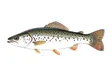
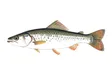
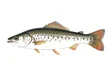
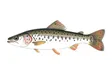
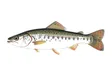
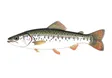
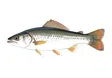
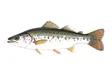
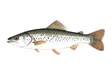
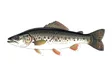
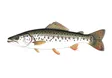
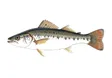
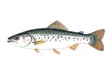
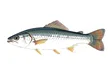
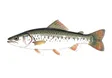
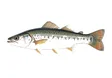
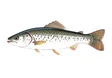
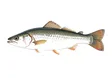
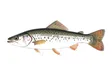
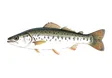
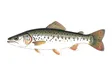
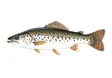
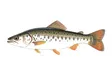
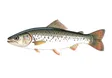
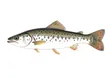
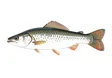
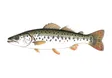
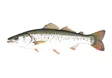
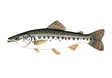
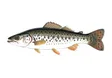
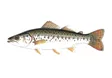
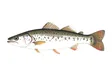
Watercress Darter field guide illustration

About Watercress Darter

The watercress darter (Etheostoma nuchale) is a species of freshwater ray-finned fish, a darter from the subfamily Etheostomatinae, part of the family Percidae, which also contains the perches, ruffes and pikeperches. It is endemic to the eastern United States where it is only known from the Black Warrior River drainage basin near Birmingham, Alabama.

Description

This species can reach a length of 5.4 centimetres (2.1 in) TL though most only reach a length of around 3.5 centimetres (1.4 in).

Distribution and habitat

The watercress darter is only known to exist in four specific bodies of water, two in the Watercress Darter National Wildlife Refuge and two at the Seven Springs in the Powderly neighborhood of Birmingham. The Seven Springs populations were discovered in 2003. The species can be found in the watercress zone of springs where the water is slow-moving. They are usually found in dense mats of watercress or other aquatic vegetation, where they rest on the leaves and stems well above the stream bed. They feed on snails, crustaceans, and insect larvae in slow-moving water.

Conservation and status

The species is endangered and is protected in areas such as the Watercress Darter National Wildlife Refuge in Jefferson County. The IUCN lists it as being "Endangered" due to its small range, small total population size and vulnerability to deterioration in the quality of the water in the springs in which it occurs.

On September 22, 2008, more than 12,000 watercress darters were killed when workers from the city of Birmingham removed a beaver dam at Roebuck Springs, emptying a pond that was the darters' habitat. An alternative solution would have been to install a flow device in the dam to regulate the pond height. The pond was emptied because it often flooded a nearby tennis court. The city emptied the beaver pond without the permission of the US Fish and Wildlife Service (FWS). The FWS has ordered the dam to be restored and the pond refilled in an effort to save the remaining darters.

The Alabama Department of Conservation and Natural Resources is suing the City of Birmingham for destroying endangered species and their wetland habitat.

Article text: Wikipedia contributors, Watercress darter (source revision). Licensed under CC BY-SA 4.0. Retrieved 2026-10-11.
Diet and feeding

The FishTraits compilation records these diet categories for this species: invertebrates or larval fish. These are broad categories, not a claim that every individual consumes every example in a category.

Reported feeding positions include bottom feeding and surface or water-column feeding. The compilation combines published observations; diets can vary with age, locality, and available food.

Habitat preferences

Reported habitat associations include springs or subterranean waters.

The source records associations with clay or silt, gravel, vegetation. An association indicates reported use, rather than an exclusive requirement.

Reproduction and parental care

The compilation reports a representative maturity age of 1 years. Its maturity field summarizes mean, median, or modal estimates, usually for females; male estimates can be used when female data are unavailable. It is not a fixed age at which every fish first breeds.

Batch or serial spawning has been reported somewhere in the species’ range. This does not establish the same spawning pattern for every population.

Recorded spawning months are Mar, Apr, May, Jun, Jul for the source’s reporting region (AL). This is a regional calendar, not a range-wide schedule.

The reproductive-guild classification includes spawning on open substrates without guarding the brood.

Size and recorded longevity

FishTraits reports a maximum total length of 4.5 centimetres. Some entries use an estimated asymptotic length; this value should not be treated as a certified record catch.

Recorded longevity in the compilation is 2 years. Wild observations were preferred, but captive records were accepted where wild records were unavailable, and unspecified records were assumed wild. The value is not a guaranteed wild lifespan or an aquarium life expectancy.

Native range

Thomas', Roebuck, Glenn, and Seven springs in the Black Warrior drainage, Jefferson County, Alabama (U.S. Fish and Wildlife Service 1992, 2009; Duncan et al. 2010).

Habitat and ecology

Inhabits slow moving spring pools and associated runs; primarily associated with aquatic vegetation (e.g., watercress) where it feeds and reproduces (Boschung and Mayden 2004; Duncan et al 2010).

Introduction history

The species was originally stocked to create a second population. At the time of the original introduction, the species was known only from Glenn Springs. That site was immediately adjacent to Jefferson County Route 20, and would have been imperiled by any road expansions. In 1965, 43 specimens from Glenn Springs were stocked in Prince Springs in hope that a second population would afford the species more security (U.S. Fish and Wildlife Service 1980a; Howell, personal communication). The Watercress Darter was listed as a federally endangered species in 1970 (U.S. Fish and Wildlife Service 1980a). The species was later discovered at two other sites during a survey conducted between 1977 and 1978. During the period 1976-1977, all three native populations were at risk. Glenn Springs deteriorated because of sewage contamination; Thomas' Spring was to be dredged, the sportfish removed and then replaced with catfish; and the Roebuck Springs population contracted "gas bubble" disease (U.S. Fish and Wildlife Service 1980a). On 19 January 1988, 400 fish were transplanted from Roebuck Springs, 200 to Tapawingo Springs and 200 to Avondale Springs, as part of an endangered species recovery plan designed to save this species from extinction (U.S. Fish and Wildlife Service 1992).

Ecological impacts

The introduction of Watercress Darters to Tapawingo Springs caused the extirpation of rush darter (E. phytophilum), a Federally Endangered species of darter described in 1999, at that locality (George et al. 2009)

Range

Where it lives

Share of 75 GBIF observation records with a state location, across 1 states.
0%
100%
Share of 75 GBIF observation records with a state location, across 1 states.

Share of records by state

Habitat

Water and movement

Water
WoRMS records this species in fresh water.
USGS NAS habitat
Freshwater
US status
Native transplant — native to part of the United States, moved to other waters inside it.
Migration
Undetermined

Classification

Taxonomy

Kingdom
Animalia
Phylum
Chordata
Superclass
Actinopterygii
Class
Teleostei
Order
Perciformes
Family
Percidae
Genus
Etheostoma
Species
Etheostoma nuchale
ITIS TSN
168415
WoRMS AphiaID
1013472
GBIF key
2382304

Common questions about Watercress Darter

What is the scientific name of Watercress Darter?
The scientific name is Etheostoma nuchale, in the family Percidae. Classification follows ITIS.
Does Watercress Darter live in fresh water or salt water?
WoRMS records this species in fresh water.
Where has Watercress Darter been recorded in the United States?
GBIF has observations in 1 states, with the most records in Alabama. The map shows observation records, which do not establish the complete natural range.

Closest relatives

Other Etheostoma species

Same family

More Percidae

All 229 species in Percidae