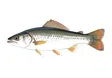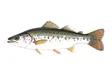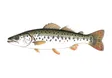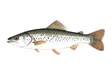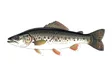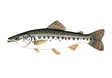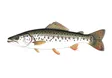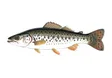
Walleye

Sander vitreus

Percidae · freshwater and brackish water fish

14 minute read · Species guide

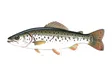
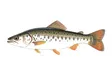
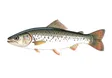
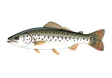
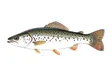
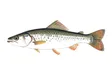
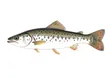
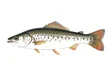
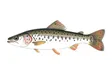
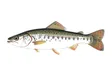
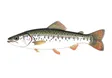
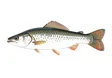
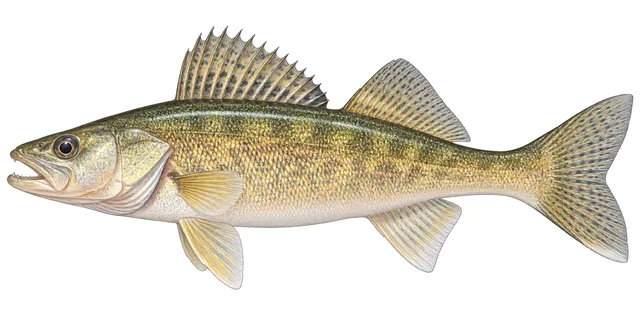
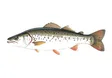
Walleye field guide illustration

About Walleye

The walleye (Sander vitreus, synonym Stizostedion vitreum), also called the walleyed pike, yellow pike, yellow pikeperch or yellow pickerel, is a freshwater perciform fish native to most of Canada and to the Northern United States. It is a North American close relative of the European zander, also known as the pikeperch. The walleye is sometimes called the yellow walleye to distinguish it from the blue walleye, which is a color morph that was once found in the southern Ontario and Quebec regions, but is now presumed extinct. However, recent genetic analysis of a preserved (frozen) 'blue walleye' sample suggests that the blue and yellow walleye were simply phenotypes within the same species and do not merit separate taxonomic classification.

In parts of its range in English-speaking Canada, the walleye is known as a pickerel, though the fish is not related to the true pickerels, which are members of the family Esocidae. It is also sometimes called a dory in British English (and its common name in French is the similar doré —meaning golden or gilded), although this name is also used for various other species.

Walleyes show a fair amount of variation across watersheds. In general, fish within a watershed are quite similar and are genetically distinct from those of nearby watersheds. The species has been artificially propagated for over a century and has been planted on top of existing populations or introduced into waters naturally devoid of the species, sometimes reducing the overall genetic distinctiveness of populations.

Etymology

The name "walleye"comes from its pearlescent eyes caused by the reflective tapetum lucidum which, in addition to allowing the fish to see well in low-light conditions, gives its eyes an opaque appearance. Their vision affects their behavior. They avoid bright light and feed in low light on fish that cannot see as well as they do. Many anglers look for walleyes at night since this is when major feeding efforts occur. The fish's eyes also allow them to see well in turbid waters (stained or rough, breaking waters), which gives them an advantage over their prey. Thus, walleye anglers commonly look for locations where a good"walleye chop" (i.e., rough water) occurs. Their vision also allows the fish to populate the deeper regions in a lake, and they can often be found in deeper water, particularly during the warmest part of the summer and at night.

Taxonomy

The walleye is part of the North American clade within the genus Sander, alongside the sauger (S. canadensis). Hubbs described a taxon called the blue walleye (S. glaucus) from the Great Lakes but subsequent taxonomic work showed no consistent differences between this form and the "yellow" walleye and the blue walleye is now considered to be a synonym and color variant of the walleye. The walleye was first formally described by the American naturalist Samuel Latham Mitchill (1764–1831) with the type locality given as Cayuga Lake near Ithaca, New York.

Description

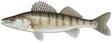
Walleyes are largely olive and gold in color (hence the French common name: doré —golden). The dorsal side of a walleye is olive, grading into a golden hue on the flanks. The olive/gold pattern is broken up by five darker saddles that extend to the upper sides. The color shades to white on the belly. The mouth of a walleye is large and is armed with many sharp teeth. The first dorsal and anal fins are spinous, as is the operculum. Walleyes are distinguished from their close relative the sauger by the white coloration on the lower lobe of the caudal fin, which is absent on the sauger. In addition, the two dorsals and the caudal fin of the sauger are marked with distinctive rows of black dots which are absent from or indistinct on the same fins of walleyes.

Length and weight

Walleyes grow to about 80 cm (31 in) in length, and weigh up to about 9 kg (20 lb). The maximum recorded size for the fish is 107 cm (42 in) in length and 13 kg (29 lb) in weight. The rate depends partly on where in their range they occur, with southern populations often growing faster and larger. In general, females grow larger than males. Walleyes may live for decades; the maximum recorded age is 29 years. In heavily fished populations, however, few walleye older than five or six years of age are encountered. In North America, where they are highly prized, their typical size when caught is on the order of 30 to 50 cm (12 to 20 in), substantially below their potential size.

As walleye grow longer, they increase in weight. The relationship between total length (L) and total weight (W) for nearly all species of fish can be expressed by an equation of the form

Invariably, b is close to 3.0 for all species, and c is a constant that varies among species. For walleye, b = 3.180 and c = 0.000228 (with units in inches and pounds) or b = 3.180 and c = 0.000005337 (with units in cm and kg).

This relationship suggests a 50 cm (20 in) walleye will weigh about 1.5 kg (3.3 lb), while a 60 cm (24 in) walleye will likely weigh about 2.5 kg (5.5 lb).

Population dynamics

The Garrison Dam National Fish Hatchery at Garrison Dam, North Dakota, is the largest walleye hatchery in the world. Although they are in high demand for fishing and consumption in North Dakota, elsewhere they are considered a nuisance. For that reason GDNFH is also researching hormonal population control to provide control options to other areas.

Reproduction

In most of the species' range, male walleyes mature sexually between three and four years of age. Females normally mature about a year later. Adults migrate to tributary streams in late winter or early spring to lay eggs over gravel and rock, although open-water reef or shoal-spawning strains are seen, as well. Some populations are known to spawn on sand or vegetation. Spawning occurs at water temperatures of 6 to 10 °C (43 to 50 °F). A large female can lay up to 500,000 eggs, and no care is given by the parents to the eggs or fry. The eggs are slightly adhesive and fall into spaces between rocks. The incubation period for the embryos is temperature-dependent, but generally lasts from 12 to 30 days. After hatching, the free-swimming embryos spend about a week absorbing a relatively small amount of yolk. Once the yolk has been fully absorbed, the young walleyes begin to feed on invertebrates, such as fly larvæ and zooplankton. After 40 to 60 days, juvenile walleyes become piscivorous. Thenceforth, both juvenile and adult walleyes eat fish almost exclusively, frequently yellow perch or ciscoes, moving onto bars and shoals at night to feed. Walleye also feed heavily on crayfish, minnows, and leeches.

As food

The walleye is considered to be a quite palatable freshwater fish, and consequently, is fished recreationally and commercially for food. Because of its nocturnal feeding habits, it is most easily caught at night using live minnows or lures that mimic small fish. Most commercial fisheries for walleye are situated in the Canadian waters of the Great Lakes, and fried walleye is considered a staple of Canadian cuisine. In Minnesota, the walleye is often fished in the late afternoon on windy days (known as a "walleye chop") or at night. A walleye sandwich is commonly served in Minnesota's pubs, and deep-fried on a stick at the Minnesota State Fair. Fried walleye is a favored dish in both Canada and Minnesota.

Fishing

Because walleyes are popular with anglers, fishing for walleyes is regulated by most natural resource agencies. Management may include the use of quotas and length limits to ensure that populations are not overexploited. For example, in Michigan, walleyes shorter than 15 in (38 cm) may not be legally kept.

Since walleyes have excellent visual acuity under low illumination levels, they tend to feed more extensively at dawn and dusk, on cloudy or overcast days, and under choppy conditions when light penetration into the water column is disrupted. Although anglers interpret this as light avoidance, it is merely an expression of the walleyes' competitive advantage over their prey under those conditions. Similarly, in darkly stained or turbid waters, walleyes tend to feed throughout the day. In the spring and fall, walleyes are located near the shallower areas due to the spawning grounds, and they are most often located in shallower areas during higher winds due to the murkier, higher oxygenated water at around 6 feet (1.8 m) deep. On calm spring days, walleyes are more often located at the deep side of the shoreline drop-off and around shore slopes at depths approaching 10 feet (3 m) or more.

As a result of their widespread presence in Canada and the northern United States, walleyes are frequently caught while ice fishing, a popular winter pastime throughout those regions.

"Walleye chop" is a term used by walleye anglers for rough water typically with winds of 10 to 25 km/h (6 to 16 mph), and is one of the indicators for good walleye fishing due to the walleyes' increased feeding activity during such conditions. In addition to fishing this chop, night fishing with live bait can be very effective.

The current all-tackle world record for a walleye is held by Mabry Harper, who caught an 11.34 kg (25.0 lb) walleye in Old Hickory Lake in Tennessee on 2 August 1960. LeRoy Chiovitte holds the Minnesota state-record for the walleye he caught on 13 May 1979 on the Seagull River near Saganaga Lake. The fish weighed 17 pounds 8 ounces (7.9 kg), was 35.75 inches (90.8 cm) long and had a girth of 21.25 inches (54.0 cm).

Cultural aspects

Walleye is a culturally significant food in the Upper Midwest. Walleye is popular in Minnesota; the Minnesota Legislature declared walleye the official state fish in 1965. Three towns — Garrison, Minnesota; Baudette, Minnesota; and Garrison, North Dakota — each claim to be the "Walleye Capital of the World"and a large statue of the fish is erected in each town. Walleye pike was declared the official"state warm water fish"of Vermont in 2012. (Vermont's official"state cold water fish" is the brook trout, Salvelinus fontinalis.)

South Dakota designated the walleye as its official state fish in 1982. Although the fish is native to South Dakota, living in Missouri River reservoirs and eastern glacial lakes of the state, it only became a popular food in South Dakota in the 1970s and 1980s, when the fishing tournament circuit promoted the fish and operated walleye fishing contests in the state.

The walleye is the official provincial fish of Manitoba. Winnipeg, Manitoba, considers the walleye (referred to locally as "pickerel") its most important local fish. Icelandic fishermen in Lake Winnipeg traditionally supplied the Winnipeg market. The walleye is also the provincial fish of Saskatchewan, which declared the species its official fish in 2015 after it won a fish emblem contest. Walleye is the most popular fish for sport fishing in Saskatchewan, and can be caught in many rivers, reservoirs, and lakes. The International Underwater Spearfishing Association record for largest spearfishing -caught walleye is held by a 13.3-pound (6.0 kg) walleye caught in 2014 on the South Saskatchewan River north of Lake Diefenbaker.

Article text: Wikipedia contributors, Walleye (source revision). Licensed under CC BY-SA 4.0. Retrieved 2026-10-11.
Diet and feeding

The FishTraits compilation records these diet categories for this species: invertebrates or larval fish; larger animal prey (a source category covering fish, crayfish, crabs, or frogs). These are broad categories, not a claim that every individual consumes every example in a category.

Reported feeding positions include surface or water-column feeding. The compilation combines published observations; diets can vary with age, locality, and available food.

Habitat preferences

Reported habitat associations include medium to large rivers, streams and small rivers, still-water habitats.

The source records associations with sand, gravel, cobble, boulders, bedrock, vegetation. An association indicates reported use, rather than an exclusive requirement.

Reproduction and parental care

The compilation reports a representative maturity age of 3 years. Its maturity field summarizes mean, median, or modal estimates, usually for females; male estimates can be used when female data are unavailable. It is not a fixed age at which every fish first breeds.

Recorded spawning months are Apr for the source’s reporting region (NC). This is a regional calendar, not a range-wide schedule.

The reproductive-guild classification includes spawning on open substrates without guarding the brood.

Size and recorded longevity

FishTraits reports a maximum total length of 89.5 centimetres. Some entries use an estimated asymptotic length; this value should not be treated as a certified record catch.

Recorded longevity in the compilation is 14 years. Wild observations were preferred, but captive records were accepted where wild records were unavailable, and unspecified records were assumed wild. The value is not a guaranteed wild lifespan or an aquarium life expectancy.

Native range

St. Lawrence-Great Lakes, Arctic, and Mississippi River basins from Quebec to Northwest Territories, and south to Alabama and Arkansas (Page and Burr 1991).

Introduction history

Intentionally stocked as a food fish and for sportfishing. One of the earliest introductions occurred in 1874 when Livingston Stone gathered a small number of adult Walleye captured in Vermont and transported them to California where the fish were released into the Sacramento River (Smith 1896). According to Dill and Cordone (1997), in the 1890s the California Fish Commission applied to the U.S. Fish Commission for shipments of Walleye for use in controlling carp in Clear and Blue lakes; however, no Walleye were imported at the time. These same authors also noted that the state received Walleye eggs from Minnesota in 1959 and that these fish were to be used to control bluegill and support other sport fish in southern California reservoirs. In Idaho, Walleye may have been stocked accidentally with yellow perch Perca flavescens (Linder 1963). McMahon and Bennett (1996) state the first introduction into southern Idaho reservoirs was in 1974. The person or agency responsible for introducing the species into Washington is uncertain. The federal government may have introduced them in the early 1960s (Dentler 1993). A sport fishery had developed in Lake Roosevelt, Washington, by the 1960s (McMahon and Bennett 1996). Walleye was first reported in Wyoming in 1961 from Seminoe Reservoir in the upper North Platte River. The fish were swept downstream and are now established in a 450-km stretch of river (McMahon and Bennett 1996). Herke (1969) performed experimental stocking into private ponds to examine the survivability of this species in peninsular Florida. The Walleye was stocked illegally in Canyon Ferry Reservoir, Montana, and was found first circa 1991 (White, personal communication). More recently, the species also was illegally stocked in Noxon Reservoir on the Clark Fork of the Columbia River, Montana (McMahon and Bennett 1996). Illegal introductions seem to be a growing problem in western states (McMahon and Bennett 1996).

Ecological impacts

McMahon and Bennett (1996) recently reviewed the literature and presented a summary of impacts of Walleye in the Northwest. Overall, the effects of its introduction were considered complex and varied. The Walleye has been shown to prey on smolts of Pacific salmon, and therefore pose a threat to these already declining species in the Columbia River (Dentler 1993; McMahon and Bennett 1996). For instance, it is estimated that Walleye consume two million smolts annually in the Columbia River, about one third of total predation loss (McMahon and Bennett 1996). A study in Seminoe Reservoir, Wyoming, found Walleye stocking to result in a sharp decline in native minnows Hybognathus spp., darters Etheostoma spp., suckers Catostomus spp., rainbow trout Oncorhynchus mykiss, and crayfish Orconectes obscurus. For instance, most of the 500,000 trout fingerlings stocked annually were eaten within a few weeks. Consequently, there was a need to stock larger rainbow trout to avoid predation, an action that increased hatchery operation costs (McMahon and Bennett 1996). In their native eastern habitat, Walleye and salmonids are able to limit interaction by living at different water temperatures (depths) and in different habitats (McLean and Magnuson 1977). However, in western reservoirs the lack of a strong thermocline and a small littoral area does not permit this separation (McMahon and Bennett 1996). Numbers and health of brown trout Salmo trutta were found to decrease after introduced Walleyes consumed a large portion of the crayfish population, the brown trout's favorite food (McMahon and Bennett 1996). When the Walleye initially was introduced into Salmon Falls Creek Reservoir, Idaho, yellow perch Perca flavescens comprised 80% of the sport fish. However, 12 years later, Walleye made up 80% and perch only 1% of the fish in the reservoir (McMahon and Bennett 1996). Similar perch collapses also have happened at two other reservoirs in Wyoming (McMahon and Bennett 1996). A crash in the yellow perch population in Canyon Ferry Reservoir may be related to past Walleye introduction; studies are being conducted to look at the problem; in addition, it has been predicted that Walleye will have a large impact on the trout fishery in the reservoir (White, personal communication). In many cases introduced Walleye deplete the forage base. As a consequence, the surviving Walleye population consists of stunted individuals and the species no longer serves as a valuable fishery (McMahon and Bennett 1996). Some states now prohibit the introduction of Walleye into certain waters. For instance, Walleye introductions are banned in the Snake River drainage in Idaho because of concern about predation on anadromous salmonids (McMahon and Bennett 1996). Further introductions in Oregon also are forbidden due to concern about predation on salmonid smolts in the Columbia River (McMahon and Bennett 1996). Although 40 million Walleye are stocked annually to maintain an important sport fishery in eastern Montana, the species has been banned from waters west of the Continental Divide in that state due to concern for important native and nonindigenous salmonid stocks (McMahon and Bennett 1996).

Record fish

State records in 8 states

  • Arkansas22 lbs., 11 oz.

    Greers Ferry Lake · 03/12/1982 · Al Nelson, Higden, AR · rod and reel

  • Montana18.02 lbs.

    Holter Lake · 5/10/21 · Trevor Johnson

  • Wisconsin18 lbs. 0 oz.

    High Lake · Vilas · 09/16/1933

  • Idaho17.88 lb

    Oakley Reservoir · 9/10/2011 · Damon Rush

  • Utah15 lbs. 9 oz.

    Provo River · 1991 · Jeffery Tanner

  • Georgia14 lb, 2 oz

    Lake Rabun · February 19, 2016 · Wes Carlton

  • Idaho13.2 lb

    Lake Pend Oreille · 7/29/2026 · Dennis Haussler

  • Oklahoma12 lbs 13.00 ozs

    Robert S. Kerr · 05/08/2004 · Kerry Carter · rod and line

  • Alabama10 lbs 14 oz

    Weiss Reservoir · 6/24/1980 · Julia Hurley, Cedar Bluff

Each figure is the state agency’s own certified record. The site holds record tables for 11 states so far, so a state missing here has not been read yet. It is not a state where this fish holds no record.

Statute

The official state fish of 3 states

A state fish is chosen by statute. It says nothing about how common the fish is in the state. See every official state fish.

Range

Where it lives

Share of 55,605 GBIF observation records with a state location, across 44 states. The orange dots are USGS stream-survey sites where this species was caught.
0%
41.1%
Share of 55,605 GBIF observation records with a state location, across 44 states. The orange dots are USGS stream-survey sites where this species was caught.

A blank area on the dot layer usually means nobody sampled there, not that the fish is absent. Turn on “every survey site” to see where the survey looked.

The USGS stream survey caught it at 1,059 of its sites, in 34 states. That survey and the GBIF records are two different counts of two different things, so the site keeps them apart.

Habitat

Water and movement

Water
WoRMS records this species in fresh water and brackish water.
USGS NAS habitat
Freshwater
US status
Native transplant — native to part of the United States, moved to other waters inside it.
Migration
Undetermined
Pattern
Disagreement
10 published references do not agree on the pattern: Non-migratory, Potamodromous. The site shows every assignment rather than picking one.

Classification

Taxonomy

Kingdom
Animalia
Phylum
Chordata
Superclass
Actinopterygii
Class
Teleostei
Order
Perciformes
Family
Percidae
Genus
Sander
Species
Sander vitreus
ITIS TSN
650173
WoRMS AphiaID
275311
GBIF key
2382172
Outside the US
ITIS also files it in Canada.

Common questions about Walleye

What is the scientific name of Walleye?
The scientific name is Sander vitreus, in the family Percidae. Classification follows ITIS.
Does Walleye live in fresh water or salt water?
WoRMS records this species in fresh water and brackish water.
Where has Walleye been recorded in the United States?
GBIF has observations in 44 states, with the most records in Pennsylvania, Minnesota, Wisconsin. The map shows observation records, which do not establish the complete natural range.

Closest relatives

Other Sander species

Same family

More Percidae

All 229 species in Percidae