Sauger

Sander canadensis

Percidae · freshwater water fish

7 minute read · Species guide

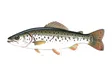
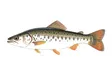
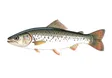
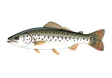
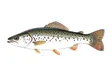
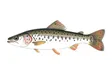
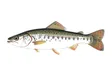
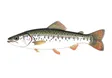
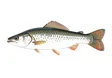
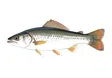
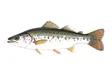
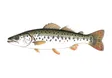
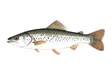
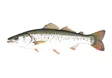
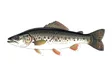
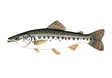
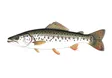
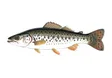
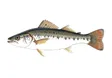
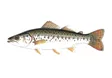
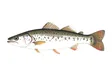
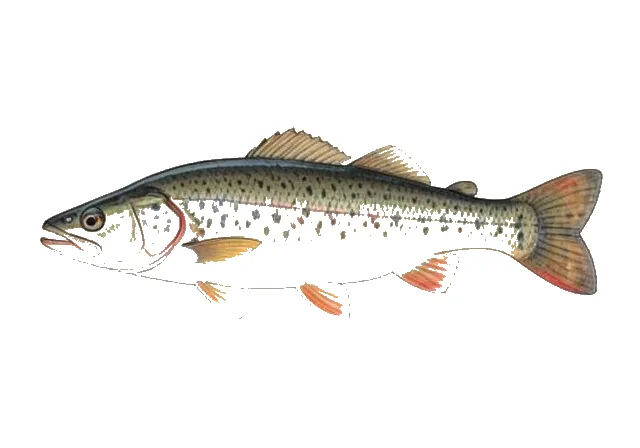
Sauger field guide illustration

About Sauger

The sauger (Sander canadensis) is a freshwater perciform fish of the family Percidae that resembles its close relative, the walleye. The species is a member of the largest vertebrate order, the Perciformes. It is the most migratory percid species in North America. Saugers have two dorsal fins; the first is spiny and the posterior dorsal fin is soft-rayed. Their paired fins are in the thoracic position and their caudal fin is truncated, which means squared off at the corners, a characteristic of the family Percidae. Another physical characteristic of saugers is their ctenoid scales, which are common in advanced fishes. Saugers have a fusiform body structure, and as a result are well adapted predatory fishes and are capable of swimming into fast currents with minimal drag on their bodies. They may be distinguished from walleyes by the distinctly spotted dorsal fin, by the lack of a white splotch on the caudal fin, by the rough skin over their gills, and by their generally more brassy color, or darker (almost black) color in some regions. The typical sauger is 300 to 400 g (11 to 14 oz) in weight.

Distribution

Saugers are widely distributed; their historical range consisted of the eastern U.S. west of the Appalachian Mountains, mostly southern, central, and western U.S., and north into southern Canada. Sauger distribution and range has decreased from historical ranges because of degraded and fragmented habitat conditions. Sauger distribution within their home range varies by time of year because they are migratory. Saugers are more typical in rivers, whereas walleyes are more common in lakes and reservoirs. In many parts of their range, saugers are sympatric with walleyes. Hybridization between saugers and walleyes is not unknown; the hybrids, referred to as saugeyes, exhibit traits of both species. Being intermediate in appearance between the two species, saugeyes are sometimes difficult to differentiate, but they generally carry the dark blotches characteristic of the sauger. Saugers, however, are usually smaller and better tolerate waters of higher turbidity than walleyes. Saugers require warmer summer water temperatures of 20–28 °C (68–82 °F). Their need for warm water is thought to affect the northern and western boundaries of their range.

Reproduction and lifecycle

Saugers generally move upstream to spawn during March to May, depending on where they are. They move downstream to their home locations from April–July after their spawning period is over. Saugers have been known to travel between 10 and 600 km from their home to spawning locations upstream. Habitats at spawning sites are less complex and diverse than home locations. Females prefer rocky substrate and pools to deposit their eggs. As females increase in length, egg quality and fecundity increase, but egg production is thought to decline after age 6. Sexual maturity is reached between 2 and 5 years old. Other measures of sexual maturity are related to size. A sauger is considered to be an adult when it reaches 250 to 300 millimetres (9.8 to 11.8 in). Upon hatching, larval saugers drift downstream before developing feeding tendencies and horizontal maneuverability. Juvenile saugers tend to develop in diversion canals and backwaters until autumn, when they migrate upstream to their winter habitat. Residing in diversion canals is a large cause of mortality for juvenile saugers.

Diet

Saugers feed on a variety of invertebrates and small fishes depending on the time of year and size of the sauger. Channel catfish Ictalurus punctatus and freshwater drum Aplodinotus grunniens are midsize (300–379 mm) and large (>379 mm) saugers' main food source during spring. The diet of a small sauger (200–299 mm) is slightly different from a larger sauger's. Smaller saugers generally feed on benthic invertebrates, mayfly larvae, and catfish during spring and summer. Midsized and large saugers feed mainly on fish from spring to autumn, but their diets alter during summer. Midsized and large saugers feed predominantly on mayfly larvae but only during summer. Freshwater drum Aplodinotus grunniens and gizzard shad Dorosoma cepedianum are predominant food sources for saugers of all sizes during autumn. Fish accounted for over 99% of a sauger's diet during autumn. Saugers also prey on shiners during spring and summer, but they do not account for a significant part of their diet. Shiners are absent from a sauger's diet in autumn probably due to their availability.

Habitat

Saugers are more likely to be found in large rivers with deep pools (depths greater than 0.6 m). They encounter a variety of habitats because of their migratory tendencies. They are usually found in natural rivers because they have more abundant pools and their flows have not been altered by dams or diversions. They are still common in impounded river systems. Diversions and dams affect habitat and spawning areas of saugers. They are usually found in areas with high turbidity, low channel slope, low stream velocity, and deep water. Saugers tend to select pools with sand and silt substrates, and habitat features that provide cover from the river current. They tend to avoid runs and riffles. They are most commonly found in pools that are at least 1.5 m deep. They can also be found in shallower pools, but in lesser numbers. No differences in habitat preference between males and females has been observed. The number of saugers observed increases with mean summer water temperature, maximum water depth, and alkalinity.

Taxonomy

Alongside the walleye, the sauger forms the North American clade within the genus Sander, and the sauger is thought to have first speciated into its modern form about 7.3 million years ago. The sauger was first formally described as Lucioperca canadensis in 1834 by British naturalists and explorers Edward Griffith (1790–1858) and Charles Hamilton Smith (1776–1859) based on the work of French naturalist and anatomist Georges Cuvier (1769–1832) which Griffith translated from the French language.

Conservation

Saugers face many conservation issues because of migratory barriers, habitat loss, entrainment in irrigation canals, and overexploitation. Dams and diversion canals prevent spawning in upstream habitats. Altering flows in rivers affect turbidity, formation of pools, and temperature, all of which are important for the timing and success of spawning saugers. Long migrations are the main reason why saugers struggle in dammed or diverted river systems. Low water levels in periods of drought are the most detrimental to sauger populations because it strands eggs during spawning and prevents larval saugers from reaching their downstream locations. High death rates that occur during spawning are related to degraded and fragmented river systems. Mortality rates in autumn are related to exploitation by fishermen.

Sauger are critically imperiled in the state of New York, with a small population still remaining in Lake Champlain. Sauger were extirpated from Lake Erie at some point after a population crash in the 1950s, as well as from Lake Ontario. Populations in the Allegheny River are prevented from reaching New York by the Kinzua Dam, which has led to the initiation of a sauger stocking program in the upper Allegheny River. As of 2022, fishing for sauger in New York is totally prohibited statewide.

Article text: Wikipedia contributors, Sauger (source revision). Licensed under CC BY-SA 4.0. Retrieved 2026-10-11.
Diet and feeding

The FishTraits compilation records these diet categories for this species: invertebrates or larval fish; larger animal prey (a source category covering fish, crayfish, crabs, or frogs). These are broad categories, not a claim that every individual consumes every example in a category.

Reported feeding positions include surface or water-column feeding. The compilation combines published observations; diets can vary with age, locality, and available food.

Habitat preferences

Reported habitat associations include medium to large rivers, still-water habitats.

The source records associations with sand, gravel, cobble, boulders, bedrock, vegetation. An association indicates reported use, rather than an exclusive requirement.

Reproduction and parental care

The compilation reports a representative maturity age of 3 years. Its maturity field summarizes mean, median, or modal estimates, usually for females; male estimates can be used when female data are unavailable. It is not a fixed age at which every fish first breeds.

Recorded spawning months are Mar, Apr for the source’s reporting region (NC). This is a regional calendar, not a range-wide schedule.

The reproductive-guild classification includes spawning on open substrates without guarding the brood.

Size and recorded longevity

FishTraits reports a maximum total length of 70.5 centimetres. Some entries use an estimated asymptotic length; this value should not be treated as a certified record catch.

Recorded longevity in the compilation is 10 years. Wild observations were preferred, but captive records were accepted where wild records were unavailable, and unspecified records were assumed wild. The value is not a guaranteed wild lifespan or an aquarium life expectancy.

Identification and appearance

Becker (1983); Page and Burr (1991); Etnier and Starnes (1993); Jenkins and Burkhead (1994). Reasons for changing the generic name from Stizostedion to Sander are given in Nelson et al. 2003. The specific name is changed from canadense to canadensis to agree with the masculine Sander (Nelson et al. 2004).

Native range

St. Lawrence-Great Lakes, Hudson Bay, and Mississippi River basins from Quebec to Alberta, and south to northern Alabama and Louisiana (Page and Burr 1991).

Introduction history

Intentionally stocked for sportfishing in most areas. Introductions in the Lake Michigan drainage of Wisconsin are likely due to an canal connection linking the Wisconsin drainage to the Fox drainage.

Ecological impacts

Sauger compete with walleye where both species coexist, but are generally out-competed by the walleye except in highly turbid waters where the Saugers' eyes are better adapted (Schneider et al. 2007).

Record fish

State records in 7 states

  • Montana8.805 lbs.

    Fort Peck Reservoir · 12/12/94 · Gene Moore

  • Arkansas6 lbs., 12 oz.

    Arkansas River · 12/15/1976 · Claude Eubanks, Fort Smith, AR · rod and reel

  • Wisconsin6 lbs. 6.7 oz.

    Mississippi River · Pierce · 03/19/2009

  • Minnesota6 lb 2 oz

    Mississippi River near Red Wing, (L&D No.3) · Goodhue · 5/23/1988

  • Oklahoma5 lbs 5.00 ozs

    Robert S. Kerr · 01/18/1981 · Chet Munds · rod and line

  • Alabama5 lbs 2 oz

    Wilson Dam tailwater · 3/5/1972 · William F. Huntley, Athens

  • Georgia4 lb, 3 oz

    Clarks Hill Lake · April 5, 1986 · Stuart Bowers

Each figure is the state agency’s own certified record. The site holds record tables for 11 states so far, so a state missing here has not been read yet. It is not a state where this fish holds no record.

Range

Where it lives

Share of 1,980 GBIF observation records with a state location, across 32 states. The orange dots are USGS stream-survey sites where this species was caught.
0%
16.9%
Share of 1,980 GBIF observation records with a state location, across 32 states. The orange dots are USGS stream-survey sites where this species was caught.

A blank area on the dot layer usually means nobody sampled there, not that the fish is absent. Turn on “every survey site” to see where the survey looked.

The USGS stream survey caught it at 577 of its sites, in 22 states. That survey and the GBIF records are two different counts of two different things, so the site keeps them apart.

Habitat

Water and movement

Water
WoRMS records this species in fresh water.
USGS NAS habitat
Freshwater
US status
Native transplant — native to part of the United States, moved to other waters inside it.
Migration
Migratory
Pattern

Classification

Taxonomy

Kingdom
Animalia
Phylum
Chordata
Superclass
Actinopterygii
Class
Teleostei
Order
Perciformes
Family
Percidae
Genus
Sander
Species
Sander canadensis
ITIS TSN
650171
WoRMS AphiaID
723270
GBIF key
2382152
Outside the US
ITIS also files it in Canada.

Common questions about Sauger

What is the scientific name of Sauger?
The scientific name is Sander canadensis, in the family Percidae. Classification follows ITIS.
Does Sauger live in fresh water or salt water?
WoRMS records this species in fresh water.
Where has Sauger been recorded in the United States?
GBIF has observations in 32 states, with the most records in Minnesota, Wyoming, Illinois. The map shows observation records, which do not establish the complete natural range.

Closest relatives

Other Sander species

Same family

More Percidae

All 229 species in Percidae