Variegate Darter

Etheostoma variatum

Percidae · freshwater water fish

4 minute read · Species guide

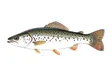
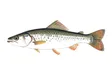
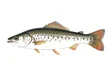
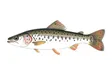
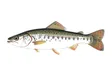
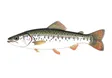
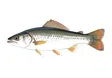
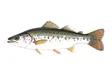
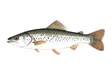
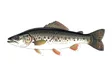
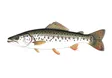
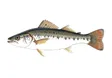
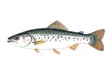
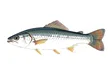
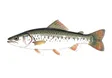
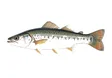
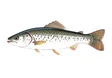
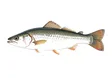
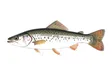
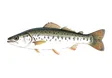
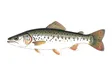
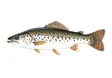
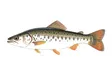
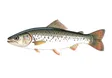
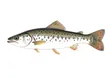
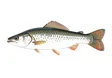
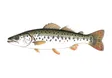
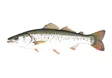
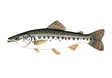
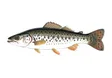
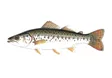
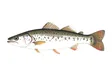
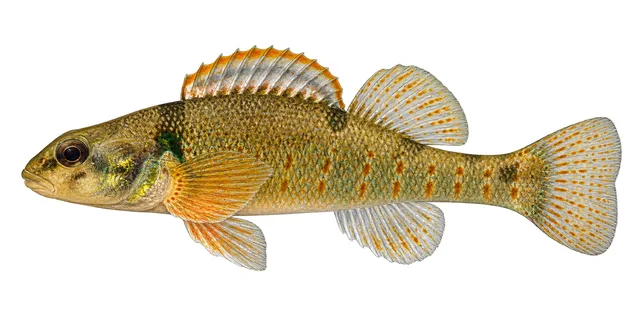
Variegate Darter field guide illustration

About Variegate Darter

Etheostoma variatum, the variegate darter, is a species of freshwater ray-finned fish, a darter from the subfamily Etheostomatinae, part of the family Percidae, which also contains the perches, ruffes and pikeperches. It is native to the eastern United States where it occurs primarily in the Ohio River basin; it is present in the states of Ohio, New York, Pennsylvania, Indiana, West Virginia and Kentucky with a small population in Virginia. It is a large darter, growing to 10 cm (4 in) long, orange-red with black vertical barring on its body, and horizontal barring on its front dorsal fin. Its typical habitat is swift-flowing riffles with rubble, boulder and gravel. No major threats have been identified for this fish and the International Union for Conservation of Nature has assessed its conservation status as being of "least concern".

Description

Etheostoma variatum is large in size for its family; it has an average length of between two and a half and three and a half inches (6 and 9 cm). It has a wide variety of markings. There is a red-orange band on its dorsal fin, which is followed by a blue-green band and a red-brown band at the edge of the fin. There are also red spots located on its other fins.

This darter has large pectoral fins, which are used to keep the fish upright in the fast-moving streams it inhabits. It also has four to six saddles along its back. Three to four of these saddles tend to be dark and visible while the remaining saddles are not.

Habitat

Etheostoma variatum lives in small and medium rivers and streams. They tend to live within riffles that contain small rocks. The darter will tend to live in the fastest flowing riffles. In order to survive, it needs rivers and streams with high water quality. Due to this attribute, the fish is often viewed as an indicator of good water quality.

The darter lives predominantly in the states of Ohio, New York, Pennsylvania, Indiana, West Virginia and Kentucky. It has also been found within Virginia, although only rarely.

Diet

The diet of E. variatum consists of crustaceans, insect larvae and other aquatic invertebrates.

Reproduction

During the early spring, males establish spawning territory, which will occur from April to May. After spawning, the eggs are laid in riffles by females, who will bury them with pebbles. After the eggs are buried, they are abandoned by the parents.

Status

The population trend of this fish seems to be stable and it is a common species with numerous sub-populations over a wide range, and the International Union for Conservation of Nature has assessed its conservation status as being of "least concern".

Article text: Wikipedia contributors, Etheostoma variatum (source revision). Licensed under CC BY-SA 4.0. Retrieved 2026-10-11.
Diet and feeding

The FishTraits compilation records these diet categories for this species: invertebrates or larval fish. These are broad categories, not a claim that every individual consumes every example in a category.

Reported feeding positions include bottom feeding. The compilation combines published observations; diets can vary with age, locality, and available food.

Habitat preferences

Reported habitat associations include medium to large rivers, streams and small rivers, creeks.

The source records associations with sand, gravel, cobble, boulders. An association indicates reported use, rather than an exclusive requirement.

Reproduction and parental care

The compilation reports a representative maturity age of 2 years. Its maturity field summarizes mean, median, or modal estimates, usually for females; male estimates can be used when female data are unavailable. It is not a fixed age at which every fish first breeds.

Recorded spawning months are Apr, May for the source’s reporting region (OH). This is a regional calendar, not a range-wide schedule.

The reproductive-guild classification includes hiding a brood without subsequent guarding.

Size and recorded longevity

FishTraits reports a maximum total length of 11 centimetres. Some entries use an estimated asymptotic length; this value should not be treated as a certified record catch.

Recorded longevity in the compilation is 3 years. Wild observations were preferred, but captive records were accepted where wild records were unavailable, and unspecified records were assumed wild. The value is not a guaranteed wild lifespan or an aquarium life expectancy.

Range

Where it lives

Share of 1,704 GBIF observation records with a state location, across 8 states. The orange dots are USGS stream-survey sites where this species was caught.
0%
42.2%
Share of 1,704 GBIF observation records with a state location, across 8 states. The orange dots are USGS stream-survey sites where this species was caught.

A blank area on the dot layer usually means nobody sampled there, not that the fish is absent. Turn on “every survey site” to see where the survey looked.

The USGS stream survey caught it at 259 of its sites, in 7 states. That survey and the GBIF records are two different counts of two different things, so the site keeps them apart.

Habitat

Water and movement

Water
WoRMS records this species in fresh water.
USGS NAS habitat
Freshwater
US status
Native transplant — native to part of the United States, moved to other waters inside it.
Migration
Migratory
Pattern

Classification

Taxonomy

Kingdom
Animalia
Phylum
Chordata
Superclass
Actinopterygii
Class
Teleostei
Order
Perciformes
Family
Percidae
Genus
Etheostoma
Species
Etheostoma variatum
ITIS TSN
168446
WoRMS AphiaID
1022350
GBIF key
2382344

Common questions about Variegate Darter

What is the scientific name of Variegate Darter?
The scientific name is Etheostoma variatum, in the family Percidae. Classification follows ITIS.
Does Variegate Darter live in fresh water or salt water?
WoRMS records this species in fresh water.
Where has Variegate Darter been recorded in the United States?
GBIF has observations in 8 states, with the most records in Ohio, Kentucky, West Virginia. The map shows observation records, which do not establish the complete natural range.

Closest relatives

Other Etheostoma species

Same family

More Percidae

All 229 species in Percidae