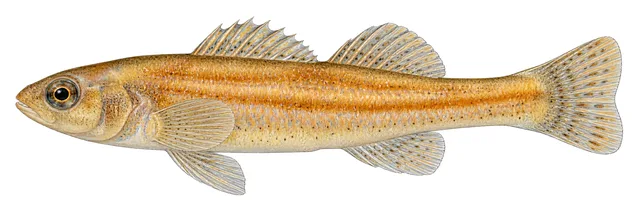
Trispot Darter

Etheostoma trisella

Percidae · freshwater water fish

4 minute read · Species guide

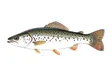
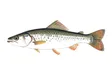
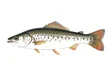
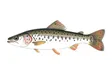
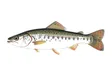
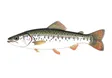
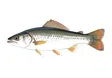
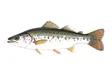
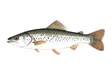
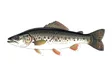
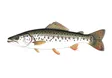
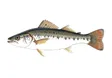
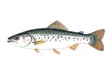
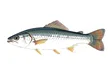
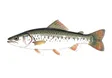
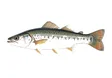
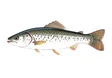
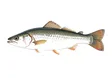
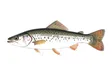
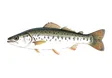
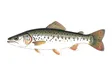
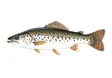
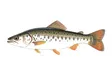
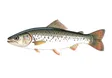
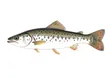
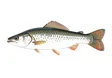
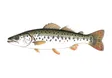
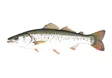
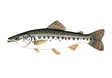
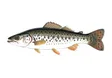
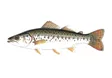
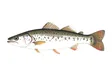
Trispot Darter field guide illustration

About Trispot Darter

The trispot darter (Etheostoma trisella) is a species of freshwater ray-finned fish, a darter from the subfamily Etheostomatinae, part of the family Percidae, which also contains the perches, ruffes and pikeperches. It is endemic to northern Georgia and southern Tennessee in the United States, where it occurs in the Conasauga River and its tributaries and historically in the Alabama River system. It requires two interconnecting habitats; outside the breeding season it occupies the peripheral zones of the main river, with slow-moving water and silt gravel substrates with vegetation cover; during the breeding season it moves to warmer water with a clay-bottomed substrate with much vegetation. The population of this fish is declining due to loss of suitable habitat because of stream impoundment and land development. The International Union for Conservation of Nature has assessed its conservation status as being "vulnerable".

Distribution

The trispot darter is endemic to the Conasauga River and its tributaries located in northern Georgia and southern Tennessee. The species was thought to be extinct from its historical range for seven years, until a specimen was found in north Georgia in 1967. The historical range was in the Alabama River system and as far south as the Coosa River, and in some Georgia rivers. The species also was found in a reservoir, Lake Weiss. Other recent efforts to find the darter have not been successful; it is now only found in the Conasauga and in Alabama's Big Canoe Creek. The reason for the decline in distribution is thought to be due to human impact and development. Silt in water affects egg survival, and correct water temperature is vital for the species' breeding. The Conasauga River offers the critical, undisturbed habitat for the species.

Habitat and ecology

E. trisella requires two separate but interconnected habitats. When not breeding, it occupies the peripheral zones of the main river, with slow-moving water and silt gravel substrates with vegetation cover. The breeding habitat is much warmer water (water at 12 °C (54 °F) is best for egg maturation), and usually is a clay-bottomed substrate with heavy vegetation seepage.

Chironomidae larvae account for 70% of the diet of this darter; Ephemeroptera nymphs account for another 19%, as measured by examining the fish's stomach contents. The species coexists with several other species in its habitat, such as the central stoneroller (Campostoma anomalum), southern studfish (Fundulus stellifer), and Coosa darter (Etheostoma coosae). The species' only real competitor is the Coosa darter, because its mouth size and body length allow it to be a threat for food and space. The main natural predators of the species are from the black basses (genus Micropterus). The average standard length of the fish is 35 millimeters (1.4 in).

Life history

The trispot darter has an average life span around 2.5 years.

They spawn around January through March, when males' skin becomes brilliantly pigmented. The skin color is thought to attract mates. Egg clutch numbers vary from 50 to 300 eggs per female.

Conservation and management

The species is listed as being threatened with extinction and is on the decline. Loss of habitat through land development and stream impoundment is the primary reason for the species' decline.

Article text: Wikipedia contributors, Trispot darter (source revision). Licensed under CC BY-SA 4.0. Retrieved 2026-10-11.
Diet and feeding

The FishTraits compilation records these diet categories for this species: invertebrates or larval fish. These are broad categories, not a claim that every individual consumes every example in a category.

Reported feeding positions include bottom feeding and surface or water-column feeding. The compilation combines published observations; diets can vary with age, locality, and available food.

Habitat preferences

Reported habitat associations include streams and small rivers, creeks, springs or subterranean waters.

The source records associations with vegetation, organic debris, large woody material. An association indicates reported use, rather than an exclusive requirement.

Reproduction and parental care

The compilation reports a representative maturity age of 1 years. Its maturity field summarizes mean, median, or modal estimates, usually for females; male estimates can be used when female data are unavailable. It is not a fixed age at which every fish first breeds.

Batch or serial spawning has been reported somewhere in the species’ range. This does not establish the same spawning pattern for every population.

Recorded spawning months are Jan, Feb, Mar, Apr, Nov, Dec for the source’s reporting region (TN). This is a regional calendar, not a range-wide schedule.

The reproductive-guild classification includes spawning on open substrates without guarding the brood.

Size and recorded longevity

FishTraits reports a maximum total length of 4.9 centimetres. Some entries use an estimated asymptotic length; this value should not be treated as a certified record catch.

Recorded longevity in the compilation is 2.5 years. Wild observations were preferred, but captive records were accepted where wild records were unavailable, and unspecified records were assumed wild. The value is not a guaranteed wild lifespan or an aquarium life expectancy.

Spawning movements

The compilation records significant spawning-related movement. Its combined migration flag covers movements within fresh water as well as between rivers and the sea; this flag alone does not establish which migration pattern applies.

Range

Where it lives

Share of 108 GBIF observation records with a state location, across 3 states.
0%
38.9%
Share of 108 GBIF observation records with a state location, across 3 states.

Share of records by state

Habitat

Water and movement

Water
WoRMS records this species in fresh water.
Migration
Undetermined

Classification

Taxonomy

Kingdom
Animalia
Phylum
Chordata
Superclass
Actinopterygii
Class
Teleostei
Order
Perciformes
Family
Percidae
Genus
Etheostoma
Species
Etheostoma trisella
ITIS TSN
168444
WoRMS AphiaID
1013619
GBIF key
2382382

Common questions about Trispot Darter

What is the scientific name of Trispot Darter?
The scientific name is Etheostoma trisella, in the family Percidae. Classification follows ITIS.
Does Trispot Darter live in fresh water or salt water?
WoRMS records this species in fresh water.
Where has Trispot Darter been recorded in the United States?
GBIF has observations in 3 states, with the most records in Georgia, Alabama, Tennessee. The map shows observation records, which do not establish the complete natural range.

Closest relatives

Other Etheostoma species

Same family

More Percidae

All 229 species in Percidae