Swannanoa Darter

Etheostoma swannanoa

Percidae · freshwater water fish

5 minute read · Species guide

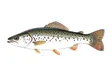
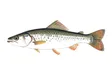
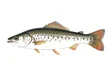
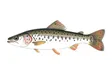
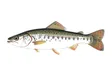
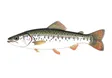
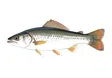
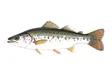
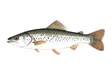
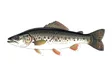
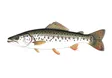
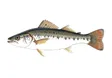
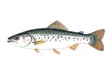
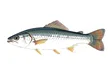
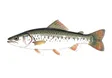
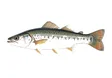
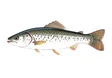
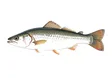
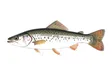
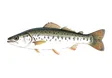
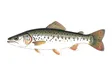
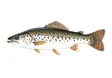
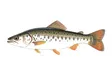
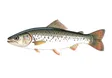
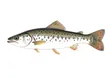
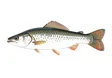
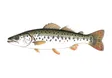
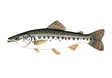
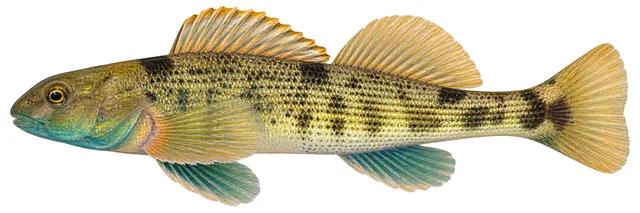
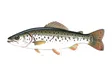
Swannanoa Darter field guide illustration

About Swannanoa Darter

The Swannanoa darter (Etheostoma swannanoa) is a species of freshwater ray-finned fish, a darter from the subfamily Etheostomatinae, part of the family Percidae, which also contains the perches, ruffes and pikeperches. It is endemic to the eastern United States where it occurs in the drainage of the Tennessee River. It prefers flowing water in riffles in cool, clear mountain streams, with boulder substrates. The diet and natural history of this species have been little studied but are probably similar to those of its close relative, the greenside darter (Etheostoma blenniodies). The population trend of this fish seems to be stable and it is a common species with numerous sub-populations over its limited range, and the International Union for Conservation of Nature has assessed its conservation status as being of "least concern".

Distribution

The Swannanoa darter has a relatively limited distribution compared to some other etheostomid darters. It can be found in the southern Appalachian Mountain headwaters of the Tennessee River and other areas in East Tennessee, Southwest Virginia, and Western North Carolina. It is found in the Clinch and Powell River systems in Virginia and through the upper Holston and French Broad River systems along the Tennessee, Virginia, and North Carolina borders. Although it has been documented in the Clinch and Powell River systems in Virginia, it is not found in these same systems in Tennessee. E. swannanoa was found only sporadically in the Tennessee River headwaters and specifically in the Clinch, Holston, Watauga, and Nolichucky Rivers. It prefers cold, clear water with boulder substrates.

Ecology

The Swannanoa darter prefers flowing water in riffles pools in cool, clear mountain streams. For the greenside darter (Etheostoma blenniodies), a close relative of the Swannanoa darter found in similar areas, juveniles mostly eat midge larvae and microcrustaceans. Adults have more varied diets, primarily made up of mayflies and caddisflies. Adults also eat midge, black fly, and other aquatic insect larvae. In some areas, such as the Little River of Tennessee, adults ate many Leptoxis spp. snails. Feeding intensity is much less in winter and greatest in May and June. Juvenile specimens were lacking in summer and early fall collections. This suggests the juvenile habitat is different from the adult habitat. Pollution from mining operations and the impoundment of streams and rivers throughout the Swannanoa darter's range has possibly resulted in declines in distribution.

Lifecycle

Unfortunately, not much is known about the lifecycle of Swannanoa darters compared to some other members of the genus Etheostoma. The breeding season of the Swannanoa darter is in early spring, and has been observed to occur on 2 April. Greenside darters also spawn in early spring, when water temperatures reach 50–53 °F (10–12 °C) and this is probably similar to the time when Swannanoa darters breed. Swannanoa darters spawn on variable substrates, and these may include vegetation, sand, or rock substrates. Sexual maturity is usually achieved at about one year of age, and growth is rapid. Lengths of about 45 mm (1.8 in) are achieved after the first year of growth, as well. Adults can reach up to 90 mm (3.5 in) in length. Greenside darters, which share many lifecycle characteristics with Swannanoa darters, usually live for about five years.

Management

Currently, little to no active management is used specifically for the Swannanoa darter. Trout, which are often associated with Swannanoa darters, drive much of the current management of the streams and rivers where these darters are found because of their recreational and economic value in the southern Appalachian Mountains. Much of the current range of the Swannanoa darter lies within protected areas in national forests and parks, but any activity that increases sedimentation or decreases water flow could negatively impact this species. Activities with a potential for negative effects include careless logging, mining, development, and impoundment of streams and rivers. In the lower elevations and larger water bodies where these darters are found, pollution and contaminants could also pose problems for this species. The use of streamside management zones (SMZs), an excellent management practice used to protect stream health and water quality, in turn benefits these darters. Water quality monitoring, including water chemistry, temperature and dissolved oxygen, would be helpful to obtain baseline data and monitor for possible negative trends. Due to the lack of research on E. swannanoa, current management should also include research to gain knowledge on specific habitat needs for this fish.

Article text: Wikipedia contributors, Swannanoa darter (source revision). Licensed under CC BY-SA 4.0. Retrieved 2026-10-11.
Diet and feeding

The FishTraits compilation records these diet categories for this species: invertebrates or larval fish. These are broad categories, not a claim that every individual consumes every example in a category.

Reported feeding positions include bottom feeding. The compilation combines published observations; diets can vary with age, locality, and available food.

Habitat preferences

Reported habitat associations include medium to large rivers, streams and small rivers, creeks.

The source records associations with gravel, cobble, boulders. An association indicates reported use, rather than an exclusive requirement.

Reproduction and parental care

The compilation reports a representative maturity age of 1.5 years. Its maturity field summarizes mean, median, or modal estimates, usually for females; male estimates can be used when female data are unavailable. It is not a fixed age at which every fish first breeds.

Batch or serial spawning has been reported somewhere in the species’ range. This does not establish the same spawning pattern for every population.

Recorded spawning months are Apr for the source’s reporting region (NC). This is a regional calendar, not a range-wide schedule.

The reproductive-guild classification includes hiding a brood without subsequent guarding.

Size and recorded longevity

FishTraits reports a maximum total length of 9 centimetres. Some entries use an estimated asymptotic length; this value should not be treated as a certified record catch.

Recorded longevity in the compilation is 3.5 years. Wild observations were preferred, but captive records were accepted where wild records were unavailable, and unspecified records were assumed wild. The value is not a guaranteed wild lifespan or an aquarium life expectancy.

Range

Where it lives

Share of 590 GBIF observation records with a state location, across 3 states. The orange dots are USGS stream-survey sites where this species was caught.
0%
70.8%
Share of 590 GBIF observation records with a state location, across 3 states. The orange dots are USGS stream-survey sites where this species was caught.

A blank area on the dot layer usually means nobody sampled there, not that the fish is absent. Turn on “every survey site” to see where the survey looked.

The USGS stream survey caught it at 66 of its sites, in 3 states. That survey and the GBIF records are two different counts of two different things, so the site keeps them apart.

Habitat

Water and movement

Water
WoRMS records this species in fresh water.
Migration
Undetermined

Classification

Taxonomy

Kingdom
Animalia
Phylum
Chordata
Superclass
Actinopterygii
Class
Teleostei
Order
Perciformes
Family
Percidae
Genus
Etheostoma
Species
Etheostoma swannanoa
ITIS TSN
168440
WoRMS AphiaID
1019687
GBIF key
2382225

Common questions about Swannanoa Darter

What is the scientific name of Swannanoa Darter?
The scientific name is Etheostoma swannanoa, in the family Percidae. Classification follows ITIS.
Does Swannanoa Darter live in fresh water or salt water?
WoRMS records this species in fresh water.
Where has Swannanoa Darter been recorded in the United States?
GBIF has observations in 3 states, with the most records in North Carolina, Tennessee, Virginia. The map shows observation records, which do not establish the complete natural range.

Closest relatives

Other Etheostoma species

Same family

More Percidae

All 229 species in Percidae