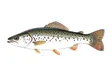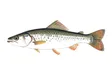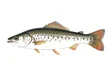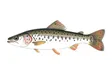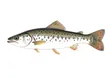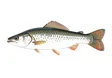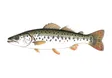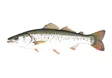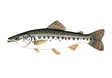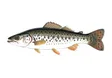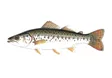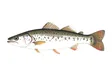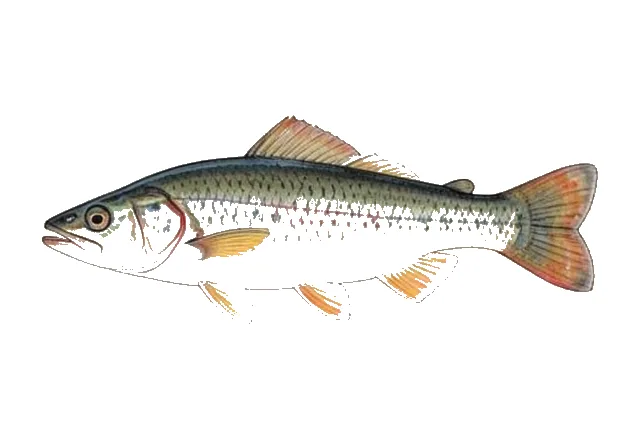
Candy Darter

Etheostoma osburni

Percidae · freshwater water fish

3 minute read · Species guide

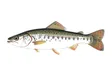
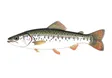
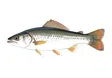
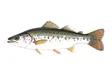
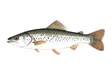
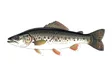
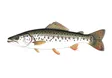
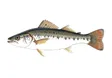
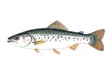
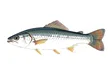
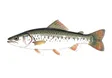
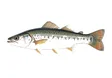
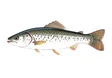
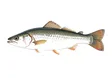
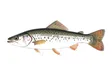
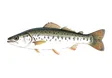
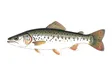
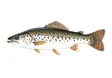
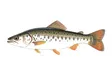
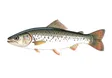
Candy Darter field guide illustration

About Candy Darter

Etheostoma osburni, the candy darter or finescale saddled darter, is a species of fish in the family Percidae, a member of the group known as darters. This species is endemic to the eastern United States where it is known only from the Kanawha River system in the states of Virginia and West Virginia.

Description and natural history

E. osburni can reach a length of 10 cm (3.9 in), though most only reach about 7.3 cm (2.9 in). This species has a lifespan of up to three years. It spawns in April and May. It is an invertivore, feeding on aquatic insect larvae and water mites.

Habitat and geographic distribution

E. osburni lives in a system of rivers, streams, and creeks in the central Appalachian Mountains. It can be found in rapid riffles in rocky riverbed habitat. It occurs in cold, cool, and warm waters, as long as the substrate is rocky and the water is clear. It tolerates fast currents.

Conservation

E. osburni has a limited geographic range, it has been recorded in more than 10 locations and does not have a severely fragmented distribution, so it has been designated a near-threatened species on the IUCN Red List. In 2018, US Fish and Wildlife Service designated it as a federally protected endangered species. It is probably declining, however, due to threats from human activity. It prefers clear, unsilted waters, and increases in silt and sediment may reduce populations by reducing tolerable habitat.

Taxonomy and etymology

E. osburni was first formally described as Poecilichthys osburni in 1932 by the American ichthyologists Carl Leavitt Hubbs and Milton Bernhard Trautman with the type locality given as Stony Creek which is a tributary of the Greenbrier River in Pocahontas County, West Virginia. The specific name honors the American zoologist Raymond Carroll Osburn (1872–1955). The candy darter is considered to be closely related to the variegate darter (E. variatum).

In popular culture

In 2023 E. osburni was featured on a United States Postal Service forever stamp as part of the Endangered Species set, based on a photograph from Joel Sartore's Photo Ark. The stamp was dedicated at a ceremony at the National Grasslands Visitor Center in Wall, South Dakota.

Article text: Wikipedia contributors, Etheostoma osburni (source revision). Licensed under CC BY-SA 4.0. Retrieved 2026-10-11.
Diet and feeding

The FishTraits compilation records these diet categories for this species: invertebrates or larval fish. These are broad categories, not a claim that every individual consumes every example in a category.

Reported feeding positions include bottom feeding. The compilation combines published observations; diets can vary with age, locality, and available food.

Habitat preferences

Reported habitat associations include medium to large rivers, streams and small rivers, creeks.

The source records associations with gravel, cobble, boulders, bedrock. An association indicates reported use, rather than an exclusive requirement.

Reproduction and parental care

The compilation reports a representative maturity age of 2 years. Its maturity field summarizes mean, median, or modal estimates, usually for females; male estimates can be used when female data are unavailable. It is not a fixed age at which every fish first breeds.

Recorded spawning months are Apr, May, Jun for the source’s reporting region (VA). This is a regional calendar, not a range-wide schedule.

The reproductive-guild classification includes hiding a brood without subsequent guarding.

Size and recorded longevity

FishTraits reports a maximum total length of 10 centimetres. Some entries use an estimated asymptotic length; this value should not be treated as a certified record catch.

Recorded longevity in the compilation is 3 years. Wild observations were preferred, but captive records were accepted where wild records were unavailable, and unspecified records were assumed wild. The value is not a guaranteed wild lifespan or an aquarium life expectancy.

Range

Where it lives

Share of 106 GBIF observation records with a state location, across 2 states.
0%
55.7%
Share of 106 GBIF observation records with a state location, across 2 states.

Share of records by state

Habitat

Water and movement

Water
WoRMS records this species in fresh water.
Migration
Undetermined

Classification

Taxonomy

Kingdom
Animalia
Phylum
Chordata
Superclass
Actinopterygii
Class
Teleostei
Order
Perciformes
Family
Percidae
Genus
Etheostoma
Species
Etheostoma osburni
ITIS TSN
168419
WoRMS AphiaID
1525436
GBIF key
2382323

Common questions about Candy Darter

What is the scientific name of Candy Darter?
The scientific name is Etheostoma osburni, in the family Percidae. Classification follows ITIS.
Does Candy Darter live in fresh water or salt water?
WoRMS records this species in fresh water.
Where has Candy Darter been recorded in the United States?
GBIF has observations in 2 states, with the most records in West Virginia, Virginia. The map shows observation records, which do not establish the complete natural range.

Closest relatives

Other Etheostoma species

Same family

More Percidae

All 229 species in Percidae