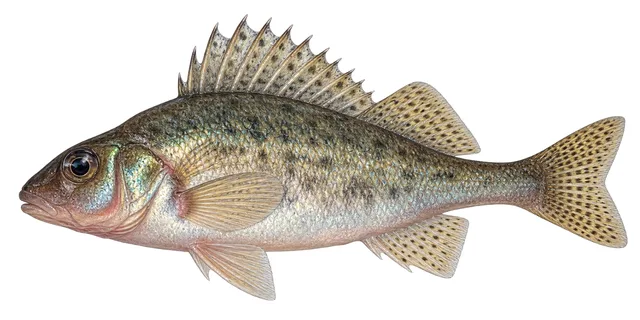
Ruffe

Gymnocephalus cernuus

Percidae · freshwater and brackish water fish

2 minute read · Species guide

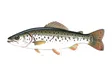
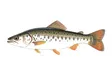
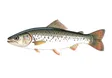
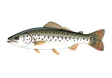
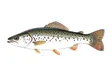
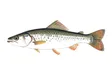
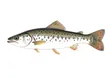
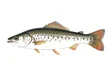
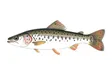
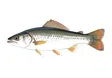
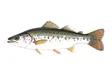
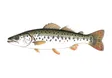
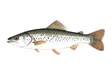
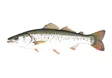
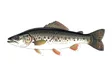
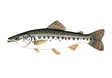
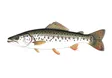
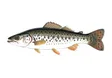
Ruffe field guide illustration

About Ruffe

Ruffe are bottom-feeding fish recorded from both flowing and still freshwater habitats.

Natural history

The FishTraits compilation associates them with silt, sand, and gravel and records invertebrates and eggs among the broad food categories. This makes the river or lake bed an important part of their feeding environment. The compilation’s broad salinity-tolerance flag does not provide a precise limit for every population.

Reproduction is classified as egg laying on open substrates without brood guarding. Reported spawning movement and repeated spawning indicate a life cycle involving more than a single stationary nesting event. The Wisconsin calendar in this dataset covers April through June and should remain a regional observation.

Sources: FishTraits: ecological and life-history traits

Guide sources

Research reviewed 2026-10-19.

Diet and feeding

The FishTraits compilation records these diet categories for this species: invertebrates or larval fish; fish or frog eggs. These are broad categories, not a claim that every individual consumes every example in a category.

Reported feeding positions include bottom feeding. The compilation combines published observations; diets can vary with age, locality, and available food.

Habitat preferences

Reported habitat associations include streams and small rivers, still-water habitats.

The source records associations with clay or silt, sand, gravel. An association indicates reported use, rather than an exclusive requirement.

The species is classified as tolerant of a broad range of salinities. This flag does not specify a salinity range for aquarium care.

Reproduction and parental care

The compilation reports a representative maturity age of 1.5 years. Its maturity field summarizes mean, median, or modal estimates, usually for females; male estimates can be used when female data are unavailable. It is not a fixed age at which every fish first breeds.

Batch or serial spawning has been reported somewhere in the species’ range. This does not establish the same spawning pattern for every population.

Recorded spawning months are Apr, May, Jun for the source’s reporting region (WI). This is a regional calendar, not a range-wide schedule.

The reproductive-guild classification includes spawning on open substrates without guarding the brood.

Size and recorded longevity

FishTraits reports a maximum total length of 25 centimetres. Some entries use an estimated asymptotic length; this value should not be treated as a certified record catch.

Recorded longevity in the compilation is 9 years. Wild observations were preferred, but captive records were accepted where wild records were unavailable, and unspecified records were assumed wild. The value is not a guaranteed wild lifespan or an aquarium life expectancy.

Spawning movements

The compilation records significant spawning-related movement. Its combined migration flag covers movements within fresh water as well as between rivers and the sea; this flag alone does not establish which migration pattern applies.

Range

Where it lives

Share of 55 GBIF observation records with a state location, across 3 states.
0%
38.2%
Share of 55 GBIF observation records with a state location, across 3 states.

Habitat

Water and movement

Water
WoRMS records this species in fresh water and brackish water.
USGS NAS habitat
Freshwater
US status
Exotic — the USGS Nonindigenous Aquatic Species database lists it as introduced from outside North America.
Migration
Migratory
Pattern

Classification

Taxonomy

Kingdom
Animalia
Phylum
Chordata
Superclass
Actinopterygii
Class
Teleostei
Order
Perciformes
Family
Percidae
Genus
Gymnocephalus
Species
Gymnocephalus cernuus
ITIS TSN
168520
WoRMS AphiaID
151302
GBIF key
5209574

Common questions about Ruffe

What is the scientific name of Ruffe?
The scientific name is Gymnocephalus cernuus, in the family Percidae. Classification follows ITIS.
Does Ruffe live in fresh water or salt water?
WoRMS records this species in fresh water and brackish water.
Where has Ruffe been recorded in the United States?
GBIF has observations in 3 states, with the most records in Minnesota, Wisconsin, Michigan. The map shows observation records, which do not establish the complete natural range.

Same family

More Percidae

All 229 species in Percidae