Fallfish

Semotilus corporalis

Leuciscidae · freshwater water fish

4 minute read · Species guide

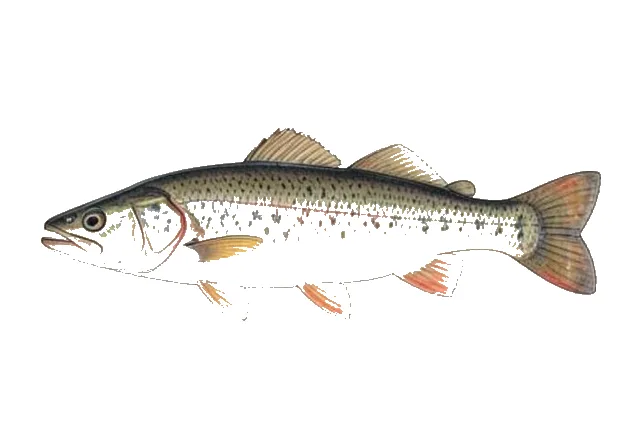
Fallfish field guide illustration

About Fallfish

The fallfish (Semotilus corporalis) is a species of freshwater ray-finned fish in the family Leuciscidae. The fallfish is the largest minnow species native to Eastern North America.

Description

Average specimens generally measure about 7 in (18 cm) in length, but individuals occasionally grow to 15 in (38 cm) with exceptional specimens of more than 19 in (48 cm) having been recorded. Juvenile fallfish have a dark stripe that runs down the center of their body. They are a silvery shade on the top and sides of the body, but have a white shading on the belly. Breeding males develop a pinkish tone on the opercular region, although the species does not develop bright breeding colors. Spawning males build stone nests, known as a redd, which form a prominent part of the bottom on many streams throughout the northeast. Spawning is communal with both males and females joining the nest builder.

Distribution and habitat

Fallfish are found in the northeastern United States and eastern Canada, where they inhabit clear streams, lakes, and ponds. They predominantly prefer swift currents, however, they can also be found in well oxygenated pools. As their name suggests they are often found at the base of waterfalls. Before the introduction of fish such as smallmouth bass, largemouth bass, and brown trout, the fallfish was the apex predator in many streams.

Diet and predation

Juvenile and young fallfish primarily consume chironomids and zooplankton. Once they reach 100mm their diet transitions to small fish (including their own young) and prey of opportunity such as fish eggs and terrestrial insects. There is little overlap between the diets of juvenile and adult fallfish.

Angling

Fallfish are often encountered when fishing for more desirable species, but their large size, dogged fighting style, powerful runs on light tackle, and willingness to strike make them a worthy quarry in their own right. They will readily take bait, lures, and flies, and have been known to strike lures almost as large as themselves.

The International Game Fish Association (IGFA) All Tackle World Record for fallfish is 1.65 kg (3 lb 10 oz), caught by Jonathan McNamara in the Susquehanna River near Owego, New York, USA on April 15, 2009. The record was tied on May 6, 2022, by angler Josh D. Dolin while fishing the Cowpasture River near Williamsville, Virginia. Two heavier, more recent, record fish from this river are currently pending, which will take the former record to 4.0 lb (1.81 kg). Previous records came from New Hampshire and Pennsylvania. Alex Pidhorodeckyj caught a record-breaking fallfish weighing 4 lbs. 1 oz. from the St. Lawrence River, St. Lawrence County on May 13, 2025. This broke the 16-year-old record caught from the Susquehanna River by nearly half a pound.

Thoreau said of its eating qualities: "it tastes of brown paper, salted."

Article text: Wikipedia contributors, Fallfish (source revision). Licensed under CC BY-SA 4.0. Retrieved 2026-10-11.
Diet and feeding

The FishTraits compilation records these diet categories for this species: algae or phytoplankton; detritus or unidentified plant material; invertebrates or larval fish; larger animal prey (a source category covering fish, crayfish, crabs, or frogs). These are broad categories, not a claim that every individual consumes every example in a category.

Reported feeding positions include bottom feeding and surface or water-column feeding. The compilation combines published observations; diets can vary with age, locality, and available food.

Habitat preferences

Reported habitat associations include medium to large rivers, streams and small rivers, still-water habitats.

The source records associations with sand, gravel, cobble, boulders, bedrock. An association indicates reported use, rather than an exclusive requirement.

Reproduction and parental care

The compilation reports a representative maturity age of 2.5 years. Its maturity field summarizes mean, median, or modal estimates, usually for females; male estimates can be used when female data are unavailable. It is not a fixed age at which every fish first breeds.

Recorded spawning months are Apr, May for the source’s reporting region (VA). This is a regional calendar, not a range-wide schedule.

The reproductive-guild classification includes hiding a brood without subsequent guarding.

Size and recorded longevity

FishTraits reports a maximum total length of 51 centimetres. Some entries use an estimated asymptotic length; this value should not be treated as a certified record catch.

Recorded longevity in the compilation is 9 years. Wild observations were preferred, but captive records were accepted where wild records were unavailable, and unspecified records were assumed wild. The value is not a guaranteed wild lifespan or an aquarium life expectancy.

Identification and appearance

Fallfish are similar in appearance to the Creek Chubs (S. atromaculatus). Creek chubs have a black spot at the front of the dorsal fin base and have a smaller eye and less of the distinction in the scales outlining (Page and Burr 2011).

Smith (1985); Jenkins and Burkhead (1994).

Native range

Atlantic Slope from New Brunswick to James River drainage, Virginia; Hudson Bay, Lake America, and St. Lawrence drainages, Quebec, Ontario, and New York (Page and Burr 2011).

Habitat and ecology

Fallfish are associated with medium-sized and larger streams with sandy bottoms (Carlson et al. 2016).

Introduction history

Smith did not speculate or provide details on its method of introduction into Tonawanda Creek, New York; that population may also have originated through bait bucket release. Jenkins and Burkhead (1994) strongly suspected that the source of the Falling River population in Virginia started with fish introduced from the adjacent James drainage. Presumably these introductions were a result of bait bucket release as well. Illegally introduced into California (Moyle 1976a).

Range

Where it lives

Share of 5,149 GBIF observation records with a state location, across 22 states. The orange dots are USGS stream-survey sites where this species was caught.
0%
30.6%
Share of 5,149 GBIF observation records with a state location, across 22 states. The orange dots are USGS stream-survey sites where this species was caught.

A blank area on the dot layer usually means nobody sampled there, not that the fish is absent. Turn on “every survey site” to see where the survey looked.

The USGS stream survey caught it at 1,543 of its sites, in 13 states. That survey and the GBIF records are two different counts of two different things, so the site keeps them apart.

Habitat

Water and movement

Water
WoRMS records this species in fresh water.
USGS NAS habitat
Freshwater
US status
Native transplant — native to part of the United States, moved to other waters inside it.
Migration
Undetermined
Pattern

Classification

Taxonomy

Kingdom
Animalia
Phylum
Chordata
Superclass
Actinopterygii
Class
Teleostei
Order
Cypriniformes
Genus
Semotilus
Species
Semotilus corporalis
ITIS TSN
163375
WoRMS AphiaID
1026490
GBIF key
2360492
Outside the US
ITIS also files it in Canada.

Common questions about Fallfish

What is the scientific name of Fallfish?
The scientific name is Semotilus corporalis, in the family Leuciscidae. Classification follows ITIS.
Does Fallfish live in fresh water or salt water?
WoRMS records this species in fresh water.
Where has Fallfish been recorded in the United States?
GBIF has observations in 22 states, with the most records in New York, Maryland, Pennsylvania. The map shows observation records, which do not establish the complete natural range.

Closest relatives

Other Semotilus species

Same family

More Leuciscidae

Alabama Shiner4 states
Cyprinella callistiaLeuciscidaeNativeFresh
Allegheny Pearl Dace19 states
Margariscus margaritaLeuciscidaeNative and introducedFresh
Altamaha Shiner1 states
Cyprinella xaenuraLeuciscidaeNativeFresh
Alvord Chub2 states
Siphateles alvordensisLeuciscidaeNativeFresh
Apalachee Shiner3 states
Pteronotropis grandipinnisLeuciscidaeNativeFresh
Arkansas River Shiner5 states
Notropis girardiLeuciscidaeNative and introducedFresh
Arroyo Chub1 states
Gila orcuttiiLeuciscidaeNative and introducedFresh
Bandfin Shiner5 states
Luxilus zonistiusLeuciscidaeNative and introducedFresh
Bannerfin Shiner5 states
Cyprinella leedsiLeuciscidaeNativeFresh
Beautiful Shiner3 states
Cyprinella formosaLeuciscidaeNativeFresh
Bedrock Shiner3 states
Notropis rupestrisLeuciscidaeNativeFresh
Bigeye Chub25 states
Hybopsis amblopsLeuciscidaeNative and introducedFresh
Bigeye Shiner17 states
Notropis boopsLeuciscidaeNative and introducedFresh
Bigmouth Chub3 states
Nocomis platyrhynchusLeuciscidaeNativeFresh
Bigmouth Shiner21 states
Notropis dorsalisLeuciscidaeNative and introducedFresh
Blackchin Shiner13 states
Notropis heterodonLeuciscidaeNativeFresh
Blackmouth Shiner3 states
Notropis melanostomusLeuciscidaeNativeFresh
Blacknose Shiner21 states
Notropis heterolepisLeuciscidaeNative and introducedFresh
Blackside Dace2 states
Chrosomus cumberlandensisLeuciscidaeNativeFresh
Blackspot Shiner5 states
Notropis atrocaudalisLeuciscidaeNativeFresh
Blacktail Shiner14 states
Cyprinella venustaLeuciscidaeNative and introducedFresh
Blacktip Shiner4 states
Lythrurus atrapiculusLeuciscidaeNative and introducedFresh
Bleeding Shiner8 states
Luxilus zonatusLeuciscidaeNativeFresh
Blotched Chub6 states
Erimystax insignisLeuciscidaeNativeFresh

All 267 species in Leuciscidae