White River Spinedace

Lepidomeda albivallis

Leuciscidae · freshwater water fish

3 minute read · Species guide

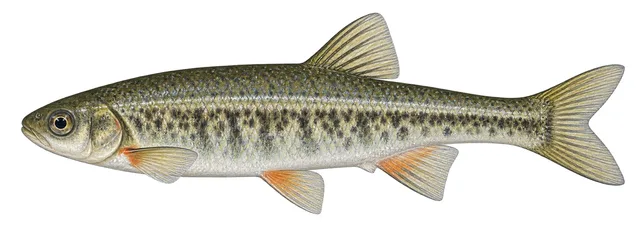
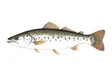
White River Spinedace field guide illustration

About White River Spinedace

The White River spinedace (Lepidomeda albivallis) is a species of freshwater ray-finned fish belonging to the family Leuciscidae, which includes the daces, Eurasian minnows and related species. This critically endangered fish is found in Nevada, where it is restricted to the White River in the southeastern part of the state.

Taxonomy

The White River spinedace was first formally described in 1960 by the American ichthyologists Robert Rush Miller and Carl Leavitt Hubbs with its type locality given as the White River, just below the mouth of Ellison Creek, approximately 5 miles (8.0 km) northwest of Preston in White Pine County, Nevada. This species is included in the genus Lepidomeda which is included in the subfamily Plagopterinae in the family Leuciscidae.

Etymology

The White River spinedace is in the genus Lepidomeda which prefixes lepido- on to the genus name Meda because these fishes resemble the spikedace, the only species in Meda, but they have scales. The specific name, albivallus, combines albus, which means "white", with vallis, meaning "valley", and is a reference to the valley of the White River.

Description

The White River spinedace is a brightly colored fish with the males being vividly metallic green on the back with silver green sides with dusky blotches. The females are similar but less brightly colored. This species has between 79 and 92 scales on its lateral line, the operculum is dotted with dark spots. The dorsal fin and caudal fin are pinkish brown with vermilion bases while the anl and pelvic fins are vermilion. This species has a maximum total length of 15 cm (5.9 in), although 9.8 cm (3.9 in) is a more typical total length.

Distribution and habitat

The White River spinedace is restricted to the catchment of the White River in White Pine and Nye Counties in Nevada. Its range has shrunk so that the only viable population is in the Flag Spring complex and its outflows, within the Wayne E. Kirch WMA. Here it occurs over substrates of sand and gravel with some mud, in shallow areas of 0.5 to 1.5 m (1 ft 8 in to 4 ft 11 in) depth.

Article text: Wikipedia contributors, White River spinedace (source revision). Licensed under CC BY-SA 4.0. Retrieved 2026-10-11.
Diet and feeding

The FishTraits compilation records these diet categories for this species: aquatic or other vascular plants; invertebrates or larval fish. These are broad categories, not a claim that every individual consumes every example in a category.

Reported feeding positions include bottom feeding and surface or water-column feeding. The compilation combines published observations; diets can vary with age, locality, and available food.

Habitat preferences

Reported habitat associations include medium to large rivers, streams and small rivers, springs or subterranean waters.

The source records associations with sand, gravel. An association indicates reported use, rather than an exclusive requirement.

Reproduction and parental care

Recorded spawning months are Apr, May for the source’s reporting region (NV). This is a regional calendar, not a range-wide schedule.

Size and recorded longevity

FishTraits reports a maximum total length of 12.5 centimetres. Some entries use an estimated asymptotic length; this value should not be treated as a certified record catch.

Recorded longevity in the compilation is 9 years. Wild observations were preferred, but captive records were accepted where wild records were unavailable, and unspecified records were assumed wild. The value is not a guaranteed wild lifespan or an aquarium life expectancy.

Native range

Historically in the White River system, Nevada. Most populations are extirpated, and the species now exists only at Flag Springs in Nye County, Nevada (Page and Burr 1991; U.S. Fish and Wildlife Service 1994e).

Introduction history

Reportedly used as bait in 1951 in lower Colorado River (Miller 1952; La Rivers 1962). Transplanted from White River below Adams-McGill Reservoir to Railroad Valley in 1957 by Nevada Department of Wildlife (La Rivers 1962; U.S. Fish and Wildlife Service 1994e).

Range

Where it lives

Share of 51 GBIF observation records with a state location, across 3 states.
0%
94.1%
Share of 51 GBIF observation records with a state location, across 3 states.

Share of records by state

Habitat

Water and movement

Water
WoRMS records this species in fresh water.
USGS NAS habitat
Freshwater
US status
Native transplant — native to part of the United States, moved to other waters inside it.
Migration
Undetermined

Classification

Taxonomy

Kingdom
Animalia
Phylum
Chordata
Superclass
Actinopterygii
Class
Teleostei
Order
Cypriniformes
Genus
Lepidomeda
Species
Lepidomeda albivallis
ITIS TSN
163571
WoRMS AphiaID
1013782
GBIF key
2361898

Common questions about White River Spinedace

What is the scientific name of White River Spinedace?
The scientific name is Lepidomeda albivallis, in the family Leuciscidae. Classification follows ITIS.
Does White River Spinedace live in fresh water or salt water?
WoRMS records this species in fresh water.
Where has White River Spinedace been recorded in the United States?
GBIF has observations in 3 states, with the most records in Nevada, Arizona, California. The map shows observation records, which do not establish the complete natural range.

Closest relatives

Other Lepidomeda species

Same family

More Leuciscidae

Alabama Shiner4 states
Cyprinella callistiaLeuciscidaeNativeFresh
Allegheny Pearl Dace19 states
Margariscus margaritaLeuciscidaeNative and introducedFresh
Altamaha Shiner1 states
Cyprinella xaenuraLeuciscidaeNativeFresh
Alvord Chub2 states
Siphateles alvordensisLeuciscidaeNativeFresh
Apalachee Shiner3 states
Pteronotropis grandipinnisLeuciscidaeNativeFresh
Arkansas River Shiner5 states
Notropis girardiLeuciscidaeNative and introducedFresh
Arroyo Chub1 states
Gila orcuttiiLeuciscidaeNative and introducedFresh
Bandfin Shiner5 states
Luxilus zonistiusLeuciscidaeNative and introducedFresh
Bannerfin Shiner5 states
Cyprinella leedsiLeuciscidaeNativeFresh
Beautiful Shiner3 states
Cyprinella formosaLeuciscidaeNativeFresh
Bedrock Shiner3 states
Notropis rupestrisLeuciscidaeNativeFresh
Bigeye Chub25 states
Hybopsis amblopsLeuciscidaeNative and introducedFresh
Bigeye Shiner17 states
Notropis boopsLeuciscidaeNative and introducedFresh
Bigmouth Chub3 states
Nocomis platyrhynchusLeuciscidaeNativeFresh
Bigmouth Shiner21 states
Notropis dorsalisLeuciscidaeNative and introducedFresh
Blackchin Shiner13 states
Notropis heterodonLeuciscidaeNativeFresh
Blackmouth Shiner3 states
Notropis melanostomusLeuciscidaeNativeFresh
Blacknose Shiner21 states
Notropis heterolepisLeuciscidaeNative and introducedFresh
Blackside Dace2 states
Chrosomus cumberlandensisLeuciscidaeNativeFresh
Blackspot Shiner5 states
Notropis atrocaudalisLeuciscidaeNativeFresh
Blacktail Shiner14 states
Cyprinella venustaLeuciscidaeNative and introducedFresh
Blacktip Shiner4 states
Lythrurus atrapiculusLeuciscidaeNative and introducedFresh
Bleeding Shiner8 states
Luxilus zonatusLeuciscidaeNativeFresh
Blotched Chub6 states
Erimystax insignisLeuciscidaeNativeFresh

All 267 species in Leuciscidae