Little Colorado Spinedace

Lepidomeda vittata

Leuciscidae · freshwater water fish

4 minute read · Species guide

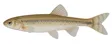
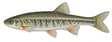
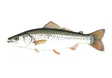
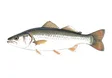
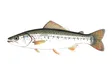
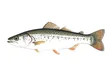
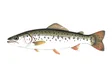
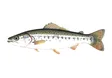
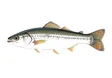
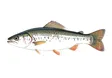
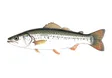
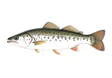
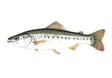
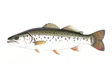
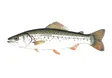
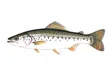
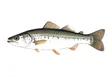
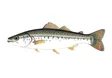
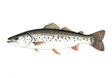
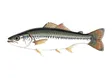
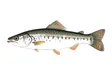
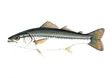
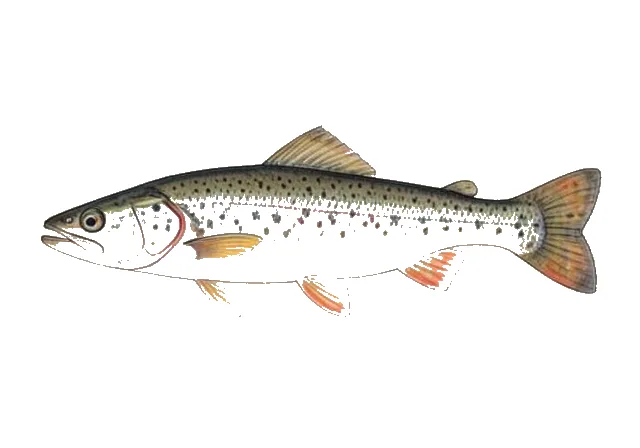
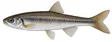
Little Colorado Spinedace field guide illustration

About Little Colorado Spinedace

The Little Colorado spinedace (Lepidomeda vittata) is a species of ray-finned fish in the family Leuciscidae. It is found only in Arizona in the United States.

Description

The Little Colorado spinedace is small, generally less than 10 cm in length. The scales are in a lateral line of usually more than 90. The second spine of the dorsal fin is strong. The dorsal fin is moderately high and acute, and its depressed length is 5.2 to 5.8 cm predorsal length. There are eight anal fin rays, and rarely nine. The pharyngeal teeth are in two rows. The Little Colorado spinedace sides are usually silvery, darker above and sometimes white below, rarely with lateral blotches. The upper side and back are a bit of a bluish or lead grey. The breeding Little Colorado Spinedace males have bases of paired fins watery-yellow to orange or red-orange, otherwise however the fins are clear, and parts of the belly are watery-yellow.

Range

The Little Colorado spinedace is endemic to the Little Colorado River and north-flowing tributaries, flowing through Coconino, Navajo, and Apache Counties of Arizona. The historical distribution is similar to the current distribution but the species may have possibly historically occurred in the Zuni River watershed south of Gallup, New Mexico. The Little Colorado spinedace are now considered extirpated from the Silver Creek and its tributaries.

Four populations of spinedace exist in Arizona with populations still found in the mainstream of Little Colorado, Nutrioso Creek, Clear Creek, as well as Chevelon Creek.

Habitat

The Little Colorado spinedace is found in water ranging from 0.16-1.3 meters in-depth, but most abundant in depths of around 0.6 meters. The fish are most common in slow to moderate water currents, over fine gravel bottoms. They normally avoid deep, heavily shaded pools and shallow, open areas. They generally prefer unshaded pools with rocks or undercut banks for cover. Temperatures where populations exist generally range from 14-26 degrees Celsius. Young of the year are most abundant on uniformly turbulent riffles 10 to 25 cm in depth.

Population trends

Populations of this species fluctuate dramatically from year to year, and probably reflect cyclic periods of drought and/or increased rainfall. Populations are thought to be declining, however, due to alteration of habitat through reduced streamflow and interaction with introduced fish species.

Management factors

Limiting factors include road construction, timber harvest operations, stream gravel removal, and chemical treatment of streams. Additional limiting factors and concerns include decreased streamflow, impoundment of water, and interaction with and predation by, introduced exotic fishes. Predation by rainbow trout has been strongly suggested as an important factor in the success and distribution of L. vittata.

Article text: Wikipedia contributors, Little Colorado spinedace (source revision). Licensed under CC BY-SA 4.0. Retrieved 2026-10-11.
Diet and feeding

The FishTraits compilation records these diet categories for this species: algae or phytoplankton; invertebrates or larval fish. These are broad categories, not a claim that every individual consumes every example in a category.

Reported feeding positions include surface or water-column feeding. The compilation combines published observations; diets can vary with age, locality, and available food.

Habitat preferences

Reported habitat associations include streams and small rivers, creeks.

The source records associations with sand, gravel, cobble, boulders, bedrock. An association indicates reported use, rather than an exclusive requirement.

Reproduction and parental care

The compilation reports a representative maturity age of 1 years. Its maturity field summarizes mean, median, or modal estimates, usually for females; male estimates can be used when female data are unavailable. It is not a fixed age at which every fish first breeds.

Batch or serial spawning has been reported somewhere in the species’ range. This does not establish the same spawning pattern for every population.

Recorded spawning months are May, Jun, Jul, Aug, Sep for the source’s reporting region (AZ). This is a regional calendar, not a range-wide schedule.

The reproductive-guild classification includes spawning on open substrates without guarding the brood.

Size and recorded longevity

FishTraits reports a maximum total length of 15 centimetres. Some entries use an estimated asymptotic length; this value should not be treated as a certified record catch.

Recorded longevity in the compilation is 3 years. Wild observations were preferred, but captive records were accepted where wild records were unavailable, and unspecified records were assumed wild. The value is not a guaranteed wild lifespan or an aquarium life expectancy.

Range

Where it lives

Share of 76 GBIF observation records with a state location, across 2 states.
0%
98.7%
Share of 76 GBIF observation records with a state location, across 2 states.

Share of records by state

Habitat

Water and movement

Water
WoRMS records this species in fresh water.
Migration
Undetermined

Classification

Taxonomy

Kingdom
Animalia
Phylum
Chordata
Superclass
Actinopterygii
Class
Teleostei
Order
Cypriniformes
Genus
Lepidomeda
Species
Lepidomeda vittata
ITIS TSN
163574
WoRMS AphiaID
1020375
GBIF key
2361905

Common questions about Little Colorado Spinedace

What is the scientific name of Little Colorado Spinedace?
The scientific name is Lepidomeda vittata, in the family Leuciscidae. Classification follows ITIS.
Does Little Colorado Spinedace live in fresh water or salt water?
WoRMS records this species in fresh water.
Where has Little Colorado Spinedace been recorded in the United States?
GBIF has observations in 2 states, with the most records in Arizona, Nevada. The map shows observation records, which do not establish the complete natural range.

Closest relatives

Other Lepidomeda species

Same family

More Leuciscidae

Alabama Shiner4 states
Cyprinella callistiaLeuciscidaeNativeFresh
Allegheny Pearl Dace19 states
Margariscus margaritaLeuciscidaeNative and introducedFresh
Altamaha Shiner1 states
Cyprinella xaenuraLeuciscidaeNativeFresh
Alvord Chub2 states
Siphateles alvordensisLeuciscidaeNativeFresh
Apalachee Shiner3 states
Pteronotropis grandipinnisLeuciscidaeNativeFresh
Arkansas River Shiner5 states
Notropis girardiLeuciscidaeNative and introducedFresh
Arroyo Chub1 states
Gila orcuttiiLeuciscidaeNative and introducedFresh
Bandfin Shiner5 states
Luxilus zonistiusLeuciscidaeNative and introducedFresh
Bannerfin Shiner5 states
Cyprinella leedsiLeuciscidaeNativeFresh
Beautiful Shiner3 states
Cyprinella formosaLeuciscidaeNativeFresh
Bedrock Shiner3 states
Notropis rupestrisLeuciscidaeNativeFresh
Bigeye Chub25 states
Hybopsis amblopsLeuciscidaeNative and introducedFresh
Bigeye Shiner17 states
Notropis boopsLeuciscidaeNative and introducedFresh
Bigmouth Chub3 states
Nocomis platyrhynchusLeuciscidaeNativeFresh
Bigmouth Shiner21 states
Notropis dorsalisLeuciscidaeNative and introducedFresh
Blackchin Shiner13 states
Notropis heterodonLeuciscidaeNativeFresh
Blackmouth Shiner3 states
Notropis melanostomusLeuciscidaeNativeFresh
Blacknose Shiner21 states
Notropis heterolepisLeuciscidaeNative and introducedFresh
Blackside Dace2 states
Chrosomus cumberlandensisLeuciscidaeNativeFresh
Blackspot Shiner5 states
Notropis atrocaudalisLeuciscidaeNativeFresh
Blacktail Shiner14 states
Cyprinella venustaLeuciscidaeNative and introducedFresh
Blacktip Shiner4 states
Lythrurus atrapiculusLeuciscidaeNative and introducedFresh
Bleeding Shiner8 states
Luxilus zonatusLeuciscidaeNativeFresh
Blotched Chub6 states
Erimystax insignisLeuciscidaeNativeFresh

All 267 species in Leuciscidae