Banded Sculpin

Cottus carolinae

Cottidae · freshwater water fish

6 minute read · Species guide

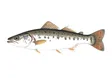
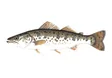
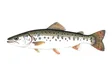
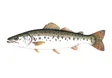
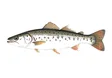
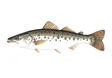
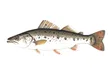
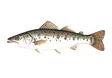
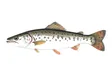
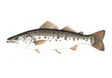
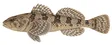
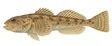
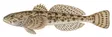
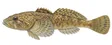
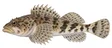
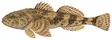
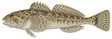
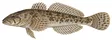
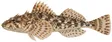
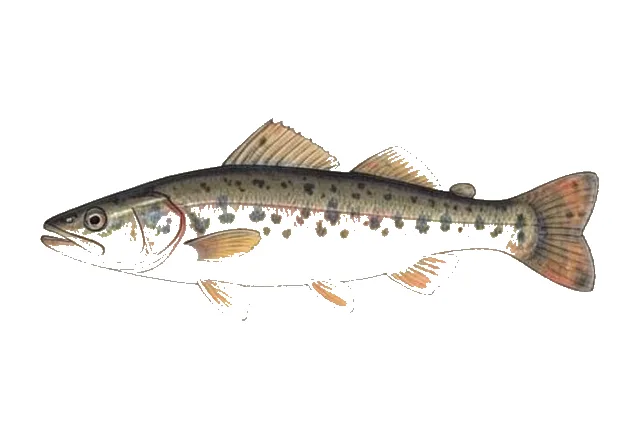
Banded Sculpin field guide illustration

About Banded Sculpin

The banded sculpin (Cottus carolinae) is a freshwater fish dwelling mostly in small to moderate sized streams in areas of swift current. Young and juvenile C. carolinae can mainly be found in pools, riffles, and other shallow habitats while adults tend to prefer deeper waters. C. carolinae primarily eats insects and insect larvae, but their large mouths enable them to eat prey nearly as large as themselves, including other sculpin. To prevent predation, including by other fish, the color and pattern of the sculpin tends to match its environment. Most Cottus carolinae are mottled brown with dark vertical banding and usually reach about three inches in length. They have a broad head which rather quickly narrows into a slim body, giving them the appearance of a tadpole reaching adulthood.

Cottus carolinae has proven to be useful as a representative species for the effects of mining related impacts on fishing communities since it has been proven that their density is negatively correlated with higher metal concentrations from mining. In other areas around the Cumberland Basin, as a benthic fish, the C. carolinae is in danger of increased siltation by area farming. Though the sculpin faces these threats, they are not yet on the list of endangered species.

Distribution

Cottus carolinae is a freshwater species dwelling within the United States. The wide-ranging species occurs in eastern North America west of the Appalachians and south of the Ohio River Valley. The species lives as far south as the mountain streams of Alabama, but prefers the cooler streams of the mid to northern United States.

Habitat

Cottus carolinae usually inhabits streams and rivers with cool, running water. They are a benthic species and prefer stream beds made of sand bedrock, stones, or boulders. C. carolinae partake in size-specific habitat segregation, with the majority of adults in the pools of streams and rivers with the young-of-the-year inhabiting the riffles. Most streams inhabited by the species are less than two meters deep with a velocity between 0.1 and 0.7 meters per second with a standard deviation of + or -.2 meters per second.

The species is sometimes found in caves, but such individuals generally resemble the aboveground population and may only be occasional visitors. An apparently cave-adapted individual that lacked pigmentation but had normal eye-size has been reported from a cave in West Virginia. Other better-known cave-adapted (in both pigmentation and eyes) populations from Missouri were formerly included in this species, but recognized as a separate species, the grotto sculpin (C. specus), in 2013.

The banded sculpin is intolerant to habitat changes, and has experienced some limitations due to the effects of pollution. The largest pollutant threat to Cottus carolinae habitat is siltation of rivers and streams. Additionally, water impurities such as mining-derived metals in areas of Missouri have posed a high enough threat to populations that numbers have dwindled in those areas.

Diet and competition

Cottus carolinae is primarily a nocturnal ambush predators and subsists largely off of a diet of insects and insect larvae, though they are opportunistic feeders and have been known to feed on one another, as well as salamanders, other fish, plants, and detritus. A large portion of their diet consists of mayflies, followed closely by fly larvae. Because of their flexible feeding habits, diet of C. carolinae varies with habitat, and they consume invertebrates whose own presence is determined by the relative availability of food sources such as algae and detritus.

The greatest risk of predation for larger C. carolinae is posed by piscivorous mammals, reptiles, and birds, which lead to the habitat shift from shallow riffles to deeper pools into adulthood.

Their largest concern with respect to competition is for rock shelters with other species such as crayfish. Individual fish have an average home range of 47 square meters.

Life history

Mating and nesting for C. carolinae begins in early spring. Spawning is triggered by a spike in water temperature of about fifty degrees Fahrenheit. Though the temperature spike does not have to be maintained for continued spawning, it is necessary for spawning activation. In preparation for the spawning period, some males will darken in coloration, though this is less common in Cottus carolinae and more common in other Cottus species', such as Cottus bairdii.

The spawning period for Cottus carolinae is short, lasting less than two weeks. Spawning occurs underneath stones or other objects and eggs are deposited in large clumps. Fecundity averages 465 ova per female. Once spawning is complete, males guard the nests until the eggs hatch. Some very attentive males groom out bad eggs while eggs in the clutches of less attentive males are sometimes preyed upon by opportunistic bacteria and fungi. Most male Cottus carolinae begin reproduction at the age of two years or beyond, with females beginning to reproduce slightly sooner. The lifespan of Cottus carolinae averages four years.

Current management

The United States Environmental Protection Agency has Cottus carolinae listed as intolerant to habitat destruction and intermediately intolerant to pollution. As a species that feeds and reproduces benthically, C. carolinae is more vulnerable to stream degradation that non-benthic species. Because of this pollution sensitive nature, the species is often used as an indicator of stream health. Studies have shown that populations of C. carolinae decrease in the presence of silts, pollution, and disturbance and it has been shown in the past that C. carolinae densities are negatively correlated with water metal concentrations. Though there is not a huge threat to the species from invasive species, excess trout introduction in some areas has reduced species numbers.

Currently, Cottus carolinae is not listed as threatened or endangered by the United States Fish and Wildlife Services, nor is it on the IUCN Red List. Though some studies have been done to determine the effects of siltation and mining-related metal concentrations, there are currently no large conservation efforts in place for Cottus carolinae due to its absence from any threatened or endangered species lists. In the future, human impact can be reduced by managing the effects of farming on siltation and devising a way to prevent run-off water containing mining-related metals from flowing into streams and rivers.

Article text: Wikipedia contributors, Banded sculpin (source revision). Licensed under CC BY-SA 4.0. Retrieved 2026-10-11.
Diet and feeding

The FishTraits compilation records these diet categories for this species: invertebrates or larval fish; larger animal prey (a source category covering fish, crayfish, crabs, or frogs). These are broad categories, not a claim that every individual consumes every example in a category.

Reported feeding positions include bottom feeding. The compilation combines published observations; diets can vary with age, locality, and available food.

Habitat preferences

Reported habitat associations include medium to large rivers, streams and small rivers, creeks, springs or subterranean waters.

The source records associations with clay or silt, gravel, cobble, boulders, bedrock, organic debris. An association indicates reported use, rather than an exclusive requirement.

Reproduction and parental care

The compilation reports a representative maturity age of 2 years. Its maturity field summarizes mean, median, or modal estimates, usually for females; male estimates can be used when female data are unavailable. It is not a fixed age at which every fish first breeds.

Recorded spawning months are Jan, Feb, Mar for the source’s reporting region (NC). This is a regional calendar, not a range-wide schedule.

The reproductive-guild classification includes guarding eggs or young at a spawning substrate or nest.

Size and recorded longevity

FishTraits reports a maximum total length of 18 centimetres. Some entries use an estimated asymptotic length; this value should not be treated as a certified record catch.

Recorded longevity in the compilation is 5 years. Wild observations were preferred, but captive records were accepted where wild records were unavailable, and unspecified records were assumed wild. The value is not a guaranteed wild lifespan or an aquarium life expectancy.

Range

Where it lives

Share of 8,528 GBIF observation records with a state location, across 17 states. The orange dots are USGS stream-survey sites where this species was caught.
0%
25.3%
Share of 8,528 GBIF observation records with a state location, across 17 states. The orange dots are USGS stream-survey sites where this species was caught.

A blank area on the dot layer usually means nobody sampled there, not that the fish is absent. Turn on “every survey site” to see where the survey looked.

The USGS stream survey caught it at 908 of its sites, in 14 states. That survey and the GBIF records are two different counts of two different things, so the site keeps them apart.

Habitat

Water and movement

Water
WoRMS records this species in fresh water.
Migration
Undetermined
Pattern
Disagreement
2 published references do not agree on the pattern: Non-migratory, Potamodromous. The site shows every assignment rather than picking one.

Classification

Taxonomy

Kingdom
Animalia
Phylum
Chordata
Superclass
Actinopterygii
Class
Teleostei
Order
Scorpaeniformes
Family
Cottidae
Genus
Cottus
Species
Cottus carolinae
ITIS TSN
167239
WoRMS AphiaID
1044999
GBIF key
2334072

Common questions about Banded Sculpin

What is the scientific name of Banded Sculpin?
The scientific name is Cottus carolinae, in the family Cottidae. Classification follows ITIS.
Does Banded Sculpin live in fresh water or salt water?
WoRMS records this species in fresh water.
Where has Banded Sculpin been recorded in the United States?
GBIF has observations in 17 states, with the most records in Alabama, Tennessee, Kentucky. The map shows observation records, which do not establish the complete natural range.

Closest relatives

Other Cottus species

Same family

More Cottidae

Bear Lake Sculpin2 states
Cottus extensusCottidaeNativeFresh
Black Sculpin4 states
Cottus baileyiCottidaeNativeFresh
Coastrange Sculpin4 states
Cottus aleuticusCottidaeNativeFreshSaltBrackish
Deepwater Sculpin7 states
Myoxocephalus thompsoniiCottidaeNativeFresh
Fourhorn Sculpin4 states
Myoxocephalus quadricornisCottidaeNativeFreshSaltBrackish
Klamath Lake Sculpin1 states
Cottus princepsCottidaeNativeFresh
Marbled Sculpin2 states
Cottus klamathensisCottidaeNativeFresh
Margined Sculpin2 states
Cottus marginatusCottidaeNativeFresh
Mottled Sculpin33 states
Cottus bairdiiCottidaeNative and introducedFreshSalt
Ozark Sculpin4 states
Cottus hypselurusCottidaeNativeFresh
Pacific Staghorn Sculpin4 states
Leptocottus armatusCottidaeNativeSaltBrackish
Paiute Sculpin8 states
Cottus beldingiiCottidaeNativeFresh
Pit Sculpin2 states
Cottus pitensisCottidaeNativeFresh
Potomac Sculpin4 states
Cottus girardiCottidaeNativeFresh
Prickly Sculpin5 states
Cottus asperCottidaeNative and introducedFreshSaltBrackish
Reticulate Sculpin3 states
Cottus perplexusCottidaeNativeFresh
Riffle Sculpin4 states
Cottus gulosusCottidaeNativeFresh
Rough Sculpin1 states
Cottus asperrimusCottidaeNativeFresh
Sharpnose Sculpin4 states
Clinocottus acuticepsCottidaeNativeFreshSaltBrackish
Shorthead Sculpin5 states
Cottus confususCottidaeNativeFresh
Shoshone Sculpin1 states
Cottus greeneiCottidaeNativeFresh
Slender Sculpin1 states
Cottus tenuisCottidaeNativeFresh
Slimy Sculpin23 states
Cottus cognatusCottidaeNativeFreshBrackish
Spoonhead Sculpin8 states
Cottus riceiCottidaeNativeFresh

All 28 species in Cottidae