Taxonomy
The fourhorn sculpin was first formally described as Cottus quadricornus in the 10th edition of Linnaeus's Systema Naturae with its type locality given as the Baltic Sea. In 2020 workers undertook a comparison of the Mitochondrial DNA of the fourhorn sculpin and the belligerent sculpin (Megalcottus platycephalus) and found that the fourhorn sculpin was more closely related to the belligerent sculpin than it was to the other species in the genus Myoxocephalus, they proposed that the fourhorn sculpin be reclassified as a member of the genus Megalocottus.
The deepwater sculpin Myoxocephalus thompsonii of continental North American freshwater lakes (e.g., the Great Lakes) is closely related to the fourhorn sculpin and alternatively considered as a subspecies of the latter, Myoxocephalus quadricornis thompsonii.
Description
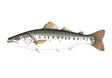
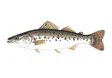
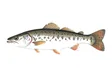
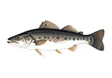
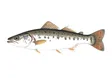
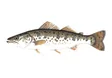
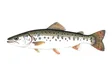
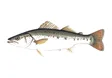
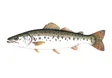
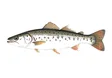
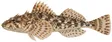
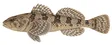
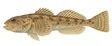
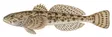
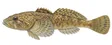
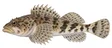
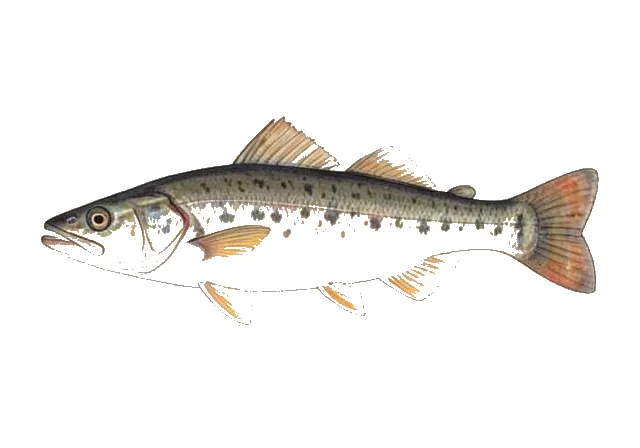
The fourhorn sculpin has a large knobbly head with protruding lips and four bony protuberances, though the latter are not present in freshwater, lake forms of this fish. The pectoral fins are large and rounded. Freshwater forms resemble the Alpine bullhead and European bullhead but can be distinguished from them by the fact that the dorsal and anal fins terminate further forward giving a greater length to the caudal peduncle. The head, body and fins are brownish, mottled and barred with darker colour. The belly of the male is yellowish-brown while that of the female is whitish. In the sea this fish reaches 20 to 30 cm (8 to 12 in) but in lakes it seldom exceeds 15 cm (6 in).
Distribution and habitat
The fourhorn sculpin is a demersal fish distributed mainly in brackish arctic coastal waters in Canada, Greenland, Russia, and Alaska, and also as a relict in the boreal Baltic Sea. There are also freshwater populations in the lakes of Norway, Sweden, Finland and Karelia and in Arctic Canada (Nunavut and Northwest Territories).
Biology
The fourhorn sculpin feeds on bottom-dwelling invertebrates and fish eggs. It breeds in winter between November and March and the male tends the eggs. He digs a hollow in the substrate into which the female lays a batch of eggs. He then remains on guard, fanning the eggs with his fins throughout the hundred-day incubation period.
Additional field notes
Fourhorn sculpin combine bottom feeding with seasonal changes in activity.
Seasonal activity
FishBase describes a shift from mainly daytime activity between November and April to largely nocturnal activity during the rest of the year. Movements include short seasonal journeys between nearshore and offshore water rather than large coordinated migrations. Small crustaceans, fish, and mollusks are included in the diet.
Article text: Wikipedia contributors, Fourhorn sculpin (source revision). Licensed under CC BY-SA 4.0. Retrieved 2026-10-11.