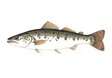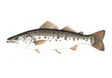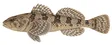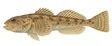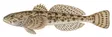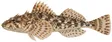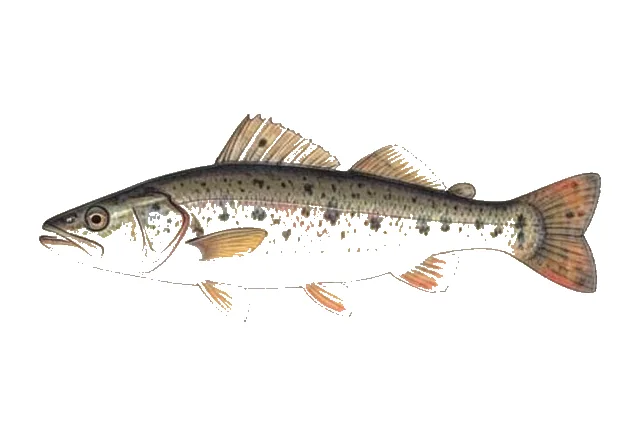
Prickly Sculpin

Cottus asper

Cottidae · freshwater and saltwater and brackish water fish

5 minute read · Species guide

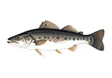
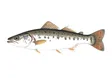
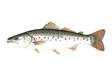
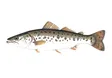
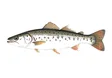
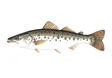
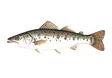
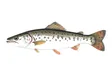
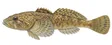
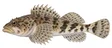
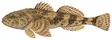
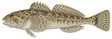
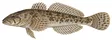
Prickly Sculpin field guide illustration

About Prickly Sculpin

The prickly sculpin (Cottus asper) is a species of ray-finned fish belonging to the family Cottidae, the typical sculpins. It is native to the river drainages of the Pacific Slope of North America from Seward, Alaska south to the Ventura River of Southern California. It extends east of the Continental Divide in the Peace River of British Columbia. It has also been introduced to several reservoirs in Southern California.

Description

This fish can reach about 30 centimeters in length, but it is usually smaller, often around 4–10 cm in length with a large head and wide fan-like pectoral fins. In California, sculpins reach 20 cm in length. It is mature at 2 to 4 years of age, and its maximum lifespan is around 7 years. The prickly sculpin camouflages with muted tones it is brown, gray, or olive green on its upper parts and white or yellowish ventrally. There are dark spots or bars on the back and dark bars on most of the fins. The breeding male is darker in color than the female and nonbreeding male. Both sexes develop an orange coloration along the edge of the first dorsal fin during breeding. The body of the fish is prickly with spines that can pierce bare skin. Inland-dwelling fish tend to be more prickly compared to those at the coast.

Biology

There are two main forms of the species. The inland form lives in lakes, while the coastal form lives in rivers and swims down into brackish estuaries to breed. A catadromous species, it is tolerant of high and low salinities. It is generally a bottom-dwelling species. It is nocturnal, feeding at night.

The diet of the fish includes water invertebrates, insects and their larvae, salmon eggs, fish larvae, especially those of the Sacramento sucker (Catostomus occidentalis occidentalis), and zooplankton, especially Daphnia spp. Larger sculpins eat small fish, frogs, and molluscs. The adults are known to cannibalize the juveniles. The prickly sculpin lives and hunts at the bottom of tide pools and streams. Prickly Sculpins catch their prey by darting at the prey.

In its habitat it lives alongside its relative, the coastrange sculpin (Cottus aleuticus), which is quite similar to it in terms of morphology and behavior. It can also be found with the three-spined stickleback (Gasterosteus aculeatus), steelhead trout (Oncorhynchus mykiss), Klamath small-scale sucker (Catostomus rimiculus), coastal cutthroat trout (Oncorhynchus clarki clarki), Chinook salmon (O. tshawytscha), and coho salmon (O. kisutch). Sculpins avoid predators by hiding along the bottom of the streams under rocks and wood.

Spawning season can extend from February to June. The male creates a nest under debris such as logs or garbage, and the female lays many eggs, from a few hundred up to 11,000. The male guards the nest. He may breed with more than one female per season.

Distribution

This fish is common in most of its range, becoming quite abundant in the summer when recruitment occurs and the previous season's juveniles join the population. Sculpins reside in cold-water streams. Prickly sculpins can be found in Pacific Northwest streams. While it is native to many waterways in California and found all the way up to Alaska, it represents an introduced species in some Southern California lakes, rivers, and tributaries, such as the Santa Clara River, the Santa Ana River, Irvine Lake, and Big Bear Lake. It occurs in reservoirs such as Pyramid Lake. It was likely introduced to many of these places from farther north via the California Aqueduct.

Conservation status

Prickly sculpins are not currently listed under the Endangered Species Act. Sculpins are minimally concerning under the Endangered Species Act.

Uses

The fish is said to be edible by humans, at least the larger individuals. It also makes a good bait fish.

Article text: Wikipedia contributors, Prickly sculpin (source revision). Licensed under CC BY-SA 4.0. Retrieved 2026-10-11.
Diet and feeding

The FishTraits compilation records these diet categories for this species: invertebrates or larval fish; larger animal prey (a source category covering fish, crayfish, crabs, or frogs); fish or frog eggs. These are broad categories, not a claim that every individual consumes every example in a category.

Reported feeding positions include bottom feeding. The compilation combines published observations; diets can vary with age, locality, and available food.

Habitat preferences

Reported habitat associations include streams and small rivers, creeks, still-water habitats.

The species is classified as tolerant of a broad range of salinities. This flag does not specify a salinity range for aquarium care.

Reproduction and parental care

The compilation reports a representative maturity age of 2 years. Its maturity field summarizes mean, median, or modal estimates, usually for females; male estimates can be used when female data are unavailable. It is not a fixed age at which every fish first breeds.

Recorded spawning months are Feb, Mar, Apr, May, Jun for the source’s reporting region (CA). This is a regional calendar, not a range-wide schedule.

The reproductive-guild classification includes guarding eggs or young at a spawning substrate or nest.

Size and recorded longevity

FishTraits reports a maximum total length of 30 centimetres. Some entries use an estimated asymptotic length; this value should not be treated as a certified record catch.

Recorded longevity in the compilation is 5 years. Wild observations were preferred, but captive records were accepted where wild records were unavailable, and unspecified records were assumed wild. The value is not a guaranteed wild lifespan or an aquarium life expectancy.

Native range

Pacific Slope drainages from Seward, Alaska, to Ventura River, California; east of Continental Divide in upper Peace River, British Columbia (Page and Burr 1991).

Introduction history

Apparently introduced in imported water, possibly with water released into Piru Creek, a tributary of the Santa Clara River, from Pyramid Reservoir during the 1970s (Bell 1978; Swift et al. 1993; Moyle 2002). Pyramid Reservoir recevies water through the California Aqueduct from the Sacaramento and San Joaquin River basins, which are part of the inland range of this species (Bell 1978; Moyle 2002).

Ecological impacts

Unknown. The occurrence of this cottid in the Santa Clara River system has been viewed as a possible threat to the survival of the federally endangered unarmoured threespine stickleback Gasterosteus aculeatus williamsoni (U.S. Fish and Wildlife Service 1977).

Range

Where it lives

Share of 2,951 GBIF observation records with a state location, across 5 states. The orange dots are USGS stream-survey sites where this species was caught.
0%
43.7%
Share of 2,951 GBIF observation records with a state location, across 5 states. The orange dots are USGS stream-survey sites where this species was caught.

A blank area on the dot layer usually means nobody sampled there, not that the fish is absent. Turn on “every survey site” to see where the survey looked.

The USGS stream survey caught it at 102 of its sites, in 3 states. That survey and the GBIF records are two different counts of two different things, so the site keeps them apart.

Habitat

Water and movement

Water
WoRMS records this species in fresh water, brackish water and the sea.
USGS NAS habitat
Freshwater
US status
Native transplant — native to part of the United States, moved to other waters inside it.
Migration
Migratory
Pattern
Disagreement
3 published references do not agree on the pattern: Amphidromous, Catadromous, Potamodromous. The site shows every assignment rather than picking one.

Classification

Taxonomy

Kingdom
Animalia
Phylum
Chordata
Superclass
Actinopterygii
Class
Teleostei
Order
Scorpaeniformes
Family
Cottidae
Genus
Cottus
Species
Cottus asper
ITIS TSN
167233
WoRMS AphiaID
274368
GBIF key
2334177
Outside the US
ITIS also files it in Canada.

Common questions about Prickly Sculpin

What is the scientific name of Prickly Sculpin?
The scientific name is Cottus asper, in the family Cottidae. Classification follows ITIS.
Does Prickly Sculpin live in fresh water or salt water?
WoRMS records this species in fresh water, brackish water and the sea.
Where has Prickly Sculpin been recorded in the United States?
GBIF has observations in 5 states, with the most records in Washington, California, Oregon. The map shows observation records, which do not establish the complete natural range.

Closest relatives

Other Cottus species

Same family

More Cottidae

All 28 species in Cottidae