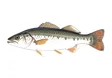
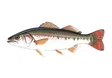
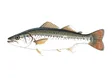
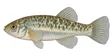
Common names

Types of pupfish

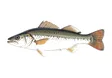
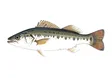
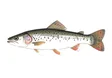
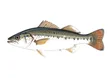
13 species carry pupfish in an English common name. They sit in 1 family, so the group is a name, not a scientific rank.

About pupfish

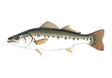
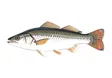
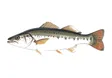
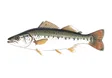
Pupfish are a group of small killifish belonging to ten genera of the family Cyprinodontidae of ray-finned fish. Pupfish are especially noted for being found in extreme and isolated situations. They are primarily found in North America, South America, and the Caribbean region. As of August 2006, 120 nominal species and 9 subspecies were known. Several pupfish species are extinct and most extant species are listed. In the U.S., the most well-known pupfish species may be the Devils Hole pupfish, native to Devils Hole on the Nevada side of Death Valley National Park. Since 1995 the Devils Hole pupfish has been in a nearly steady decline, where it was close to extinction at 35–68 fish in 2013.

The common name is said to derive from the mating habits of the males, whose activities vaguely resemble puppies at play; Carl L. Hubbs, a prominent ichthyologist and one of the first people to take an interest in them, coined the name after he observed their "playful" circling and tussling, which is actually the aggressive behavior of territorial males.

In spite of their name, the cyprinodontids are not closely related to Cyprinidae, or carp family. They were formerly considered near allies of the pikes and their relatives, as they share some features: a flat head with protractile mouth beset with cardiform, villiform, or compressed, bi- or tricuspid teeth, generally large scales, and the absence of a well-developed lateral line. However, they are now generally assigned to the order Cyprinodontiformes. Several forms occur in the fossil records of the Oligocene and Miocene beds of Europe. Pupfish from San Salvador Island were able to diversify into multiple species with different eating habits due to interbreeding with pupfish from other islands, mainly Caribbean.

Most pupfish are inhabitants of fresh and brackish waters. Many species are ovoviviparous; often the sexes are dissimilar, the female being larger and less brilliantly coloured, with smaller fins; the anal fin of the male may be modified into an intromittent organ by means of which internal fertilization takes place. Most pupfishes' diet consists, mainly, of algae, decaying vegetation, and any insects they can get.

Pupfish evolution

Pupfish on the island of San Salvador, Bahamas, have a large adaptive diversification in only two small lakes. They evolve 50–130 times faster than any other species of pupfish. This is also the fastest morphological diversification seen in any fish that has been documented. It is believed that this diversification is because of their ecological niches.

Three species of pupfish on the island of San Salvador, Bahamas, all live in salty lakes. These pupfish are able to take advantage of different food sources so they can all coexist. One species feeds on only the scales of other pupfish. Another has a modified jaw to be able to eat snails and ostracods.

Before the 1990s, Lake Chichancanab, in Mexico, was full of brackish water and another five species of pupfish were found there. Cyprinodon maya was the largest pupfish, and it ate other fish. Cyprinodon simus was the second smallest, and it ate zooplankton. These species are now considered extinct in the wild because of an invasive species of African tilapia.

The Death Valley pupfish evolve 5–10 faster than average and are known for their abilities to survive in extremely hot waters. Cyprinodon diabolis eat algae off a rock shelf near the surface of the deep pool they live in.

North American pupfish

The pupfish found in Death Valley were once thought to be one main species. They were once all found in Lake Manly, a glacial lake over 620 square miles (1,600 km), roughly 185,000-128,000 years ago. Over time this lake dried up and started to separate into smaller lakes or ponds. As this drying happened the pupfish became separated into different ponds and started to divergently evolve. There are thought to be two main subspecies of Death Valley pupfish (C. salinus and C. milleri) present. These are both considered endangered since they are only found in one area of the world. Cyprinodon pachycephalus live in extremely hot waters, 114 °F (45.5 °C).

The Devils Hole pupfish (Cyprinodon diabolis) is a specific species native to Nevada. There are fewer than 200 individuals since 2005. Their population size usually fluctuates between 37 and 400 fish. They are considered one of the world's rarest fish. These fish live in 94 °F (34.4 °C) waters.
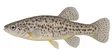
Pupfish species in focus

These species profiles show how members of the group differ. Their biology describes each named species, rather than every fish in the group.

Sheepshead Minnow

The sheepshead minnow (Cyprinodon variegatus), also known as sheepshead pupfish, is a species of ray-finned fish in the family Cyprinodontidae, the pupfishes. It is found in salt marsh and estuary environments and is native to the eastern coasts of North and Central America.

Description

The sheepshead minnow is a deep-bodied fish; its body, exclusive of its tail, is nearly half as deep as it is long. The length of the fish averages 30 mm (1.2 in); it ranges to a maximum of 75 mm (3 in). It is laterally compressed with flat sides, an arched back and a small head with a flattened top. The small mouth is at the end of the snout and the teeth are large and wedge-shaped with three cusps. The pectoral fins are large and extend past the origins of the small pelvic fins. The origin of the anal fin hardly overlaps the trailing edge of the dorsal fin. The caudal peduncle is thick and the caudal fin is truncated and square-ended. The arrangement of the fins, the deep body and the tri-cuspid teeth help to distinguish this fish from the mummichog (Fundulus heteroclitus), which is found in the same habitats. The body is covered by large, circular scales, the ones on the cheeks and the top of the head and a single scale just above the pectoral fin being the largest. The male is generally larger and more deep-bodied than the female, with larger dorsal, pelvic and anal fins.

The color of the sheepshead minnow is olive green above and yellowish below. Juveniles have irregular transverse dark bars and the females keep these as they mature, while the males lose theirs. The dorsal fin is dark while the pectoral, pelvic and anal fins are orange. During the breeding season the male becomes very colorful with steel blue upper parts in front of the dorsal fin, lustrous green upper parts behind and deep salmon-pink underparts.

Distribution and habitat

The sheepshead minnow is native to the eastern coast of the United States. Its range extends from Cape Cod southwards to the Yucatan peninsula in Mexico, also the West Indies. It is found in brackish water in bays, inlets, lagoons, saltmarshes and similar locations with little wave action and sandy or muddy bottoms. It is tolerant of wide variations in salinity and is also found in hypersaline conditions.

Behavior

The sheepshead minnow is an omnivore, eating both animal and vegetable matter. Its diet mainly consists of detritus, microalgae, crustacean larvae and other small invertebrates. Males are aggressive and will attack fish larger than itself, slashing its prey with its sharp teeth and devouring it when it is subdued. Breeding takes place in shallow water between April and September, the males competing fiercely for the females. A few eggs are spawned at a time, and these are fertilised by the males which grasp the females with their fins. The eggs clump together and sink to the seabed, connected by sticky threads. They hatch after five or six days. During the winter, this fish burrows into the soft substrate and remains dormant.

Read the full species guide.

Leon Springs Pupfish

The Leon Springs pupfish (Cyprinodon bovinus) is a species of fish in the family Cyprinodontidae. It is endemic to Pecos County, Texas in the United States. It is a federally listed endangered species.

The Leon Springs pupfish is found at the shallow edges of spring-fed wetland pools, where it is most frequently observed in areas without vegetation. Its diet consists of diatoms, amphipods, and ostracods.

Read the full species guide.

Devil's Hole Pupfish

The Devils Hole pupfish (Cyprinodon diabolis) is a critically endangered species of the family Cyprinodontidae (pupfishes) found only in Devils Hole, a water-filled cavern in the US state of Nevada. It was first described as a species in 1930 and is most closely related to C. nevadensis and the Death Valley pupfish (C. salinus). The age of the species is unknown, with differing analyses offering ranges between one thousand and sixty thousand years. It is a small fish, with maximum lengths of up to 30 mm (1.2 in). Individuals vary in coloration based on age and sex: males are bright metallic blue while females and juveniles are more yellow. A defining trait of this species is its lack of pelvic fins. The pupfish consumes nearly every available food resource at Devils Hole, including beetles, snails, algae, and freshwater crustaceans, with diet varying throughout the year. It is preyed on by the predaceous diving beetle species Neoclypeodytes cinctellus, which was first observed in Devils Hole in 1999 or 2000. Reproduction occurs year-round, with spikes in the spring and fall. Females produce few eggs and the survivorship from egg to adult is low. Individuals live 10 – 14 months.

Devils Hole is more than 130 m (430 ft) deep, though pupfish are only found in the upper 24 m (80 ft). The water is a constant temperature of 33 °C (91 °F) and dissolved oxygen levels are low. A small, shallowly submerged rock shelf provides critical feeding and spawning habitat for the pupfish. Nearby agricultural irrigation in the 1960s and 1970s caused the water to drop in Devils Hole, resulting in less and less of the shelf remaining submerged. Several court cases ensued, resulting in the Supreme Court case Cappaert v. United States, which determined that the preservation of Devils Hole as a National Monument in 1952 implicitly included preservation of adequate groundwater to maintain the scientific value of the pool and its fauna. Other threats faced by the species include flash floods, earthquakes, and vandalism.

Taxonomy and evolution

The Devils Hole pupfish was described as a new species in 1930 by American ichthyologist Joseph H. Wales. The holotype had been collected by Wales and George S. Myers in March 1930 at Devils Hole in the US state of Nevada. The species name "diabolis"was chosen to allude to the type locality of Devils Hole. Both the species name and the location spell"Devils Hole"without an apostrophe, a relic of the"quirks of government cartographers and scientists". According to genetic analysis, the sister taxon of the Devils Hole pupfish is Cyprinodon nevadensis. Along with the Death Valley pupfish (C. salinus), the three Amargosa River basin species form a clade.

The age of the species is subject to considerable debate, with analyses recovering starkly different figures. Devils Hole was formed around 60,000 years ago, with some researchers assuming the pupfish has existed in isolation for 10,000 – 20,000 years. How it colonized Devils Hole is unknown; hypotheses include arriving via subterranean waters or over dry land. As Native Americans used pupfish species as food, it has been speculated that they introduced the pupfish to Devils Hole, intentionally or not. Its divergence from a common ancestor with C. nevadensis mionectes was estimated at 217 – 2530 years in one study. Two studies, each based on independent genetic datasets, estimated that this species may have first colonized the hole within the past 1,000 years, but another suggested the species is as old as 60,000 years. These estimates depend heavily on knowledge of the mutation rate in this species, which is unknown, but is predicted to be one of the highest for any vertebrate due to its small population size.

Description

The Devils Hole pupfish is the smallest pupfish species in the genus Cyprinodon, with lengths up to 30 mm (1.2 in). The average length is 23 mm (0.9 in). Males and females differ in coloration. Males are overall dark brown with metallic blue on their sides. The margins of all fins are black, and the back has golden iridescence. Iridescence is particularly pronounced on the opercles (gill covers) which have a violet sheen on their posterior side. The iris is blue and also iridescent. Females and young are more yellow in color than the males. Females have yellowish-brown backs, and the margins of their pectoral and caudal fins are yellow, not black. The dorsal fin has a black margin like the males, however. Females' opercles are metallic green, and their eyes are tinted metallic blue. The young are overall colored as the females, though they have a faint vertical bar on their sides.

Individuals lack pelvic fins, though have been observed to grow them when raised in lower temperatures in captivity. Its dorsal fin has twelve rays, while each pectoral fin has seventeen rays. The caudal fin is convex in appearance and has twenty-eight rays, curving outward at the margin. Its lateral series (the number of scales from the back end of the opercle to the beginning of the tail) is twenty-seven scales. The scales are ctenoid, or toothed, on the outer margin.

Biology and ecology

The Devils Hole pupfish consumes a variety of food items representing nearly all possible food resources in Devils Hole. Its food resources include inorganic particulate matter; the algae Spirogyra and diatoms; the freshwater crustaceans Hyalella azteca and ostracods; protozoa; the beetle Stenelmis calida; the flatworm Girardia dorotocephala; and the freshwater snails Tryonia. The consumption of the various food resources varies seasonally, though inorganic particulate matter had a high frequency of occurrence in stomach contents year-round in one study. The inorganic particulate matter consists of primarily travertine, a form of limestone. The three most common food items for each season by frequency of occurrence were:

As Spirogyra was mostly found undigested in the stomach, the authors hypothesized that it was not important as a food resource, but rather as a foraging substrate. The inorganic particulate matter was thought to be incidentally consumed as well as a result of the fish's foraging strategy of bottom feeding and surface feeding.

Read the full species guide.

Range

Where pupfish live

How many of the 13 species are recorded in each state.
0
6
How many of the 13 species are recorded in each state.

Species

All 13 pupfish species