White Sands Pupfish

Cyprinodon tularosa

Cyprinodontidae · freshwater and brackish water fish

4 minute read · Species guide

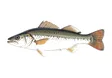
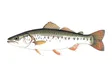
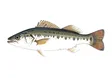
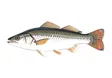
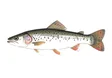
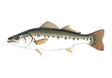
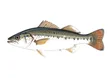
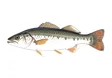
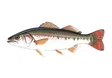
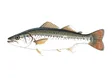
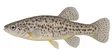
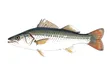
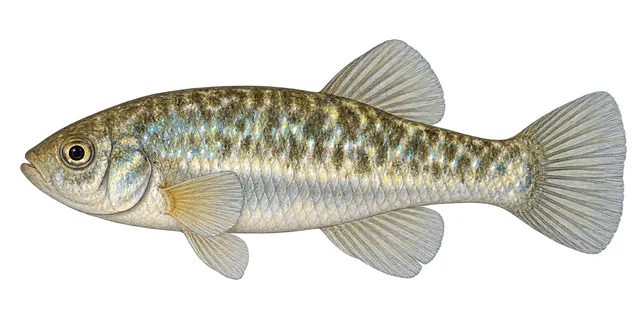
White Sands Pupfish field guide illustration

About White Sands Pupfish

The White Sands pupfish (Cyprinodon tularosa) is an endangered species of pupfish from the family Cyprinodontidae. The native range of the White Sands pupfish included the Pleistocene Lake Otero and its surrounding tributaries. Currently, the extant populations of White Sands pupfish reside on the Tularosa Basin in White Sands, New Mexico, United States. Four populations of White Sands pupfish exist: native populations found in Salt Creek and Malpais Spring, and two introduced populations in Mound Spring and Lost River.

Description

The White Sands pupfish ranges from 4.4 to 6.4 cm (1.75 to 2.5 in) in length. The males have gray scales and a white underside; they are differentiated from females by a blue sheen and a band on their tails. Females have a dark spot on their ventral fin and vertical striping on their sides. During mating season, the White Sands pupfish undergo a colorful transformation. Males turn a bright metallic blue with yellow-orange fins. Females turn green to yellow with butter-colored fins.

Habitat

White Sands pupfish are found in the Tularosa Basin, New Mexico, where they occur in two springs and two streams. Their native habitats include Salt Creek and Malpais Spring, and new populations have been established in Mound Springs and Lost Creek. Vegetation such as salt grass, salt alder, pondweed, bulrush and pickleweed lining the sides of creeks provide negative cover for the pupfish. The population living in Salt Creek spends the winter months living in the lower portion of the creek; once summer arrives, this section of the creek begins to dry up, and the pupfish return to the springs feeding the creek. It has been noted that the salinity of Salt Creek is higher than the salinity of the ocean. There have been recorded genetic differences between populations of White Sands pupfish that live in Malpais Springs and Salt Creek. High F ST values were reported for the populations of pupfish in Malpais springs and Salt Creek. There was also a high- F ST subpopulation of pupfish living in Salt Creek that is fragmented by a head-cut waterfall.

Biology

The lifespan of a White Sands pupfish is two years. These fish reach maturity at around 4.4–6.4 cm (1.75–2.5 in) in length. Mating season lasts from beginning of April and continues through early fall in October. Males are often territorial during mating and will mate with a multitude of females. The White Sands pupfish will lay clutches of 12–15 eggs in size. They have become highly adaptive, living in water conditions that range from fresh to saltier than the ocean.

Conservation efforts

Only two native populations of White Sands pupfish were known before 1967: Malpais Springs and Salt Creek. In 1967, a population of pupfish was introduced to Mound Springs, and in 1970, a group of 30 White Sands pupfish from the Salt Creek population was introduced into Lost River through conservation efforts. Populations of White Sands pupfish are still threatened by introduction of exotic species such as Virile Crayfish and Western mosquitofish. White Sands pupfish are also vulnerable to parasites such as trematodes.

Article text: Wikipedia contributors, White Sands pupfish (source revision). Licensed under CC BY-SA 4.0. Retrieved 2026-10-11.
Diet and feeding

The FishTraits compilation records these diet categories for this species: algae or phytoplankton; invertebrates or larval fish. These are broad categories, not a claim that every individual consumes every example in a category.

Reported feeding positions include bottom feeding and surface or water-column feeding. The compilation combines published observations; diets can vary with age, locality, and available food.

Habitat preferences

Reported habitat associations include springs or subterranean waters.

The source records associations with muck, clay or silt, sand, gravel, vegetation. An association indicates reported use, rather than an exclusive requirement.

Reproduction and parental care

The compilation reports a representative maturity age of 0.5 years. Its maturity field summarizes mean, median, or modal estimates, usually for females; male estimates can be used when female data are unavailable. It is not a fixed age at which every fish first breeds.

Batch or serial spawning has been reported somewhere in the species’ range. This does not establish the same spawning pattern for every population.

Recorded spawning months are Apr, May, Jun, Jul, Aug, Sep for the source’s reporting region (NM). This is a regional calendar, not a range-wide schedule.

The reproductive-guild classification includes spawning on open substrates without guarding the brood.

Size and recorded longevity

FishTraits reports a maximum total length of 5 centimetres. Some entries use an estimated asymptotic length; this value should not be treated as a certified record catch.

Recorded longevity in the compilation is 4 years. Wild observations were preferred, but captive records were accepted where wild records were unavailable, and unspecified records were assumed wild. The value is not a guaranteed wild lifespan or an aquarium life expectancy.

Range

Where it lives

Share of 416 GBIF observation records with a state location, across 1 states.
0%
100%
Share of 416 GBIF observation records with a state location, across 1 states.

Share of records by state

Habitat

Water and movement

Water
WoRMS records this species in fresh water and brackish water.
Migration
Not migratory

Classification

Taxonomy

Kingdom
Animalia
Phylum
Chordata
Superclass
Actinopterygii
Class
Teleostei
Order
Cyprinodontiformes
Genus
Cyprinodon
Species
Cyprinodon tularosa
ITIS TSN
165643
WoRMS AphiaID
276023
GBIF key
2347878

Common questions about White Sands Pupfish

What is the scientific name of White Sands Pupfish?
The scientific name is Cyprinodon tularosa, in the family Cyprinodontidae. Classification follows ITIS.
Does White Sands Pupfish live in fresh water or salt water?
WoRMS records this species in fresh water and brackish water.
Where has White Sands Pupfish been recorded in the United States?
GBIF has observations in 1 states, with the most records in New Mexico. The map shows observation records, which do not establish the complete natural range.

Closest relatives

Other Cyprinodon species

Same family

More Cyprinodontidae