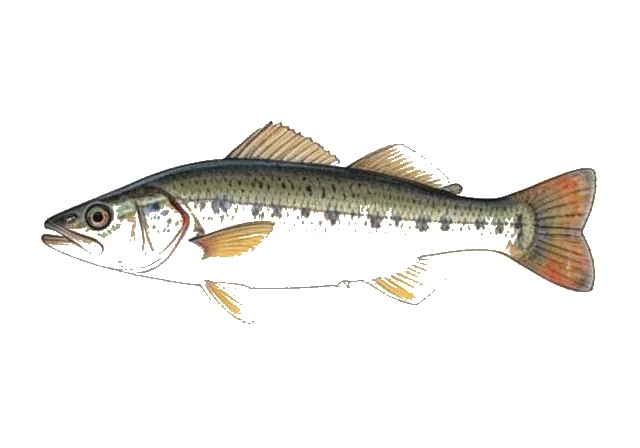
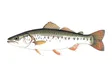
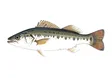
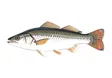
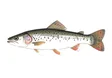
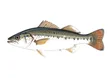
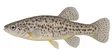
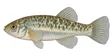
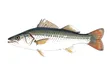
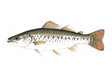
The Leon Springs pupfish is found at the shallow edges of spring-fed wetland pools, where it is most frequently observed in areas without vegetation. Its diet consists of diatoms, amphipods, and ostracods.
This fish was first discovered in 1851 at Leon Springs, near Fort Stockton, Texas. Leon Springs was impounded, poisoned, stocked with game fish, and drained, and the fish was considered extinct by 1938. In the 1960s it was rediscovered at Diamond Y Spring a few miles away. It is also found in the Diamond Y Draw, a tributary of the Pecos River.
Additional field notes
Leon Springs pupfish feed on both microscopic algae and small crustaceans.
Sources: Cyprinodon bovinus species summary
Food at the pool margins
FishBase lists diatoms, amphipods, and ostracods as foods. It describes adults along the margins of spring-fed marsh pools and notes that fish are most common away from vegetation. This is a useful distinction within a marsh setting: dense plant cover does not necessarily mark the most heavily occupied part of the pool.
Sources: Cyprinodon bovinus species summary
Guide sources
Research reviewed 2026-10-19.
Article text: Wikipedia contributors, Leon Springs pupfish (source revision). Licensed under CC BY-SA 4.0. Retrieved 2026-10-11.
Diet and feeding
The FishTraits compilation records these diet categories for this species: algae or phytoplankton; detritus or unidentified plant material; invertebrates or larval fish. These are broad categories, not a claim that every individual consumes every example in a category.
Reported feeding positions include bottom feeding. The compilation combines published observations; diets can vary with age, locality, and available food.
Habitat preferences
Reported habitat associations include springs or subterranean waters.
The source records associations with muck, clay or silt. An association indicates reported use, rather than an exclusive requirement.
Reproduction and parental care
The compilation reports a representative maturity age of 0.5 years. Its maturity field summarizes mean, median, or modal estimates, usually for females; male estimates can be used when female data are unavailable. It is not a fixed age at which every fish first breeds.
Batch or serial spawning has been reported somewhere in the species’ range. This does not establish the same spawning pattern for every population.
Recorded spawning months are Jan, Feb, Mar, Apr, May, Jun, Jul, Aug, Sep, Oct, Nov, Dec for the source’s reporting region (TX). This is a regional calendar, not a range-wide schedule.
The reproductive-guild classification includes spawning on open substrates without guarding the brood.
Size and recorded longevity
FishTraits reports a maximum total length of 5 centimetres. Some entries use an estimated asymptotic length; this value should not be treated as a certified record catch.
Recorded longevity in the compilation is 2 years. Wild observations were preferred, but captive records were accepted where wild records were unavailable, and unspecified records were assumed wild. The value is not a guaranteed wild lifespan or an aquarium life expectancy.