Salt Creek Pupfish

Cyprinodon salinus

Cyprinodontidae · freshwater and brackish water fish

5 minute read · Species guide

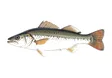
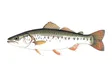
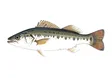
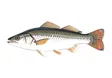
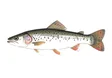
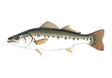
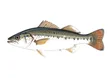
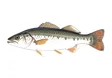
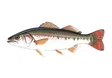
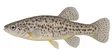
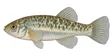
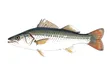
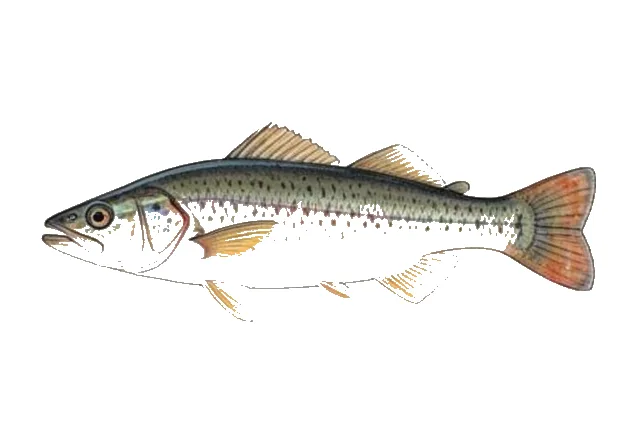
Salt Creek Pupfish field guide illustration

About Salt Creek Pupfish

The Death Valley pupfish (Cyprinodon salinus), also known as Salt Creek pupfish, is a small species of fish in the family Cyprinodontidae found only in Death Valley National Park, California, United States. There are two recognized subspecies: C. s. salinus and C. s. milleri. The Death Valley pupfish is endemic to two small, isolated locations and currently classified as endangered.

Description

The Death Valley pupfish is a small, silvery colored fish with 6–9 vertical dark bands on its sides. It has an average length of 3.7 cm (1.5 in), with a recorded maximum of 7.8 cm (3.1 in).

The males, often appearing in larger sizes compared to females, turn bright blue during mating season, April through October. The females, along with premature pupfish, tend to have tanned backs with iridescent, silvery sides. Both males and females have plump bodies with rounded fins, a squashed head and an upturned mouth. The pupfish can withstand harsh conditions that would kill other fish: water that is 4 times more saline than the ocean, hot water up to 116 °F (47 °C), and cold water down to 32 °F (0 °C).

Distribution and habitat

This species is known from only two locations in Death Valley: Salt Creek (subspecies salinus) at about 49 m (161 ft) below sea level, and Cottonball Marsh (subspecies milleri), at about 80 m (260 ft) below sea level. They are thought to be the remainders of a large ecosystem of fish species that lived in Lake Manly, which dried up at the end of the last ice age leaving the present-day Death Valley.

The Salt Creek subspecies is also found at River Springs and Soda Lake, in Death Valley National Park.

Diet

The Death Valley pupfish mostly feeds on algae and, when available, small invertebrates. In the winter, its diet primarily consists of diatoms, while in the summer it eats spirogyra.

Conservation

The Death Valley pupfish has been classified as endangered by the IUCN because of its extremely restricted distribution (if the two extant locations were treated as a single unit, it would be considered critically endangered). Numbers of individuals at the locations are highly seasonally variable, and fluctuate with water level and flow volume. While the entire range of the species is located in a protected area, it may be under threat from accidental introduction of non-native species, local catastrophic events, and excessive pumping of the aquifer that feeds the habitat.

The habitats of the known Death Valley pupfish populations, characterized by warm temperatures, high salinity, and seasonal fluctuations in water availability, are vulnerable to environmental change and disturbance. Pupfish species rely on highly variable seasonal output of nutrients in order to survive. Due to the short life span of individuals (10–12 months), successful annual reproduction is crucial to population survival. Climate change-driven increases in air and water temperatures in the shallow spawning habitats can significantly reduce egg survival and increase larva mortality. Research has shown that the spawning habitats have already warmed, and it is forecast that by 2050, the window for successful optimum conditions for pupfish reproduction will have shortened by at least 2 weeks.

Changes in ground-water availability or flow can alter spring habitats and reduce suitable environments used by pupfish populations that are already experiencing seasonal fluctutations in water levels. Long-time monitoring of the Devils Hole pupfish habitat in the 1960s and 1970s showed declining water levels caused by nearby pumping, followed by recovering water levels as ground-water pumping was discontinued due to implemented management (such as hydrologic monitoring) and protection plans.

Article text: Wikipedia contributors, Death Valley pupfish (source revision). Licensed under CC BY-SA 4.0. Retrieved 2026-10-11.
Diet and feeding

The FishTraits compilation records these diet categories for this species: algae or phytoplankton; invertebrates or larval fish. These are broad categories, not a claim that every individual consumes every example in a category.

Reported feeding positions include bottom feeding and surface or water-column feeding. The compilation combines published observations; diets can vary with age, locality, and available food.

Habitat preferences

Reported habitat associations include streams and small rivers, creeks, springs or subterranean waters.

The source records associations with muck, clay or silt, vegetation. An association indicates reported use, rather than an exclusive requirement.

The species is classified as tolerant of a broad range of salinities. This flag does not specify a salinity range for aquarium care.

Reproduction and parental care

The compilation reports a representative maturity age of 0.3 years. Its maturity field summarizes mean, median, or modal estimates, usually for females; male estimates can be used when female data are unavailable. It is not a fixed age at which every fish first breeds.

Batch or serial spawning has been reported somewhere in the species’ range. This does not establish the same spawning pattern for every population.

Recorded spawning months are Apr, May, Jun, Jul, Aug, Sep, Oct for the source’s reporting region (CA). This is a regional calendar, not a range-wide schedule.

The reproductive-guild classification includes spawning on open substrates without guarding the brood.

Size and recorded longevity

FishTraits reports a maximum total length of 6.3 centimetres. Some entries use an estimated asymptotic length; this value should not be treated as a certified record catch.

Recorded longevity in the compilation is 2 years. Wild observations were preferred, but captive records were accepted where wild records were unavailable, and unspecified records were assumed wild. The value is not a guaranteed wild lifespan or an aquarium life expectancy.

Native range

Salt Creek, Death Valley, California (Page and Burr 1991).

Introduction history

Many of the early stockings were apparently part of a series of experiments to test the effects of changed environment on meristic and morphometric characters (Miller 1968). Some introductions were presumably for establishing additional populations of a rare species with limited distribution.

Range

Where it lives

Share of 456 GBIF observation records with a state location, across 1 states.
0%
100%
Share of 456 GBIF observation records with a state location, across 1 states.

Share of records by state

Habitat

Water and movement

Water
WoRMS records this species in fresh water and brackish water.
USGS NAS habitat
Freshwater
US status
Native transplant — native to part of the United States, moved to other waters inside it.
Migration
Undetermined

Classification

Taxonomy

Kingdom
Animalia
Phylum
Chordata
Superclass
Actinopterygii
Class
Teleostei
Order
Cyprinodontiformes
Genus
Cyprinodon
Species
Cyprinodon salinus
ITIS TSN
165642
WoRMS AphiaID
293573
GBIF key
4284441

Common questions about Salt Creek Pupfish

What is the scientific name of Salt Creek Pupfish?
The scientific name is Cyprinodon salinus, in the family Cyprinodontidae. Classification follows ITIS.
Does Salt Creek Pupfish live in fresh water or salt water?
WoRMS records this species in fresh water and brackish water.
Where has Salt Creek Pupfish been recorded in the United States?
GBIF has observations in 1 states, with the most records in California. The map shows observation records, which do not establish the complete natural range.

Closest relatives

Other Cyprinodon species

Same family

More Cyprinodontidae