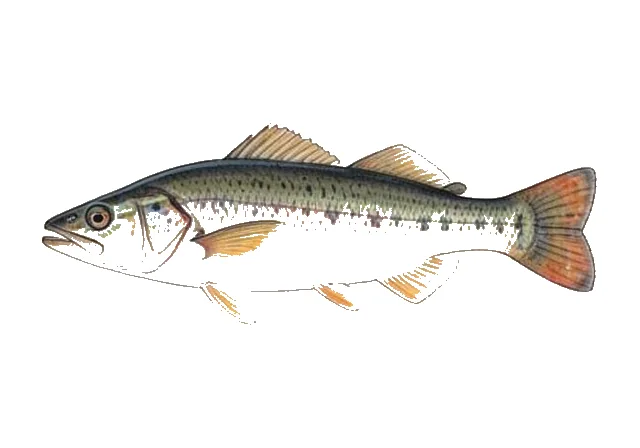
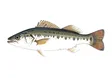
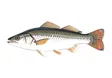
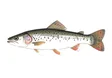
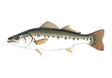
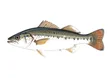
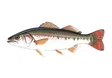
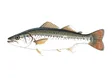
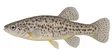
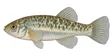
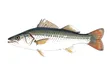
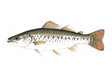
Amargosa pupfish habitats in freshwater types, including streams, springs, and spring-fed ponds and lakes.
They are small in size, and usually grow up to 25-30 mm in several months, but rarely exceed 50 mm. These pupfish have deeper, broader bodies, with a blunt head and a small, oblique terminal mouth.
Amargosa pupfish are omnivores, and have a diet consisting of algae and cyanobacteria. They also eat small invertebrates.
Male pupfish are bright blue and have a black band on the edge of the tail fin. Female pupfish are olive-brown with metallic blue on their shoulders and upper sides during breeding stages. Male pupfish are protective of their breeding territories and aggressively drive off other male fish. Female disperse their eggs a few at a time and in different locations. Male pupfish guard the territory that the eggs are laid in.
Article text: Wikipedia contributors, Cyprinodon nevadensis (source revision). Licensed under CC BY-SA 4.0. Retrieved 2026-10-11.
Diet and feeding
The FishTraits compilation records these diet categories for this species: algae or phytoplankton; invertebrates or larval fish. These are broad categories, not a claim that every individual consumes every example in a category.
Reported feeding positions include bottom feeding and surface or water-column feeding. The compilation combines published observations; diets can vary with age, locality, and available food.
Habitat preferences
Reported habitat associations include streams and small rivers, creeks, springs or subterranean waters.
The source records associations with muck, clay or silt, sand, vegetation. An association indicates reported use, rather than an exclusive requirement.
Reproduction and parental care
The compilation reports a representative maturity age of 0.5 years. Its maturity field summarizes mean, median, or modal estimates, usually for females; male estimates can be used when female data are unavailable. It is not a fixed age at which every fish first breeds.
Batch or serial spawning has been reported somewhere in the species’ range. This does not establish the same spawning pattern for every population.
Recorded spawning months are Jan, Feb, Mar, Apr, May, Jun, Jul, Aug, Sep, Oct, Nov, Dec for the source’s reporting region (CA). This is a regional calendar, not a range-wide schedule.
The reproductive-guild classification includes spawning on open substrates without guarding the brood.
Size and recorded longevity
FishTraits reports a maximum total length of 6.5 centimetres. Some entries use an estimated asymptotic length; this value should not be treated as a certified record catch.
Recorded longevity in the compilation is 1.5 years. Wild observations were preferred, but captive records were accepted where wild records were unavailable, and unspecified records were assumed wild. The value is not a guaranteed wild lifespan or an aquarium life expectancy.
Native range
Amargosa River basin, California and Nevada (Page and Burr 1991).
Introduction history
Most introductions were the result of intentional stockings, of which some were presumably attempts to expand the range of this imperiled species. Fish found in the Nevada golf course were thought to have escaped with overflow from ponds at a nearby US Fish and Wildlife Service facility. Miller and Alcorn (1946) presumed that this small species had been brought to the federal facility from the Amargosa drainage for use as forage for the bass and sunfish populations maintained at the station. A few of the earlier stockings in California were apparently part of a series of experiments to test the effects of changed environment on meristic and morphometric characters (Miller 1968).