Woundfin

Plagopterus argentissimus

Leuciscidae · freshwater water fish

5 minute read · Species guide

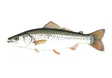
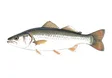
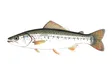
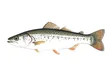
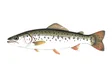
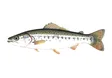
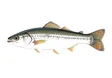
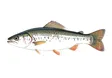
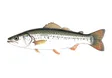
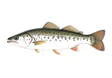
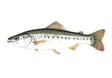
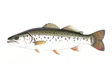
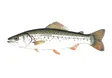
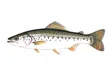
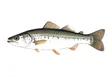
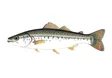
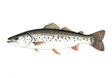
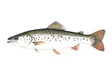
Woundfin field guide illustration

About Woundfin

The woundfin (Plagopterus argentissimus) ray-finned fish in the family Leuciscidae. This fish is endemic to the Virgin River of the southwestern United States. It is the only species in the monotypic genus Plagopterus.

Description

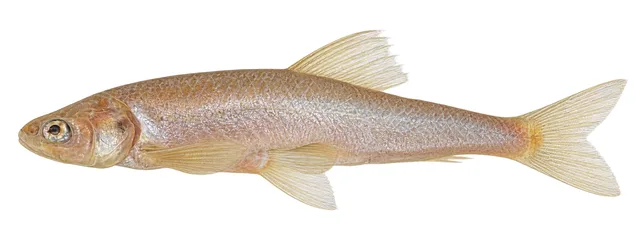
The woundfin is a small slender, silvery minnow, with a flattened head and belly, long snout, leathery skin, and no scales. There are barbels on the corners of its lips, and its common name likely comes from the first spinous ray of its dorsal fin, which is sharp-pointed. Its maximum length is rarely more than 7.5 cm (3.0 in). It can be distinguished from spikedace and spinedace by presence of barbels.

Distribution

Historically, the woundfin occupied much of the lower Colorado River basin, including two tributaries, the Virgin River and part of the Gila River; however, habitat destruction through dams and water development has led to its extirpation from these regions. In addition, several introduced species, most notably the red shiner (Cyprinella lutrensis) have contributed to a decrease in the woundfin's Virgin River population. The woundfin is currently federally listed as an endangered species, while the United States Fish and Wildlife Service lists the population status as "declining."

Habitat

The woundfin tolerates highly mineralized, turbid waters. It is typically found in warm, swift streams of high turbidity, preferring a stream speed of one to two feet per second and a depth of eight to eighteen inches.

Food

The woundfin is omnivorous, and depending on availability will feed on detritus, algae, seeds, and aquatic insects and their larvae.

Conservation status

Historically, the woundfin also occupied the lower Colorado River from the Virgin to Yuma, Arizona, and the Gila River from Yuma to its confluence with the Salt River, but habitat destruction through water development (including eight major dams which alter flow) and the introduction of several species (particularly the red shiner (Cyprinella lutrensis), which competes for food and is known to prey upon the woundfin's eggs and young) have led to its extirpation in these regions as well as a decline in population in the Virgin River. Since 1970, the woundfin has been listed as an endangered species. Other listings include "Vulnerable"on the IUCN Red List and"Critically Imperiled"(the most critical classification) by NatureServe. The United States Fish and Wildlife Service lists the population status as"declining." The Dexter National Fish Hatchery in Dexter, New Mexico studies the woundfin in an effort to help conserve the species, and has successfully spawned the fish in captivity. However, efforts to transplant the species into other rivers and creeks have failed due to reproduction not taking place. On July 11, 2007, approximately 50 woundfin were released into the Hassayampa River near Wickenburg, Arizona. The hatchery-raised fish were from wild Virgin River stock. The only wild population of the species is in the Virgin River. An aggressive program to eradicate red shiner from the Virgin River in Utah has all but removed red shiner from reaches previously dominated by red shiner. Fish barriers have been erected to prevent re-colonization by red shiner, and has allowed the reintroduction of hatchery raised woundfin. Several thousand of hatchery-raised woundfin were released in the fall of 2007 and 2008. With red shiner no longer a threat, low flows and high temperatures are the biggest threats still facing woundfin. Another minnow, the Virgin River chub (Gila seminuda), has much of the same range as the woundfin and thus faces the same threats of extinction, particularly competition from the red shiner and a decrease in water quality as the result of agricultural runoff.

Article text: Wikipedia contributors, Woundfin (source revision). Licensed under CC BY-SA 4.0. Retrieved 2026-10-11.
Diet and feeding

The FishTraits compilation records these diet categories for this species: algae or phytoplankton; invertebrates or larval fish. These are broad categories, not a claim that every individual consumes every example in a category.

Reported feeding positions include bottom feeding and surface or water-column feeding. The compilation combines published observations; diets can vary with age, locality, and available food.

Habitat preferences

Reported habitat associations include medium to large rivers, streams and small rivers.

The source records associations with sand, gravel. An association indicates reported use, rather than an exclusive requirement.

Reproduction and parental care

The compilation reports a representative maturity age of 2 years. Its maturity field summarizes mean, median, or modal estimates, usually for females; male estimates can be used when female data are unavailable. It is not a fixed age at which every fish first breeds.

Recorded spawning months are Apr, May for the source’s reporting region (UT). This is a regional calendar, not a range-wide schedule.

The reproductive-guild classification includes spawning on open substrates without guarding the brood.

Size and recorded longevity

FishTraits reports a maximum total length of 10 centimetres. Some entries use an estimated asymptotic length; this value should not be treated as a certified record catch.

Recorded longevity in the compilation is 4 years. Wild observations were preferred, but captive records were accepted where wild records were unavailable, and unspecified records were assumed wild. The value is not a guaranteed wild lifespan or an aquarium life expectancy.

Native range

Historically, in drainages of the lower Colorado River basin, including the Virgin and Gila river in Utah, Nevada, and Arizona. Now found only in the Virgin River, Arizona, Nevada, and Utah (U.S. Fish and Wildlife Service 1984a; Page and Burr 1991).

Introduction history

Stocked intentionally for conservation purposes, the goal of which was to establish self-sustaining populations of this endangered species in its historic range so as to reduce the chance of Woundfin extinction (Ono et al. 1983). Stocking was carried out by the Arizona Game and Fish Department. The species was stocked in the Hassayampa River in February 1972 (500 fish), in the Salt River in March 1972 (350 fish), in Sycamore Creek in the spring of spring 1972 (a "few" fish), and in the Paria River several times between 1969 and 1972 (a total of 650 fish) (U.S. Fish and Wildlife Service 1984a, 1994c).

Range

Where it lives

Share of 85 GBIF observation records with a state location, across 6 states.
0%
49.4%
Share of 85 GBIF observation records with a state location, across 6 states.

Habitat

Water and movement

Water
WoRMS records this species in fresh water.
USGS NAS habitat
Freshwater
US status
Native transplant — native to part of the United States, moved to other waters inside it.
Migration
Migratory
Pattern

Classification

Taxonomy

Kingdom
Animalia
Phylum
Chordata
Superclass
Actinopterygii
Class
Teleostei
Order
Cypriniformes
Genus
Plagopterus
Species
Plagopterus argentissimus
ITIS TSN
163600
WoRMS AphiaID
1020374
GBIF key
2366711
Outside the US
ITIS also files it in Mexico.

Common questions about Woundfin

What is the scientific name of Woundfin?
The scientific name is Plagopterus argentissimus, in the family Leuciscidae. Classification follows ITIS.
Does Woundfin live in fresh water or salt water?
WoRMS records this species in fresh water.
Where has Woundfin been recorded in the United States?
GBIF has observations in 6 states, with the most records in Arizona, Utah, Nevada. The map shows observation records, which do not establish the complete natural range.

Same family

More Leuciscidae

Alabama Shiner4 states
Cyprinella callistiaLeuciscidaeNativeFresh
Allegheny Pearl Dace19 states
Margariscus margaritaLeuciscidaeNative and introducedFresh
Altamaha Shiner1 states
Cyprinella xaenuraLeuciscidaeNativeFresh
Alvord Chub2 states
Siphateles alvordensisLeuciscidaeNativeFresh
Apalachee Shiner3 states
Pteronotropis grandipinnisLeuciscidaeNativeFresh
Arkansas River Shiner5 states
Notropis girardiLeuciscidaeNative and introducedFresh
Arroyo Chub1 states
Gila orcuttiiLeuciscidaeNative and introducedFresh
Bandfin Shiner5 states
Luxilus zonistiusLeuciscidaeNative and introducedFresh
Bannerfin Shiner5 states
Cyprinella leedsiLeuciscidaeNativeFresh
Beautiful Shiner3 states
Cyprinella formosaLeuciscidaeNativeFresh
Bedrock Shiner3 states
Notropis rupestrisLeuciscidaeNativeFresh
Bigeye Chub25 states
Hybopsis amblopsLeuciscidaeNative and introducedFresh
Bigeye Shiner17 states
Notropis boopsLeuciscidaeNative and introducedFresh
Bigmouth Chub3 states
Nocomis platyrhynchusLeuciscidaeNativeFresh
Bigmouth Shiner21 states
Notropis dorsalisLeuciscidaeNative and introducedFresh
Blackchin Shiner13 states
Notropis heterodonLeuciscidaeNativeFresh
Blackmouth Shiner3 states
Notropis melanostomusLeuciscidaeNativeFresh
Blacknose Shiner21 states
Notropis heterolepisLeuciscidaeNative and introducedFresh
Blackside Dace2 states
Chrosomus cumberlandensisLeuciscidaeNativeFresh
Blackspot Shiner5 states
Notropis atrocaudalisLeuciscidaeNativeFresh
Blacktail Shiner14 states
Cyprinella venustaLeuciscidaeNative and introducedFresh
Blacktip Shiner4 states
Lythrurus atrapiculusLeuciscidaeNative and introducedFresh
Bleeding Shiner8 states
Luxilus zonatusLeuciscidaeNativeFresh
Blotched Chub6 states
Erimystax insignisLeuciscidaeNativeFresh

All 267 species in Leuciscidae