American Flagfish

Jordanella floridae

Cyprinodontidae · freshwater and brackish water fish

4 minute read · Species guide

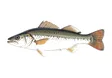
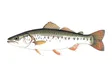
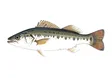
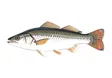
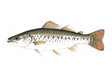
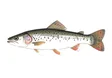
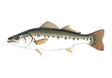
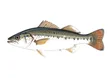
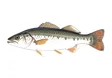
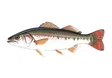
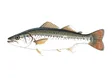
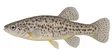
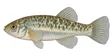
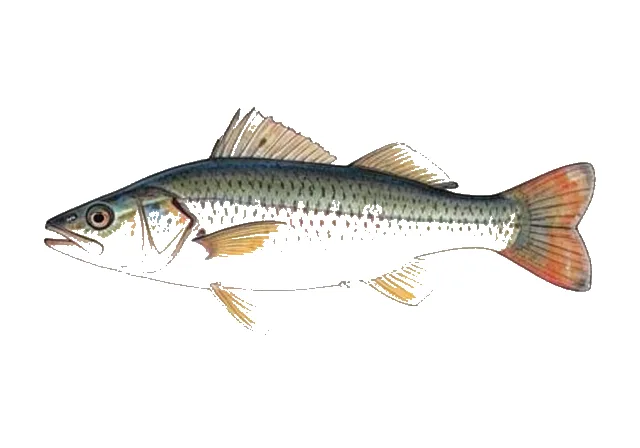
American Flagfish field guide illustration

About American Flagfish

The flagfish (Jordanella floridae), also known as the American flagfish or Florida flagfish, is a species of pupfish, a type of killifish from the family Cyprinodontidae which is endemic to Florida. It is found in the aquarium trade. Its common name derives from the dominant males' body pattern, which bears some resemblance to the flag of the United States.

Description

Flagfish are small, robust fish, 6 centimetres (2.4 in) in length, with a truncated snout which has been compared to that of a bulldog. They have rounded fins with the dorsal and anal fins positioned posteriorly and adjoining the caudal fin. Females have an obvious spot on their flanks and a clear spot near the posterior end of the dorsal fin, this has an opaque white margin. The fins may show a slight reddish color but this comes and goes in any individual but the reason for this is unknown. The females body is mainly olive but marked with turquoise scales. The common name of the flagfish is derived from the male due to the resemblance of its patterning to the flag of the United States. There is a dark rectangle on the shoulder which is imagined as the blue and white stars in the corner of the US flag and there are stripes along the flanks, some of which are red and others paler, albeit greenish rather than white. The male also has a dark spot positioned at the lower posterior corner of the dark rectangle. The olive-grey coloration and pattern of nondominant males, females, and juveniles underlies the more colorful pattern of the dominant males.

Distribution

The flagfish is endemic to Florida where it is found in the Florida Peninsula south of the drainage basins of the St. Johns River and Ochlockonee River.

Habitat and biology

The flagfish normally occurs in shallow, well vegetated freshwater habitats such as backwaters, marshes, canals and ditches but it has occasionally been recorded in slightly brackish water. The flagfish is listed in the Guinness Book of World Records as the species of fish which lays the fewest eggs, a female will lay 20 eggs over a period of a few days. They have a courtship display in which the female encourages the male to chase her by nipping him. After that they face each other with the female swimming backwards, the male then backflips. After the eggs are laid the male guards them, attacking fish which stray too close. However, the male may also eat his own eggs or offspring. Other sources say that this species shows no parental care.

This species is omnivorous, it is a micropredator feeding on small invertebrates and zooplankton but it will also feed on algae and other plant material.

They are often used to naturally control hair algae in suitable aquariums, as they are one of the only fish to consume it in an impactful volume.

Taxonomy and name

The flagfish was described by George Brown Goode and Tarleton Hoffman Bean in 1879 with the type locality given as Lake Monroe, Florida. The generic name honours the American ichthyologist David Starr Jordan (1851–1931). It is closely related to the Yucatan flagfish Garmanella pulchra which is sometimes also placed in the genus Jordanella.

Article text: Wikipedia contributors, Jordanella floridae (source revision). Licensed under CC BY-SA 4.0. Retrieved 2026-10-11.
Diet and feeding

The FishTraits compilation records these diet categories for this species: algae or phytoplankton; aquatic or other vascular plants; detritus or unidentified plant material; invertebrates or larval fish. These are broad categories, not a claim that every individual consumes every example in a category.

Reported feeding positions include bottom feeding. The compilation combines published observations; diets can vary with age, locality, and available food.

Habitat preferences

Reported habitat associations include streams and small rivers, creeks, still-water habitats.

The source records associations with muck, clay or silt, sand, vegetation, organic debris. An association indicates reported use, rather than an exclusive requirement.

The species is classified as tolerant of a broad range of salinities. This flag does not specify a salinity range for aquarium care.

Reproduction and parental care

The compilation reports a representative maturity age of 0.5 years. Its maturity field summarizes mean, median, or modal estimates, usually for females; male estimates can be used when female data are unavailable. It is not a fixed age at which every fish first breeds.

Recorded spawning months are Mar, Apr, May, Jun, Jul, Aug, Sep for the source’s reporting region (FL). This is a regional calendar, not a range-wide schedule.

The reproductive-guild classification includes guarding eggs or young at a spawning substrate or nest.

Size and recorded longevity

FishTraits reports a maximum total length of 8 centimetres. Some entries use an estimated asymptotic length; this value should not be treated as a certified record catch.

Recorded longevity in the compilation is 1 years. Wild observations were preferred, but captive records were accepted where wild records were unavailable, and unspecified records were assumed wild. The value is not a guaranteed wild lifespan or an aquarium life expectancy.

Native range

Peninsular Florida north to St. Johns and Ochlockonee River drainages (Page and Burr 1991).

Introduction history

Unknown. Likely aquarium introductions.

Range

Where it lives

Share of 1,286 GBIF observation records with a state location, across 5 states.
0%
98.4%
Share of 1,286 GBIF observation records with a state location, across 5 states.

Habitat

Water and movement

Water
WoRMS records this species in fresh water and brackish water.
USGS NAS habitat
Freshwater
US status
Native transplant — native to part of the United States, moved to other waters inside it.
Migration
Not migratory

Classification

Taxonomy

Kingdom
Animalia
Phylum
Chordata
Superclass
Actinopterygii
Class
Teleostei
Order
Cyprinodontiformes
Genus
Jordanella
Species
Jordanella floridae
ITIS TSN
165694
WoRMS AphiaID
281204
GBIF key
2348164

Common questions about American Flagfish

What is the scientific name of American Flagfish?
The scientific name is Jordanella floridae, in the family Cyprinodontidae. Classification follows ITIS.
Does American Flagfish live in fresh water or salt water?
WoRMS records this species in fresh water and brackish water.
Where has American Flagfish been recorded in the United States?
GBIF has observations in 5 states, with the most records in Florida, Texas, Louisiana. The map shows observation records, which do not establish the complete natural range.

Same family

More Cyprinodontidae