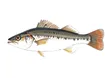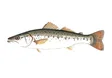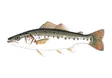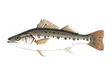
Shimofuri Goby

Tridentiger bifasciatus

Gobiidae · freshwater and saltwater and brackish water fish

6 minute read · Species guide

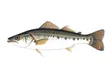
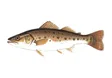
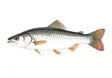
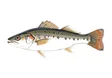
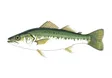
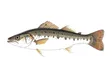
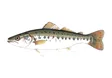
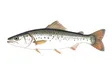
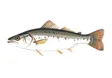
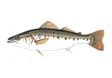
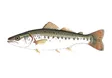
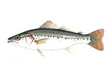
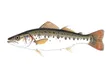
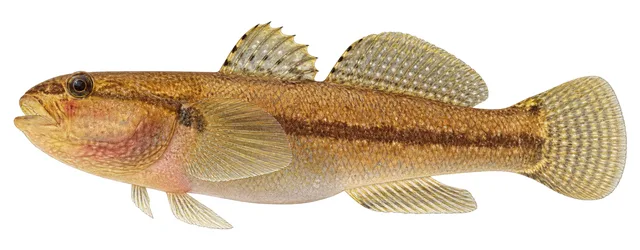
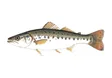
Shimofuri Goby field guide illustration

About Shimofuri Goby

The Shimofuri goby (Tridentiger bifasciatus) is found in fresh and brackish waters. However, it is most abundant in low-salinity environments. The fish has typical features consistent with the family Gobiidae and grows to a maximum of 12 centimetres (4.7 in). These characteristics include two pelvic fins united from a conical sucking disk, a spiny anterior and a soft posterior dorsal fin, and eyes near the top of the head. These fins typically have 6-7 spines and 11-14 rays with orange tints on the edges. Tridentiger bifasciatus has a flat wide head and is highly variable in color, but generally light or dark brown with midlateral spots and minuscule white spots on the head.

The native range of Tridentiger bifasciatus is fresh and brackish water habitats in Asia. This includes Japan, Korea, China, Taiwan, and the former Soviet Union.

The Shimofuri goby is widely distributed in the San Francisco estuary. By 1990, the species traveled down to the Pyramid Lake in Los Angeles County. By 2016, the Shimofuri goby has been found in seven southern California reservoirs. There are 9 total locations with observations that include Los Angeles, Lower Sacramento, San Diego, San Francisco Bay, San Joaquin Delta, San Pablo Bay, Santa Clara, Santa Margarita, and Suisun Bay. The Shimofuri goby is still distributed in its native Asian estuaries which include China, South Korea, Japan, and Russia.

Site and Year of Introduction

Tridentiger bifasciatus was first identified in the Suisun Marsh in 1985. This marsh is the largest brackish, mixture of salt and fresh body of water on the west coast. The Suisun Marsh is located within the upper San Francisco estuary, connecting to the San Francisco Bay. This bay is known for its international cargo ship ports, which is thought to be the reason for the high level of non-native species throughout the connecting bodies of water. The gobies spread from the Suisun Marsh into the connecting Sacramento-San Joaquin Delta which then provided the path into the aqueducts of the California State Water Project in 1993. The CSWP accesses multiple lakes and reservoirs where the Shimofuri goby has been detected until the present day. In 2022, Shimofuri gobies was recorded for the first time in Europe, in the Ghent–Terneuzen Canal, Belgium.

Modes of Distribution and Introduction

The Shimofuri goby is believed to have been introduced through ballast water in 1985. Ballast water is the fluid within a ship, typically a cargo ship, that is used to maintain stability and increase maneuverability when the ships do not have a heavy load on board. The ballast water is pumped off of a ship when cargo is added, to offset the weight difference. This removal of water from the cargo provides a vector for species to travel from one destination to another that otherwise would not be possible.

Factors in Establishment

The Shimofuri goby can withstand a wide range of temperatures and salinity conditions. The goby can tolerate gradual temperature increases up to 37 °C (99 °F) and salinity increases up to 17 PSU. This large range of temperature and salinity resilience allows the Shimofuri goby to compete with native species in the San Francisco Estuary. These factors show the high ecological amplitude of the Shimofuri goby. In addition, the Shimofuri goby has seasonal shifting of dominant diets, meaning they can change their preferred diet according to the availability of prey resources in the environment. These characteristics, as well as direct predation upon local prey resources and competition of resources with native species, demonstrate the high invasiveness of the Shimofuri goby.

Ecological Role

The Shimofuri goby primarily feeds on benthic invertebrates, but also predates fish, fish eggs, and detritus. The goby likely competes with the native species for seasonally abundant prey/ resources. It specializes in seasonally abundant prey and can exploit two novel food sources. In addition, Shimofuri gobies are generalist predators meaning they have several alternative prey species. The goby will typically predate the prey that is the most environmentally available. This makes them competitors to native species in the newly established habitat. However, there has not been continued monitoring to further comprehend the ecological role that the introduction of Shimofuri goby has on their new environment.

Threats

The Shimofuri goby is believed to be a threat to native tidewater goby (Eucyclogobius newberryi) because the two species have very similar habitat and dietary preferences. The overlap in diet includes oligochaetes, polychaetes, ostracods, copepods, and isopods. The endangered tidewater goby plays a large role in estuary food webs, so the diminishing population due to the invasive Shimofuri goby impacts several other species within this ecosystem. This native goby is a main food source of shorebirds, the southern steelhead trout, and the California habitat. A decrease in population levels of the tidewater goby would create a further endangerment of the species, and remove a vital food source to predators that are also endangered species (southern steelhead). These changes in population numbers within California estuaries would impact the prey and predators of each species that exist in connection to the tidewater goby, because of their reduction in numbers by the Shimofuri goby.

Article text: Wikipedia contributors, Shimofuri goby (source revision). Licensed under CC BY-SA 4.0. Retrieved 2026-10-11.
Identification and appearance

Akihito and Sakamoto (1989) resurrected this species after over 50 years of synonomy with T. trigonocephalus. They provided details on distinguishing characteristics, and also provided color photographs for both species. Distinguishing characteristics were also summarized by Matern and Fleming (1995). According to Matern and Fleming (1995), some published reports of T. trigonocephalus in California (e.g., Raquel 1988; Meng et al. 1994) actually refer to T. bifasciatus. Species of Tridentiger can be distinguished from all North American native gobies by the presence of tricuspid (three-lobed) teeth in the outer row of the jaw. This species can be separated from T. trigonocephalus primarily by coloration patterns (white spots on lower portion of head, orange/red margin and no conspicuous stripes on 2nd dorsal and anal fins in T. bifasciatus; no white spots on lower portion of head, white margin and consipicuous stripes on 2nd dorsal and anal fins in T. trigonocephalus), and from T. barbatus by the presence of barbels on the head on the latter species.

Native range

Fresh and brackish water. Asia, including Japan, Korea, China, Taiwan, and the former Soviet Union (Akihito and Sakamoto 1989).

Habitat and ecology

Shimofuri gobies can tolerate a wide range of temperature and salinity values. They exhibit thermal tolerances greater than those of most native fishes in the San Francisco Estuary, and exhibit salinity tolerances well-suited to salinities found throughout most of the San Francisco Estuary (Matern 1999, 2001).

Spawning in the shimofuri goby generally occurs from March to September in oligohaline (up to 19 ppt.) to fresh water (Matern 1999; Wang 2011). Males build and guard nests inside of cavities with hard interior surfaces, such as oyster shells, crevices, logs, or cans/bottles (Matern 1999; Wang 2011). Reproduction occurs multiple times throughout the season (Matern 1999). Maturity is reached in 1 year, with a maximum longevity of 2 years (Matern 1999).

Introduction history

Probably introduced via ballast water circa 1985 (Matern and Fleming 1995).

Ecological impacts

Shimofuri gobies likely compete with native species for Corophium amphipods, which are seasonally abundant in winter and comprise a major prey item of tule perch (Hysterocarpus traski), Sacramento sucker (Catostomus occidentalis), prickly sculpin (Cottus asper), staghorn sculpin (Leptocottus armatus), and starry flounder (Platichthys stellatus) (Feyrer et al. 2003). While Young et al. (2017) found that Shimofuri Goby are habitat generalists in the San Francisco Estuary, they claim the gobies do not have a high impact on the native Prickly Sculpin due to a lack of habitat overlap.

Range

Where it lives

Share of 99 GBIF observation records with a state location, across 1 states.
0%
100%
Share of 99 GBIF observation records with a state location, across 1 states.

Share of records by state

Habitat

Water and movement

Water
WoRMS records this species in fresh water, brackish water and the sea.
USGS NAS habitat
Freshwater;Marine
US status
Exotic — the USGS Nonindigenous Aquatic Species database lists it as introduced from outside North America.
Migration
Migratory
Pattern
  • Diadromous — moves between fresh water and the sea
  • Amphidromous — moves between fresh water and the sea, but not to spawn

Classification

Taxonomy

Kingdom
Animalia
Phylum
Chordata
Superclass
Actinopterygii
Class
Teleostei
Order
Perciformes
Family
Gobiidae
Genus
Tridentiger
Species
Tridentiger bifasciatus
ITIS TSN
553361
WoRMS AphiaID
283045
GBIF key
2376461

Common questions about Shimofuri Goby

What is the scientific name of Shimofuri Goby?
The scientific name is Tridentiger bifasciatus, in the family Gobiidae. Classification follows ITIS.
Does Shimofuri Goby live in fresh water or salt water?
WoRMS records this species in fresh water, brackish water and the sea.
Where has Shimofuri Goby been recorded in the United States?
GBIF has observations in 1 states, with the most records in California. The map shows observation records, which do not establish the complete natural range.

Closest relatives

Other Tridentiger species

Same family

More Gobiidae

Arrow Goby3 states
Clevelandia iosGobiidaeNativeSaltBrackish
Blackfin Goby1 states
Gobionellus atripinnisGobiidaeNativeFreshSaltBrackish
Brown Goby2 states
Bathygobius fuscusGobiidaeIntroducedFreshSaltBrackish
Cabillus caudimacula1 states
GobiidaeNativeSalt
Chameleon Goby1 states
Tridentiger trigonocephalusGobiidaeIntroducedFreshSaltBrackish
Clown Goby7 states
Microgobius gulosusGobiidaeNativeFreshSaltBrackish
Cocos Frillfin Goby1 states
Bathygobius cocosensisGobiidaeIntroducedSaltBrackish
Code Goby7 states
Gobiosoma robustumGobiidaeNativeSaltBrackish
Crested Goby2 states
Lophogobius cyprinoidesGobiidaeNativeFreshSaltBrackish
Frillfin Goby9 states
Bathygobius soporatorGobiidaeNativeFreshSaltBrackish
Green Goby10 states
Microgobius thalassinusGobiidaeNativeSalt
Highfin Goby8 states
Gobionellus oceanicusGobiidaeNativeFreshSaltBrackish
Hiukole Goby1 states
Lentipes concolorGobiidaeNativeFreshBrackish
Longjaw Mudsucker3 states
Gillichthys mirabilisGobiidaeNative and introducedSaltBrackish
Lyre Goby8 states
Evorthodus lyricusGobiidaeNativeFreshSaltBrackish
Naked Goby16 states
Gobiosoma boscGobiidaeNative and introducedSaltBrackish
Naniha Goby1 states
Stenogobius hawaiiensisGobiidaeNativeFreshBrackish
Neon Goby1 states
Elacatinus oceanopsGobiidaeNativeSalt
Nopoli Rockclimbing Goby1 states
Sicyopterus stimpsoniGobiidaeNativeFreshSaltBrackish
Northern Tidewater Goby1 states
Eucyclogobius newberryiGobiidaeNativeSaltBrackish
Notchtongue Goby2 states
Bathygobius curacaoGobiidaeNativeSalt
Pacific River Goby1 states
Awaous guamensisGobiidaeNativeFreshSaltBrackish
Pleurosicya larsonae1 states
GobiidaeNativeSalt
River Goby3 states
Awaous bananaGobiidaeIntroducedFreshBrackish

All 33 species in Gobiidae