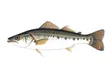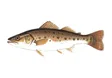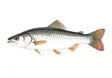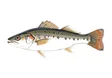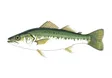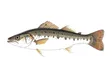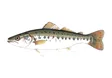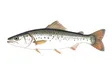
Chameleon Goby

Tridentiger trigonocephalus

Gobiidae · freshwater and saltwater and brackish water fish

4 minute read · Species guide

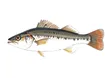
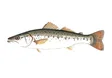
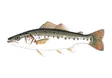
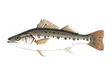
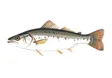
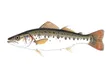
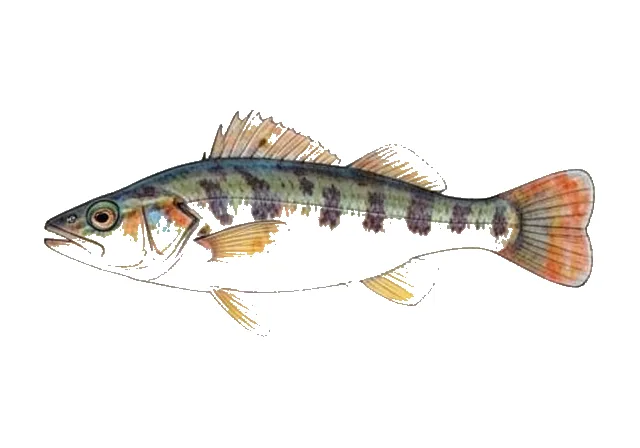
Chameleon Goby field guide illustration

About Chameleon Goby

The chameleon goby (Tridentiger trigonocephalus) is a species of ray-finned fish native to marine and brackish waters along the coasts of eastern Asia. It has also spread to other parts of the world where it is found in waters with varying degrees of salinity.

Description

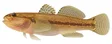
The chameleon goby can reach 11 centimetres (4.3 in) total length. It is pale greyish-brown with a white-speckled head and two longitudinal black bands extending along the flank from the head to the caudal peduncle. The two dorsal fins may be speckled with white and have a brown longitudinal stripe, and the anal fin an orange or grey band across the centre. Under certain circumstances, this fish can darken in colour so that the black bands are nearly invisible. It is very similar in appearance to the Shimofuri goby (Tridentiger bifasciatus), but it has no white spots on the underside of its head and has a white margin to the second dorsal fin and the anal fins. T. bifasciatus has white spots on both the upper and lower part of the head and an orange-red margin to the second dorsal fin and the anal fins, but lacks the distinctive stripes that T. trigonocephalus has on these fins. T. bifasciatus prefers waters with a salinity of less than 22 parts per thousand, while T. trigonocephalus prefers higher salinities.

Distribution and habitat

The chameleon goby is native to the eastern coast of Asia where its range includes Japan, Korea, China and Siberia. There have been reports that it has been found in the Black Sea, and recently in the eastern Mediterranean Sea from Ashdod harbour, Israel.

It is a demersal fish, living and feeding near the seabed, both in bays and rocky coasts, in brackish water and freshwater lakes. It typically hides in crevices, under stones, in burrows or among seagrasses.

Biology

The chameleon goby is mainly nocturnal and feeds mostly on invertebrates such as polychaete worms which it extracts from the sediment. It also consumes crustaceans including skeleton shrimps and crab larvae. Breeding takes place at intervals throughout the spring and summer. The male prepares a nest in a crevice, a mollusc shell or even a discarded bottle or can. The eggs are guarded by the male and hatch after about ten days. The juveniles become mature within a year and their life expectancy is up to three years.

Invasiveness

The chameleon goby was first detected in Los Angeles harbor in 1960 and was later found at other locations in California including Redwood City docks, the tidal lagoon of Lake Merritt in Oakland and San Diego Bay. It has also been reported from Australian waters. Possible means of introduction include being transported in a ship's ballast water, as a result of the commercial trade in Pacific oysters, or as eggs among the fouling organisms on the hull of a vessel. As an invasive species it is likely to compete with native species.

Article text: Wikipedia contributors, Chameleon goby (source revision). Licensed under CC BY-SA 4.0. Retrieved 2026-10-11.
Identification and appearance

Eschmeyer et al. (1983). Distinguishing characteristics were also provided by Masuda et al. (1984), Akhito and Sakamoto (1989), and Matern and Fleming (1995). Color photographs appeared in Masuda et al. (1984) and in Akihito and Sakamoto (1989). Tridentiger bifasciatus, formerly considered a synonym, was resurrected by Akihito and Sakamoto (1989). This species can be separated from the morphologically similar T. bifasciatus primarily based on coloration patterns (no white spots on lower portion of head, white margin and conspicuous stripes on 2nd dorsal and anal fins in T. trigonocephalus; white spots on lower portion of head, orange/red margin and no conspicuous stripes on 2nd dorsal and anal fins in T. bifasciatus) and salinity (T. trigonocephalus prefers salinities of 22 ppt and higher; T. bifasciatus generally found in brackish to freshwater regions of 0-22 ppt). It can be distinguished from T. barbatus by the presence of barbels on the head in the latter species.

Native range

Brackish and marine waters of China, Korea, and Japan (Courtenay et al. 1986; Meng et al. 1994).

Habitat and ecology

Spawning of chameleon gobies in California generally occurs from May through September (Haaker 1979; Wang 2011). Males construct and guard nests in hard substrates such as clam/oyster shells or crevices in jetties, and opportunistically in discarded cans and bottles (Haaker 1979; Wang 2011). Chameleon gobies reach maturity in 1 year, with a maximum life span of 3 years (Dotu 1958).

Introduction history

The initial introduction may have been as fertilized eggs on introduced Japanese oysters (Courtenay et al. 1984, 1986, 1991) or from ballast water (Eschmeyer et al. 1983).

Range

Where it lives

Share of 171 GBIF observation records with a state location, across 1 states.
0%
100%
Share of 171 GBIF observation records with a state location, across 1 states.

Share of records by state

Habitat

Water and movement

Water
WoRMS records this species in fresh water, brackish water and the sea.
USGS NAS habitat
Marine
US status
Exotic — the USGS Nonindigenous Aquatic Species database lists it as introduced from outside North America.

Classification

Taxonomy

Kingdom
Animalia
Phylum
Chordata
Superclass
Actinopterygii
Class
Teleostei
Order
Perciformes
Family
Gobiidae
Genus
Tridentiger
Species
Tridentiger trigonocephalus
ITIS TSN
171912
WoRMS AphiaID
283049
GBIF key
2376462

Common questions about Chameleon Goby

What is the scientific name of Chameleon Goby?
The scientific name is Tridentiger trigonocephalus, in the family Gobiidae. Classification follows ITIS.
Does Chameleon Goby live in fresh water or salt water?
WoRMS records this species in fresh water, brackish water and the sea.
Where has Chameleon Goby been recorded in the United States?
GBIF has observations in 1 states, with the most records in California. The map shows observation records, which do not establish the complete natural range.

Closest relatives

Other Tridentiger species

Same family

More Gobiidae

Arrow Goby3 states
Clevelandia iosGobiidaeNativeSaltBrackish
Blackfin Goby1 states
Gobionellus atripinnisGobiidaeNativeFreshSaltBrackish
Brown Goby2 states
Bathygobius fuscusGobiidaeIntroducedFreshSaltBrackish
Cabillus caudimacula1 states
GobiidaeNativeSalt
Clown Goby7 states
Microgobius gulosusGobiidaeNativeFreshSaltBrackish
Cocos Frillfin Goby1 states
Bathygobius cocosensisGobiidaeIntroducedSaltBrackish
Code Goby7 states
Gobiosoma robustumGobiidaeNativeSaltBrackish
Crested Goby2 states
Lophogobius cyprinoidesGobiidaeNativeFreshSaltBrackish
Frillfin Goby9 states
Bathygobius soporatorGobiidaeNativeFreshSaltBrackish
Green Goby10 states
Microgobius thalassinusGobiidaeNativeSalt
Highfin Goby8 states
Gobionellus oceanicusGobiidaeNativeFreshSaltBrackish
Hiukole Goby1 states
Lentipes concolorGobiidaeNativeFreshBrackish
Longjaw Mudsucker3 states
Gillichthys mirabilisGobiidaeNative and introducedSaltBrackish
Lyre Goby8 states
Evorthodus lyricusGobiidaeNativeFreshSaltBrackish
Naked Goby16 states
Gobiosoma boscGobiidaeNative and introducedSaltBrackish
Naniha Goby1 states
Stenogobius hawaiiensisGobiidaeNativeFreshBrackish
Neon Goby1 states
Elacatinus oceanopsGobiidaeNativeSalt
Nopoli Rockclimbing Goby1 states
Sicyopterus stimpsoniGobiidaeNativeFreshSaltBrackish
Northern Tidewater Goby1 states
Eucyclogobius newberryiGobiidaeNativeSaltBrackish
Notchtongue Goby2 states
Bathygobius curacaoGobiidaeNativeSalt
Pacific River Goby1 states
Awaous guamensisGobiidaeNativeFreshSaltBrackish
Pleurosicya larsonae1 states
GobiidaeNativeSalt
River Goby3 states
Awaous bananaGobiidaeIntroducedFreshBrackish
Rockcut Goby1 states
Gobiosoma grosvenoriGobiidaeNativeSalt

All 33 species in Gobiidae