Plains Killifish

Fundulus zebrinus

Fundulidae · freshwater and brackish water fish

5 minute read · Species guide

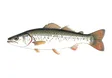
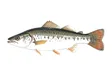
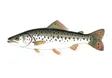
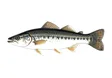
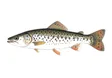
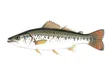
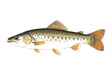
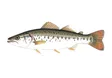
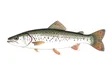
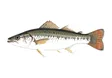
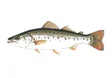
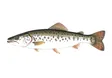
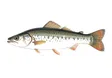
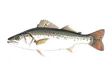
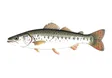
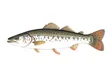
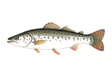
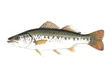
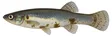
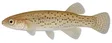
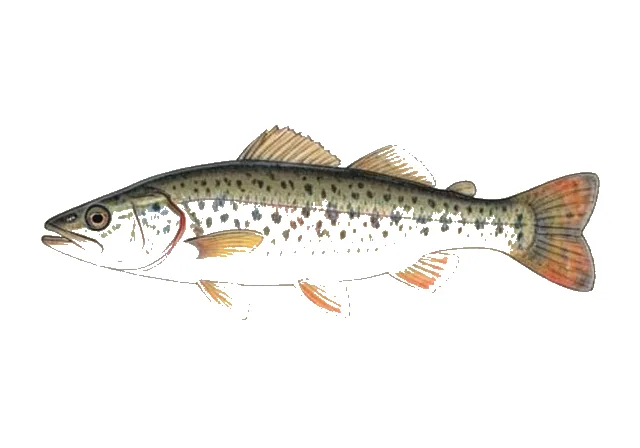
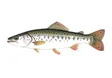
Plains Killifish field guide illustration

About Plains Killifish

Fundulus zebrinus is a species of fish in the Fundulidae known by the common name plains killifish. It is native to North America, where it is distributed throughout the Mississippi River, Colorado River, and Rio Grande drainages, and other river systems; many of its occurrences represent introduced populations.

Description

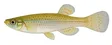
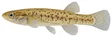
This fish grows up to about 6.9 cm (2.7 in), with a maximum length of 8–10 cm (3.1–3.9 in). Its lifespan is up to 3 years, but most fish do not exceed two. It has a flat head with a protruding jaw that allows it to feed at the water's surface. It is variable in color, being brown, black, greenish, or straw-colored, with paler yellowish or silvery coloration on the belly. The fish is striped with the 12 to 28 dark vertical bars that give the species its scientific name, meaning "like a zebra". The males have wider, darker bars than the females. The breeding male develops bright orange coloration on most of his fins.

This species feeds on chironomid larvae, copepods, nematodes, and other small animals. It is also herbivorous. It may feed by scooping up and swallowing mouthfuls of riverbed substrate to obtain buried food objects. The fish often spits out most of the sand and undigestible material, but the digestive tract usually contains an amount of sand. The fish eats mosquito larvae when available, and studies suggest it might be useful in mosquito abatement efforts.

The fish lives in a number of shallow river and stream habitat types. It may occur in lower, moderate and swift, turbid water flows. It may be found in lakes. It is tolerant of brackish, alkaline, and salty water, more so than most other local fish species. It may bury itself in the substrate with only its eyes and mouth showing. The fish might perform this behavior as a stress response, and it might serve to protect it from sunlight and heat, predators, or low water levels, or to help rid itself of parasites. The killifish may face predation by other fish, notably the green sunfish (Lepomis cyanellus); where this predator occurs, killifish populations drop.

Spawning is associated with water temperature, usually occurring when the temperature exceeds 26 °C (79 °F). Spawning season has been noted to start in April and continue through August.

A number of parasites have been observed on this species, including Myxosoma funduli, a myxozoan, a species of Trichodina, a protozoan, Urocleidus fundulus, a fluke, and Gyrodactylus bulbacanthus, a monogenean, all of which infest the gills. Also, the parasite Gyrodactylus stableri infests the fins and organisms of Neascus, a genus of flukes, infest the eye and internal tissues of the fish. The monogenean gill parasite Salsuginus thalkeni was first described from the fish.

For a long time, fish of the closely related species Fundulus kansae were considered to be members of F. zebrinus, the names being synonyms. F. kansae was sometimes considered a subspecies of F. zebrinus. Molecular and genetic studies supported the separation of the species. F. zebrinus is slightly larger than F. kansae, with larger scales and larger eyes. The fins of the breeding male become more red in color, whereas the male F. kansae develops a more yellow-orange fin color.

Distribution

This species has a wide range, mostly in the central United States. Its native range is mostly within the Great Plains. It includes much of the Mississippi River drainage, parts of the Colorado and Brazos Rivers, and some areas in the Rio Grande region, especially the Pecos River. Its distribution was influenced by Pleistocene changes in the geography of the local river systems, such as glaciation. Many occurrences of the fish represent introductions, such as populations at Lake Powell in Arizona and Utah, the Fort Peck Reservoir in Montana, and several tributaries of the Colorado River in Colorado, Utah, and Nevada. Some occurrences may or may not be native. Fish introductions began in earnest around the 1930s. Most introductions occurred when plains killifish were used as bait by anglers and escaped into the wild to establish new populations.

Article text: Wikipedia contributors, Fundulus zebrinus (source revision). Licensed under CC BY-SA 4.0. Retrieved 2026-10-11.
Diet and feeding

The FishTraits compilation records these diet categories for this species: algae or phytoplankton; invertebrates or larval fish. These are broad categories, not a claim that every individual consumes every example in a category.

Reported feeding positions include bottom feeding and surface or water-column feeding. The compilation combines published observations; diets can vary with age, locality, and available food.

Habitat preferences

Reported habitat associations include medium to large rivers, streams and small rivers, creeks.

The source records associations with clay or silt, sand, gravel. An association indicates reported use, rather than an exclusive requirement.

Reproduction and parental care

The compilation reports a representative maturity age of 1 years. Its maturity field summarizes mean, median, or modal estimates, usually for females; male estimates can be used when female data are unavailable. It is not a fixed age at which every fish first breeds.

Batch or serial spawning has been reported somewhere in the species’ range. This does not establish the same spawning pattern for every population.

Recorded spawning months are Jun, Jul, Aug for the source’s reporting region (NM). This is a regional calendar, not a range-wide schedule.

The reproductive-guild classification includes hiding a brood without subsequent guarding.

Size and recorded longevity

FishTraits reports a maximum total length of 10 centimetres. Some entries use an estimated asymptotic length; this value should not be treated as a certified record catch.

Recorded longevity in the compilation is 2.5 years. Wild observations were preferred, but captive records were accepted where wild records were unavailable, and unspecified records were assumed wild. The value is not a guaranteed wild lifespan or an aquarium life expectancy.

Identification and appearance

Sigler and Sigler (1987); Hubbs et al. (1991); Page and Burr (1991); Pflieger (1997). Fundulus kansae is considered a junior synonym (Poss and Miller 1983).

Native range

Mississippi River and Gulf Slope basins from north central Missouri to central Wyoming, and south to Colorado River, Brazos River, Galveston Bay, and Rio Grande (primarily Pecos River) drainages, Texas. Mostly on Great Plains (Page and Burr 1991).

Introduction history

Most introductions apparently originated from bait bucket releases. In western Colorado, the species may have been introduced by bait bucket transfers or accidentally stocked as a contaminant with other species, although upstream expansion from Utah cannot be ruled out (Woodling 1985). It possibly spread downstream into the Big Horn River of Montana from Wyoming (Brown 1971). The species has been introduced widely since about the 1930s (Poss and Miller 1983).

Range

Where it lives

Share of 8,379 GBIF observation records with a state location, across 16 states. The orange dots are USGS stream-survey sites where this species was caught.
0%
44.2%
Share of 8,379 GBIF observation records with a state location, across 16 states. The orange dots are USGS stream-survey sites where this species was caught.

A blank area on the dot layer usually means nobody sampled there, not that the fish is absent. Turn on “every survey site” to see where the survey looked.

The USGS stream survey caught it at 263 of its sites, in 10 states. That survey and the GBIF records are two different counts of two different things, so the site keeps them apart.

Habitat

Water and movement

Water
WoRMS records this species in fresh water and brackish water.
USGS NAS habitat
Freshwater
US status
Native transplant — native to part of the United States, moved to other waters inside it.
Migration
Undetermined

Classification

Taxonomy

Kingdom
Animalia
Phylum
Chordata
Superclass
Actinopterygii
Class
Teleostei
Order
Cyprinodontiformes
Genus
Fundulus
Species
Fundulus zebrinus
ITIS TSN
165658
WoRMS AphiaID
276035
GBIF key
5203644

Common questions about Plains Killifish

What is the scientific name of Plains Killifish?
The scientific name is Fundulus zebrinus, in the family Fundulidae. Classification follows ITIS.
Does Plains Killifish live in fresh water or salt water?
WoRMS records this species in fresh water and brackish water.
Where has Plains Killifish been recorded in the United States?
GBIF has observations in 16 states, with the most records in New Mexico, Texas, Oklahoma. The map shows observation records, which do not establish the complete natural range.

Closest relatives

Other Fundulus species

Banded Killifish31 states
Fundulus diaphanusFundulidaeNative and introducedFreshBrackish
Banded Topminnow5 states
Fundulus cingulatusFundulidaeNativeFresh
Barrens Topminnow1 states
Fundulus julisiaFundulidaeNativeFresh
Bayou Killifish6 states
Fundulus pulvereusFundulidaeNativeFreshSaltBrackish
Blackspotted Topminnow17 states
Fundulus olivaceusFundulidaeNativeFresh
Blackstripe Topminnow20 states
Fundulus notatusFundulidaeNativeFresh
Broadstripe Topminnow2 states
Fundulus euryzonusFundulidaeNativeFresh
California Killifish1 states
Fundulus parvipinnisFundulidaeNativeSaltBrackish
Golden Topminnow14 states
Fundulus chrysotusFundulidaeNativeFresh
Gulf Killifish11 states
Fundulus grandisFundulidaeNative and introducedFreshBrackish
Lined Topminnow8 states
Fundulus lineolatusFundulidaeNativeFresh
Longnose Killifish6 states
Fundulus similisFundulidaeNativeSalt
Marsh Killifish14 states
Fundulus confluentusFundulidaeNativeFreshSaltBrackish
Mummichog22 states
Fundulus heteroclitusFundulidaeNativeFreshSaltBrackish
Northern Starhead Topminnow16 states
Fundulus disparFundulidaeNativeFresh
Northern Studfish21 states
Fundulus catenatusFundulidaeNative and introducedFresh
Plains Topminnow11 states
Fundulus sciadicusFundulidaeNative and introducedFresh
Russetfin Topminnow3 states
Fundulus escambiaeFundulidaeNativeFresh
Saltmarsh Topminnow5 states
Fundulus jenkinsiFundulidaeNativeSaltBrackish
Seminole Killifish4 states
Fundulus seminolisFundulidaeNativeFresh
Southern Starhead Topminnow7 states
Fundulus blairaeFundulidaeNativeFresh
Speckled Killifish2 states
Fundulus rathbuniFundulidaeNativeFresh
Spotfin Killifish12 states
Fundulus luciaeFundulidaeNativeSaltBrackish
Stippled Studfish1 states
Fundulus bifaxFundulidaeNativeFresh

Same family

More Fundulidae

Banded Killifish31 states
Fundulus diaphanusFundulidaeNative and introducedFreshBrackish
Banded Topminnow5 states
Fundulus cingulatusFundulidaeNativeFresh
Barrens Topminnow1 states
Fundulus julisiaFundulidaeNativeFresh
Bayou Killifish6 states
Fundulus pulvereusFundulidaeNativeFreshSaltBrackish
Blackspotted Topminnow17 states
Fundulus olivaceusFundulidaeNativeFresh
Blackstripe Topminnow20 states
Fundulus notatusFundulidaeNativeFresh
Blue-fintop Minnow7 states
Lucania goodeiFundulidaeNativeFresh
Broadstripe Topminnow2 states
Fundulus euryzonusFundulidaeNativeFresh
California Killifish1 states
Fundulus parvipinnisFundulidaeNativeSaltBrackish
Diamond Killifish5 states
Adinia xenicaFundulidaeNativeFreshSaltBrackish
Golden Topminnow14 states
Fundulus chrysotusFundulidaeNativeFresh
Gulf Killifish11 states
Fundulus grandisFundulidaeNative and introducedFreshBrackish
Lined Topminnow8 states
Fundulus lineolatusFundulidaeNativeFresh
Longnose Killifish6 states
Fundulus similisFundulidaeNativeSalt
Marsh Killifish14 states
Fundulus confluentusFundulidaeNativeFreshSaltBrackish
Mummichog22 states
Fundulus heteroclitusFundulidaeNativeFreshSaltBrackish
Northern Starhead Topminnow16 states
Fundulus disparFundulidaeNativeFresh
Northern Studfish21 states
Fundulus catenatusFundulidaeNative and introducedFresh
Plains Topminnow11 states
Fundulus sciadicusFundulidaeNative and introducedFresh
Pygmy Killifish5 states
Leptolucania ommataFundulidaeNativeFresh
Rainwater Killifish20 states
Lucania parvaFundulidaeNative and introducedFreshSaltBrackish
Russetfin Topminnow3 states
Fundulus escambiaeFundulidaeNativeFresh
Saltmarsh Topminnow5 states
Fundulus jenkinsiFundulidaeNativeSaltBrackish
Seminole Killifish4 states
Fundulus seminolisFundulidaeNativeFresh

All 32 species in Fundulidae