Blackspotted Topminnow

Fundulus olivaceus

Fundulidae · freshwater water fish

4 minute read · Species guide

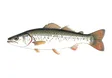
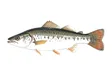
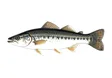
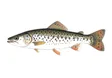
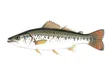
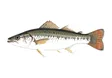
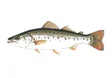
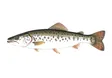
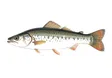
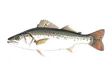
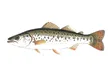
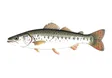
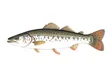
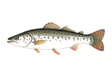
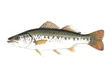
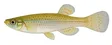
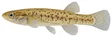
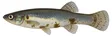
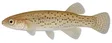
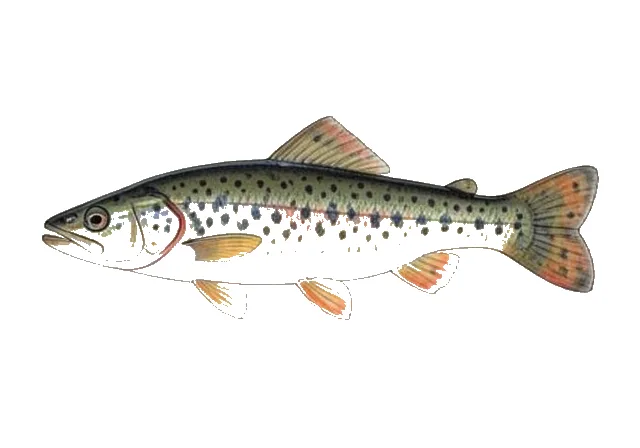
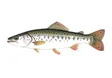
Blackspotted Topminnow field guide illustration

About Blackspotted Topminnow

The blackspotted topminnow, Fundulus olivaceus, is a species of fish in the family Fundulidae: the topminnows and North American killifishes. It is native to the south-central United States, where it is known from the drainages of the Mississippi River from Illinois to the Gulf of Mexico and as far west as Galveston Bay.

This species lives in clear streams with fast currents and sand or gravel substrates. It can often be found near the thick vegetation along the banks of the streams. It is omnivorous, consuming some plant matter along with a main diet of insects and other arthropods.

Description

The blackspotted topminnow has an elongate body up to 9.7 centimetres (3.8 in) long. It is brownish yellow to olive green on its upper side and has a wide, dark lateral band and distinct dark spots. The male has longer fins than the female and the fins of the male may take on a yellowish color during breeding. This species is very similar to the blackstripe topminnow (Fundulus notatus), which also has a dark lateral band. It can be distinguished from F. notatus by its darker, more numerous spots. The two may hybridize. In Fundulus olivaceus, the gill slit extends the dorsal to the uppermost pectoral fin ray. The distance from the origin of the dorsal fin to the end of the hypural plate is less than the distance from the origin of the dorsal fin to the preopercle or occasionally about equal to that distance. The mouth is sightly supraterminal.

Diet

The blackspotted topminnow eats various arthropods and algae.

Habitat

This species occurs near the surface in quiet or flowing, relatively clear, sand-gravel bottom headwaters, creeks, and small rivers; often occurring along margins near thick stands of emergent vegetation.

Reproduction and life cycle

Spawning season for the blackspotted topminnow stretches from March to early September, with peak spawning occurring in May. On occasion, large males have been observed keeping an open territory of three square meters, Males seldom tolerate females in the wild, except during morning or evening spawning activities. In the aquarium, however, thus fish loses its wild traits, and becomes less aggressive. When spawning approaches, though, the males start to reveal their wild, aggressive traits. The males will approach each other head-on, and exhibit flaring opercula and gular areas—very similar to cichlid or betta behavior. They will then begin to slap and bite each other's flanks until one backs down. Ripe eggs are an average of 2.14 mm in diameter. The outer egg membrane has filaments that tend to be restricted to one area forming a tuft. The eggs hatch in 10–14 days while the fish lives for about 3 years.

Distribution

Range of the blackspotted topminnow includes the Gulf Slope, from Galveston Bay drainage, Texas, east to Choctawhatchee River system, Florida, and middle Chattahoochee River drainage, Georgia; Mississippi River basin from the Gulf to southeastern Kansas, central Missouri, southern Illinois, western Kentucky, and eastern Tennessee.

Etymology

The scientific name of the blackspotted topminnow can be broken down in order to understand its meaning. The genus name Fundulus, is from the Latin name Fundus, meaning "bottom". The species name olivaceus means "olive-colored".

Article text: Wikipedia contributors, Fundulus olivaceus (source revision). Licensed under CC BY-SA 4.0. Retrieved 2026-10-11.
Diet and feeding

The FishTraits compilation records these diet categories for this species: algae or phytoplankton; invertebrates or larval fish. These are broad categories, not a claim that every individual consumes every example in a category.

Reported feeding positions include surface or water-column feeding. The compilation combines published observations; diets can vary with age, locality, and available food.

Habitat preferences

Reported habitat associations include streams and small rivers, creeks.

The source records associations with sand, gravel, vegetation. An association indicates reported use, rather than an exclusive requirement.

Reproduction and parental care

The compilation reports a representative maturity age of 1 years. Its maturity field summarizes mean, median, or modal estimates, usually for females; male estimates can be used when female data are unavailable. It is not a fixed age at which every fish first breeds.

Batch or serial spawning has been reported somewhere in the species’ range. This does not establish the same spawning pattern for every population.

Recorded spawning months are Mar, Apr, May, Jun, Jul, Aug, Sep for the source’s reporting region (MS). This is a regional calendar, not a range-wide schedule.

The reproductive-guild classification includes spawning on open substrates without guarding the brood.

Size and recorded longevity

FishTraits reports a maximum total length of 9.7 centimetres. Some entries use an estimated asymptotic length; this value should not be treated as a certified record catch.

Recorded longevity in the compilation is 3 years. Wild observations were preferred, but captive records were accepted where wild records were unavailable, and unspecified records were assumed wild. The value is not a guaranteed wild lifespan or an aquarium life expectancy.

Range

Where it lives

Share of 15,256 GBIF observation records with a state location, across 17 states. The orange dots are USGS stream-survey sites where this species was caught.
0%
28.5%
Share of 15,256 GBIF observation records with a state location, across 17 states. The orange dots are USGS stream-survey sites where this species was caught.

A blank area on the dot layer usually means nobody sampled there, not that the fish is absent. Turn on “every survey site” to see where the survey looked.

The USGS stream survey caught it at 1,341 of its sites, in 13 states. That survey and the GBIF records are two different counts of two different things, so the site keeps them apart.

Habitat

Water and movement

Water
WoRMS records this species in fresh water.
Migration
Not migratory

Classification

Taxonomy

Kingdom
Animalia
Phylum
Chordata
Superclass
Actinopterygii
Class
Teleostei
Order
Cyprinodontiformes
Genus
Fundulus
Species
Fundulus olivaceus
ITIS TSN
165655
WoRMS AphiaID
1021272
GBIF key
5203637

Common questions about Blackspotted Topminnow

What is the scientific name of Blackspotted Topminnow?
The scientific name is Fundulus olivaceus, in the family Fundulidae. Classification follows ITIS.
Does Blackspotted Topminnow live in fresh water or salt water?
WoRMS records this species in fresh water.
Where has Blackspotted Topminnow been recorded in the United States?
GBIF has observations in 17 states, with the most records in Alabama, Mississippi, Arkansas. The map shows observation records, which do not establish the complete natural range.

Closest relatives

Other Fundulus species

Banded Killifish31 states
Fundulus diaphanusFundulidaeNative and introducedFreshBrackish
Banded Topminnow5 states
Fundulus cingulatusFundulidaeNativeFresh
Barrens Topminnow1 states
Fundulus julisiaFundulidaeNativeFresh
Bayou Killifish6 states
Fundulus pulvereusFundulidaeNativeFreshSaltBrackish
Blackstripe Topminnow20 states
Fundulus notatusFundulidaeNativeFresh
Broadstripe Topminnow2 states
Fundulus euryzonusFundulidaeNativeFresh
California Killifish1 states
Fundulus parvipinnisFundulidaeNativeSaltBrackish
Golden Topminnow14 states
Fundulus chrysotusFundulidaeNativeFresh
Gulf Killifish11 states
Fundulus grandisFundulidaeNative and introducedFreshBrackish
Lined Topminnow8 states
Fundulus lineolatusFundulidaeNativeFresh
Longnose Killifish6 states
Fundulus similisFundulidaeNativeSalt
Marsh Killifish14 states
Fundulus confluentusFundulidaeNativeFreshSaltBrackish
Mummichog22 states
Fundulus heteroclitusFundulidaeNativeFreshSaltBrackish
Northern Starhead Topminnow16 states
Fundulus disparFundulidaeNativeFresh
Northern Studfish21 states
Fundulus catenatusFundulidaeNative and introducedFresh
Plains Killifish16 states
Fundulus zebrinusFundulidaeNative and introducedFreshBrackish
Plains Topminnow11 states
Fundulus sciadicusFundulidaeNative and introducedFresh
Russetfin Topminnow3 states
Fundulus escambiaeFundulidaeNativeFresh
Saltmarsh Topminnow5 states
Fundulus jenkinsiFundulidaeNativeSaltBrackish
Seminole Killifish4 states
Fundulus seminolisFundulidaeNativeFresh
Southern Starhead Topminnow7 states
Fundulus blairaeFundulidaeNativeFresh
Speckled Killifish2 states
Fundulus rathbuniFundulidaeNativeFresh
Spotfin Killifish12 states
Fundulus luciaeFundulidaeNativeSaltBrackish
Stippled Studfish1 states
Fundulus bifaxFundulidaeNativeFresh

Same family

More Fundulidae

Banded Killifish31 states
Fundulus diaphanusFundulidaeNative and introducedFreshBrackish
Banded Topminnow5 states
Fundulus cingulatusFundulidaeNativeFresh
Barrens Topminnow1 states
Fundulus julisiaFundulidaeNativeFresh
Bayou Killifish6 states
Fundulus pulvereusFundulidaeNativeFreshSaltBrackish
Blackstripe Topminnow20 states
Fundulus notatusFundulidaeNativeFresh
Blue-fintop Minnow7 states
Lucania goodeiFundulidaeNativeFresh
Broadstripe Topminnow2 states
Fundulus euryzonusFundulidaeNativeFresh
California Killifish1 states
Fundulus parvipinnisFundulidaeNativeSaltBrackish
Diamond Killifish5 states
Adinia xenicaFundulidaeNativeFreshSaltBrackish
Golden Topminnow14 states
Fundulus chrysotusFundulidaeNativeFresh
Gulf Killifish11 states
Fundulus grandisFundulidaeNative and introducedFreshBrackish
Lined Topminnow8 states
Fundulus lineolatusFundulidaeNativeFresh
Longnose Killifish6 states
Fundulus similisFundulidaeNativeSalt
Marsh Killifish14 states
Fundulus confluentusFundulidaeNativeFreshSaltBrackish
Mummichog22 states
Fundulus heteroclitusFundulidaeNativeFreshSaltBrackish
Northern Starhead Topminnow16 states
Fundulus disparFundulidaeNativeFresh
Northern Studfish21 states
Fundulus catenatusFundulidaeNative and introducedFresh
Plains Killifish16 states
Fundulus zebrinusFundulidaeNative and introducedFreshBrackish
Plains Topminnow11 states
Fundulus sciadicusFundulidaeNative and introducedFresh
Pygmy Killifish5 states
Leptolucania ommataFundulidaeNativeFresh
Rainwater Killifish20 states
Lucania parvaFundulidaeNative and introducedFreshSaltBrackish
Russetfin Topminnow3 states
Fundulus escambiaeFundulidaeNativeFresh
Saltmarsh Topminnow5 states
Fundulus jenkinsiFundulidaeNativeSaltBrackish
Seminole Killifish4 states
Fundulus seminolisFundulidaeNativeFresh

All 32 species in Fundulidae