Rainwater Killifish

Lucania parva

Fundulidae · freshwater and saltwater and brackish water fish

3 minute read · Species guide

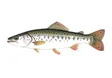
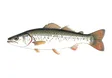
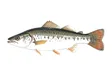
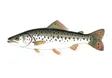
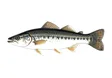
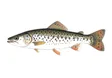
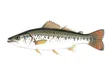
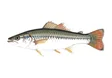
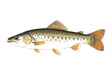
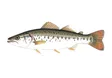
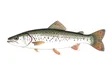
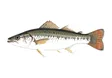
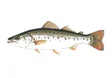
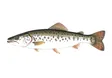
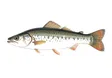
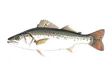
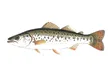
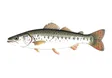
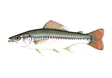
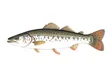
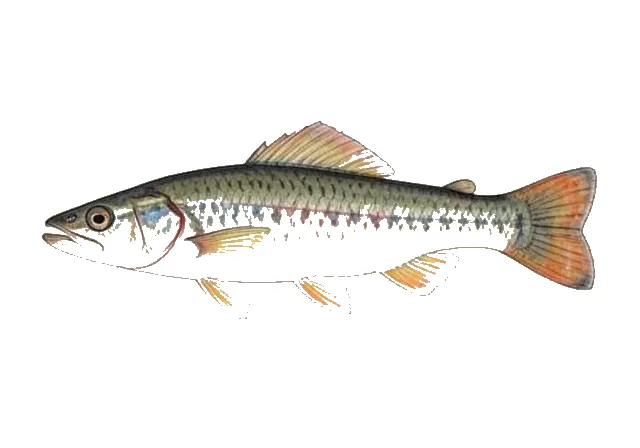
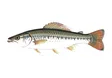
Rainwater Killifish field guide illustration

About Rainwater Killifish

The rainwater killifish (Lucania parva) is a small silvery fish with yellow flashes and diamond shaped scales that is widespread from Cape Cod, Massachusetts, through to Tampico, Mexico, with occurrences reported on the Yucatán peninsula. It is commonly found in large numbers in fresh to brackish estuarine environments, and inland in parts of New Mexico, Texas and Mexico. It feeds on various aquatic invertebrates. It can reach up to 7 centimetres (2.8 in) total length.

Species description and etymology

The rainwater killifish was formally described by Spencer Fullerton Baird and Charles Frédéric Girard as Cyprinodon parvus with the type locality given as Beesley's Point, New Jersey and as Greenport, Long Island, New York. The name of the genus, Lucania, is a Native American word from an unknown language and of unknown meaning which presumably Girard liked the sound of. Girard named this species as the type species of the genus Lucania in 1859 but using the junior synonym Limia venusta. The specific name is Latin for "small".

Article text: Wikipedia contributors, Rainwater killifish (source revision). Licensed under CC BY-SA 4.0. Retrieved 2026-10-11.
Diet and feeding

The FishTraits compilation records these diet categories for this species: algae or phytoplankton; aquatic or other vascular plants; invertebrates or larval fish. These are broad categories, not a claim that every individual consumes every example in a category.

Reported feeding positions include bottom feeding. The compilation combines published observations; diets can vary with age, locality, and available food.

Habitat preferences

Reported habitat associations include medium to large rivers, streams and small rivers.

The source records associations with clay or silt, sand, vegetation. An association indicates reported use, rather than an exclusive requirement.

The species is classified as tolerant of a broad range of salinities. This flag does not specify a salinity range for aquarium care.

Reproduction and parental care

The compilation reports a representative maturity age of 0.4 years. Its maturity field summarizes mean, median, or modal estimates, usually for females; male estimates can be used when female data are unavailable. It is not a fixed age at which every fish first breeds.

Recorded spawning months are Jan, Feb, Mar, Apr, May, Jun, Jul, Aug, Sep, Oct, Nov, Dec for the source’s reporting region (AL). This is a regional calendar, not a range-wide schedule.

Size and recorded longevity

FishTraits reports a maximum total length of 6.2 centimetres. Some entries use an estimated asymptotic length; this value should not be treated as a certified record catch.

Native range

Marine, but enters freshwater from Massachusetts to Mexico. Ascends the Pecos River, Texas and New Mexico (Hubbs and Miller 1965; Page and Burr 1991).

Introduction history

Many introductions likely were the result of contaminated stock (Sigler and Miller 1963; Hubbs and Miller 1965; Moyle 1976a, 1976b). In Utah, Rainwater Killifish arrived as a stock contaminant in a shipment of largemouth bass (Sigler and Sigler 1987). In northern California and Oregon, Rainwater Killifish may have been transported as eggs on planted oysters (Hubbs and Miller 1965; Moyle 1976a, b) or with ballast water from the Atlantic Coast (Hubbs and Miller 1965). In southern California it was a contaminant in a shipment of largemouth bass (Hubbs and Miller 1965; Moyle 1976b). Hubbs and Miller (1965) indicated some introductions may have resulted when the species was stocked along with Gambusia during mosquito control operations or from aquarium release, but that these routes were less likely than stock contamination. Most of the original introductions in the western United States apparently occurred during the 1940s and 1950s (Hubbs and Miller 1965). The species was introduced into the Great Swamp in New Jersey in 1969 (Stiles 1978) and into Texas in about 1980 (Hubbs et al. 1991), but the reasons for these introductions were not given.

Range

Where it lives

Share of 62,400 GBIF observation records with a state location, across 20 states.
0%
62.1%
Share of 62,400 GBIF observation records with a state location, across 20 states.

Habitat

Water and movement

Water
WoRMS records this species in fresh water, brackish water and the sea.
USGS NAS habitat
Freshwater
US status
Native transplant — native to part of the United States, moved to other waters inside it.
Migration
Migratory
Pattern
  • Anadromous — spawns in fresh water, grows at sea
  • Amphidromous — moves between fresh water and the sea, but not to spawn
Disagreement
2 published references do not agree on the pattern: Amphidromous, Anadromous. The site shows every assignment rather than picking one.

Classification

Taxonomy

Kingdom
Animalia
Phylum
Chordata
Superclass
Actinopterygii
Class
Teleostei
Order
Cyprinodontiformes
Genus
Lucania
Species
Lucania parva
ITIS TSN
165679
WoRMS AphiaID
159310
GBIF key
2349567

Common questions about Rainwater Killifish

What is the scientific name of Rainwater Killifish?
The scientific name is Lucania parva, in the family Fundulidae. Classification follows ITIS.
Does Rainwater Killifish live in fresh water or salt water?
WoRMS records this species in fresh water, brackish water and the sea.
Where has Rainwater Killifish been recorded in the United States?
GBIF has observations in 20 states, with the most records in Texas, Florida, New Mexico. The map shows observation records, which do not establish the complete natural range.

Closest relatives

Other Lucania species

Same family

More Fundulidae

Banded Killifish31 states
Fundulus diaphanusFundulidaeNative and introducedFreshBrackish
Banded Topminnow5 states
Fundulus cingulatusFundulidaeNativeFresh
Barrens Topminnow1 states
Fundulus julisiaFundulidaeNativeFresh
Bayou Killifish6 states
Fundulus pulvereusFundulidaeNativeFreshSaltBrackish
Blackspotted Topminnow17 states
Fundulus olivaceusFundulidaeNativeFresh
Blackstripe Topminnow20 states
Fundulus notatusFundulidaeNativeFresh
Blue-fintop Minnow7 states
Lucania goodeiFundulidaeNativeFresh
Broadstripe Topminnow2 states
Fundulus euryzonusFundulidaeNativeFresh
California Killifish1 states
Fundulus parvipinnisFundulidaeNativeSaltBrackish
Diamond Killifish5 states
Adinia xenicaFundulidaeNativeFreshSaltBrackish
Golden Topminnow14 states
Fundulus chrysotusFundulidaeNativeFresh
Gulf Killifish11 states
Fundulus grandisFundulidaeNative and introducedFreshBrackish
Lined Topminnow8 states
Fundulus lineolatusFundulidaeNativeFresh
Longnose Killifish6 states
Fundulus similisFundulidaeNativeSalt
Marsh Killifish14 states
Fundulus confluentusFundulidaeNativeFreshSaltBrackish
Mummichog22 states
Fundulus heteroclitusFundulidaeNativeFreshSaltBrackish
Northern Starhead Topminnow16 states
Fundulus disparFundulidaeNativeFresh
Northern Studfish21 states
Fundulus catenatusFundulidaeNative and introducedFresh
Plains Killifish16 states
Fundulus zebrinusFundulidaeNative and introducedFreshBrackish
Plains Topminnow11 states
Fundulus sciadicusFundulidaeNative and introducedFresh
Pygmy Killifish5 states
Leptolucania ommataFundulidaeNativeFresh
Russetfin Topminnow3 states
Fundulus escambiaeFundulidaeNativeFresh
Saltmarsh Topminnow5 states
Fundulus jenkinsiFundulidaeNativeSaltBrackish
Seminole Killifish4 states
Fundulus seminolisFundulidaeNativeFresh

All 32 species in Fundulidae