Peamouth

Mylocheilus caurinus

Leuciscidae · freshwater and brackish water fish

5 minute read · Species guide

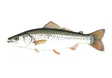
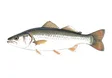
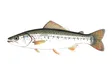
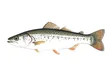
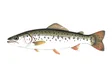
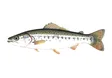
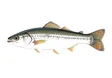
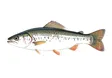
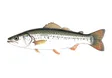
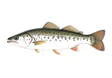
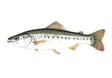
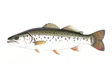
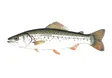
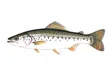
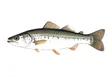
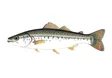
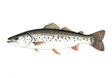
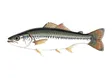
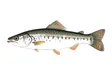
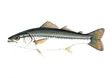
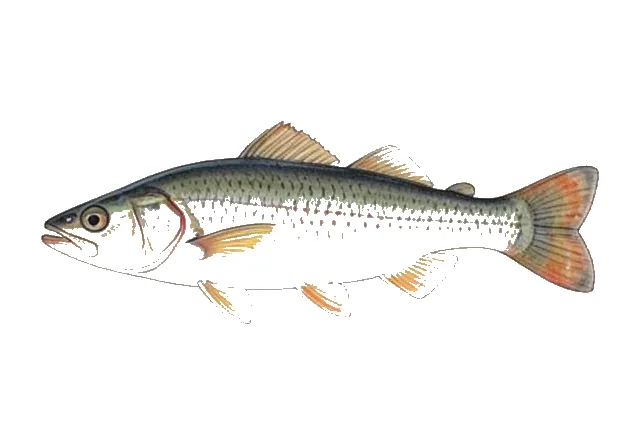
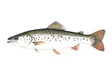
Peamouth field guide illustration

About Peamouth

The peamouth (Mylocheilus caurinus), also known as the peamouth chub, redmouth sucker or northwestern dace, is a species of freshwater ray-finned fish from the family Leuciscidae, the shiners, daces and minnows. This species is found in western North America.

Taxonomy

The peamouth is the only extant species in the genus Mylocheilus. However, three fossil species are also known from the Late Miocene and Pliocene of western North America.

Description

The peamouth is a slender fish, with a somewhat compressed body and a subterminal mouth, large eyes, a rounded snout and a forked tail. It has a dark back, contrasting with silvery underparts separated by two dusky, longitudinal stripes. The mouth is reddish at the corners where there are small barbels. When breeding the mature males develop a red stripe along the sides on the belly, mouth, gill cover and pectoral fin base. The dorsal fin and the anal fin each have 8 soft rays and the lateral line has 66–84 scales. They can grow to 36 centimetres (14 in) in total length.

Distribution

The peamouth occurs in western North America from the Mackenzie River in the North West Territories, the Nass River and the Peace River in British Columbia and the Columbia River drainage in Washington state, Oregon, Montana and Idaho. It is relatively tolerant of salt water and this has allowed it to colonise rivers on Vancouver Island and other islands off the coast of British Columbia. It has been introduced to the Redwood National Park in California.

Habitat

The peamouth can be found in the shallow, weedy zones of lakes and rivers, where it is most common among vegetation. It is usually found near the bed in depths of less than 60 feet (18 m), although in winter they will move to the deeper parts of lakes.

Biology

Young peamouths feed predominantly on micro-crustaceans which are also preyed on by the adult fish but their diet is expanded to include snails, adult aquatic and terrestrial insects and even the occasional small fish.

The peamouth reaches sexual maturity at 3–4 years old, the males normally reaching it faster than the females. Spawning takes place in May and June when the water reaches temperatures of 54–64 °F (12–18 °C), and happens in streams or along the shores of lakes where there are gravel or stony substrates in shallow water which is within 3 feet (0.91 m) of the bank. The eggs adhere to rocks or other substrates. The fish may spawn several times in a season, and the timing of spawning is not fully understood. The spawning runs of the peamouth make an impressive natural spectacle as the brightly colored fish move into areas of warm, shallow, flowing water in large numbers. These schools attract many fish-eating predators. The newly hatched fry form schools near the shore, moving into deeper water later in the summer. Each female is normally attended by at least two males and can lay between 5,000 and 30,000 eggs, the amount being dependent on the age and size of the individual fish.

The fish may spend the day in deeper water and move to the shallows to feed at night. They are preyed on by a variety of piscivorous mammals and birds, as well as by larger fish species. They may attain a life span of 8 years

Human use

They have been used as a food fish by people the past and are still fished for by anglers. In Bellevue City near Seattle has an online alert system which informs people when the peamouth appear to spawn in the local streams so that interested people can observe the spectacle, being informed by email whenever the fish are observed.

Hybridisation

Hybrids between the peamouth and the Northern pikeminnow (Ptychocheilus oregonensis) and the redside shiner (Richardsonius balteatus) have been recorded throughout North America. The latter hybrid was once described as Cheonda cooperi before its true nature was discovered.

Article text: Wikipedia contributors, Peamouth (source revision). Licensed under CC BY-SA 4.0. Retrieved 2026-10-11.
Diet and feeding

The FishTraits compilation records these diet categories for this species: algae or phytoplankton; invertebrates or larval fish; larger animal prey (a source category covering fish, crayfish, crabs, or frogs). These are broad categories, not a claim that every individual consumes every example in a category.

Reported feeding positions include bottom feeding and surface or water-column feeding. The compilation combines published observations; diets can vary with age, locality, and available food.

Habitat preferences

Reported habitat associations include medium to large rivers, still-water habitats.

The source records associations with clay or silt, sand, vegetation. An association indicates reported use, rather than an exclusive requirement.

Reproduction and parental care

The compilation reports a representative maturity age of 4 years. Its maturity field summarizes mean, median, or modal estimates, usually for females; male estimates can be used when female data are unavailable. It is not a fixed age at which every fish first breeds.

Recorded spawning months are May, Jun, Jul for the source’s reporting region (WA). This is a regional calendar, not a range-wide schedule.

The reproductive-guild classification includes spawning on open substrates without guarding the brood.

Size and recorded longevity

FishTraits reports a maximum total length of 36 centimetres. Some entries use an estimated asymptotic length; this value should not be treated as a certified record catch.

Recorded longevity in the compilation is 13 years. Wild observations were preferred, but captive records were accepted where wild records were unavailable, and unspecified records were assumed wild. The value is not a guaranteed wild lifespan or an aquarium life expectancy.

Record fish

The Montana state record

  • Montana1.52 lbs.

    Clark Fork River · 7/29/07 · Mike Jensen

Each figure is the state agency’s own certified record. The site holds record tables for 11 states so far, so a state missing here has not been read yet. It is not a state where this fish holds no record.

Range

Where it lives

Share of 274 GBIF observation records with a state location, across 5 states.
0%
48.9%
Share of 274 GBIF observation records with a state location, across 5 states.

Habitat

Water and movement

Water
WoRMS records this species in fresh water and brackish water.
USGS NAS habitat
Freshwater
US status
Native transplant — native to part of the United States, moved to other waters inside it.
Migration
Migratory
Pattern
Disagreement
3 published references do not agree on the pattern: Potamodromous, Semi-anadromous. The site shows every assignment rather than picking one.

Classification

Taxonomy

Kingdom
Animalia
Phylum
Chordata
Superclass
Actinopterygii
Class
Teleostei
Order
Cypriniformes
Genus
Mylocheilus
Species
Mylocheilus caurinus
ITIS TSN
163521
WoRMS AphiaID
281605
GBIF key
2360913
Outside the US
ITIS also files it in Canada.

Common questions about Peamouth

What is the scientific name of Peamouth?
The scientific name is Mylocheilus caurinus, in the family Leuciscidae. Classification follows ITIS.
Does Peamouth live in fresh water or salt water?
WoRMS records this species in fresh water and brackish water.
Where has Peamouth been recorded in the United States?
GBIF has observations in 5 states, with the most records in Oregon, Washington, Idaho. The map shows observation records, which do not establish the complete natural range.

Same family

More Leuciscidae

Alabama Shiner4 states
Cyprinella callistiaLeuciscidaeNativeFresh
Allegheny Pearl Dace19 states
Margariscus margaritaLeuciscidaeNative and introducedFresh
Altamaha Shiner1 states
Cyprinella xaenuraLeuciscidaeNativeFresh
Alvord Chub2 states
Siphateles alvordensisLeuciscidaeNativeFresh
Apalachee Shiner3 states
Pteronotropis grandipinnisLeuciscidaeNativeFresh
Arkansas River Shiner5 states
Notropis girardiLeuciscidaeNative and introducedFresh
Arroyo Chub1 states
Gila orcuttiiLeuciscidaeNative and introducedFresh
Bandfin Shiner5 states
Luxilus zonistiusLeuciscidaeNative and introducedFresh
Bannerfin Shiner5 states
Cyprinella leedsiLeuciscidaeNativeFresh
Beautiful Shiner3 states
Cyprinella formosaLeuciscidaeNativeFresh
Bedrock Shiner3 states
Notropis rupestrisLeuciscidaeNativeFresh
Bigeye Chub25 states
Hybopsis amblopsLeuciscidaeNative and introducedFresh
Bigeye Shiner17 states
Notropis boopsLeuciscidaeNative and introducedFresh
Bigmouth Chub3 states
Nocomis platyrhynchusLeuciscidaeNativeFresh
Bigmouth Shiner21 states
Notropis dorsalisLeuciscidaeNative and introducedFresh
Blackchin Shiner13 states
Notropis heterodonLeuciscidaeNativeFresh
Blackmouth Shiner3 states
Notropis melanostomusLeuciscidaeNativeFresh
Blacknose Shiner21 states
Notropis heterolepisLeuciscidaeNative and introducedFresh
Blackside Dace2 states
Chrosomus cumberlandensisLeuciscidaeNativeFresh
Blackspot Shiner5 states
Notropis atrocaudalisLeuciscidaeNativeFresh
Blacktail Shiner14 states
Cyprinella venustaLeuciscidaeNative and introducedFresh
Blacktip Shiner4 states
Lythrurus atrapiculusLeuciscidaeNative and introducedFresh
Bleeding Shiner8 states
Luxilus zonatusLeuciscidaeNativeFresh
Blotched Chub6 states
Erimystax insignisLeuciscidaeNativeFresh

All 267 species in Leuciscidae