Ide

Leuciscus idus

Leuciscidae · freshwater and brackish water fish

10 minute read · Species guide

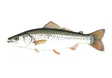
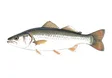
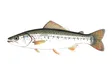
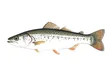
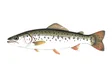
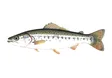
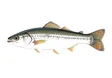
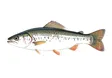
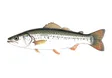
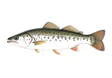
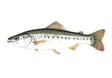
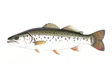
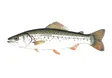
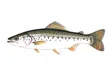
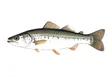
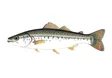
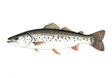
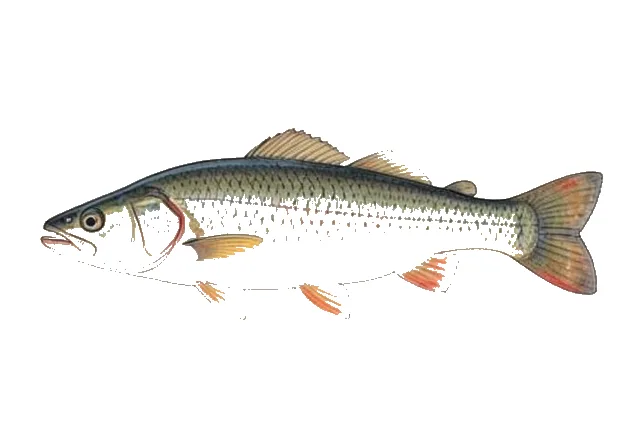
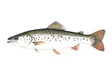
Ide field guide illustration

About Ide

The ide (Leuciscus idus), or orfe, is a species of freshwater ray-finned fish belonging to the family Leuciscidae. The ide is found in larger rivers, ponds, and lakes across Northern Europe and Asia. It has been introduced outside its native range into Europe, North America, and New Zealand. It is a popular ornamental fish, usually kept in outdoor ponds in temperate regions from which it often escapes.

Etymology

The name "ide"is from Swedish id, originally referring to its bright colour (compare the German dialect word Aitel, a kind of bright fish and Old High German Eit, funeral pyre, fire). The alternative name"orfe"derives from German Orf, through the Latin orphus meaning a"sea fish"or"sea perch", which in turn derives from the Greek orphōs. The generic name Leuciscus is derived from the Greek word leykiskos, which means "white mullet".

Description

The ide is a rather plump, sturdily built fish with a deep body, although not especially so. The peduncle of the caudal fin is thick. When they are small, ide have dark backs and silvery sides, but older fish develop a golden sheen along the flanks. At all ages, the eye is yellow and the pectoral fin and anal fin are reddish in colour. The dorsal fin has three spines and 8–11 soft rays, the anal fin has three spines and 8–11 soft rays, while the caudal fin has 19 rays. It has 47 vertebrae. It is distinguished from other European members of the genus Leucsicus by the lateral line having 56–58 scales; 3.5–5.3 pharyngeal teeth, in having a terminal mouth, and branching in 8% of the dorsal rays and 10% of the anal rays. They grow to 25–50 cm in length and the normal weight range is 0.5–1.5 kg and they seldom attain weights over 2.0 kg. The European rod-caught record is 5.5 kg. Reports have been made of ides attaining total lengths around 100 cm and weights of 8 kg.

Distribution

The ide is native to Europe and western Asia from the rivers draining into the North Sea east through southern Scandinavia and eastern Europe to the Caspian Sea drainage and the River Lena. As a popular ornamental fish, it was introduced to Great Britain in 1874 and is now widespread in England and Wales, but only has a localised distribution in Scotland. It was introduced into France and from there and Germany was introduced as an ornamental fish into the Netherlands.

Outside of Europe, the ide was first taken to the United States of America in 1877, when live specimens were imported by the United States Fish Commission to be intentionally stocked in US waters, and this was subsequently done by state agencies, too; the species also spread through escapes from commercial and government ponds. It has now been reported from nine states, but its status in the United States remains uncertain as many records are old and of a few individuals and the species apparently has either failed to establish self-sustaining populations or has been eradicated.

The ide was illegally imported into New Zealand as eggs, sometime in the 1980s. Fish were subsequently released between 1985 and 1986 in no less than eight and possibly as many as 13 sites north of Auckland. Ide probably did not last very long in at least seven of the sites where releases occurred, the outcome in most of the other sites is unknown, and at least one of the release sites remains unknown. Ide likely persist in the wild in at least one site within New Zealand.

Habitat and ecology

Ide occur in schools in the clear pools of larger rivers, ponds, and lakes, but they may move to deeper waters during the winter before moving into shallow fresh water to spawn in the spring. The species is also found in the Baltic Sea, which has a lower salinity than most seas, and in Sweden, the fish spend the first year of their lives in rivers before joining the more mature fish as they migrate downstream into the Baltic Sea during the summer. The fish then return to the rivers in the autumn, where they remain close to the mouths and in the lower reaches throughout the winter.

The ide reaches sexual maturity at 3–5 years of age, and once it has attained total length, which varies from 22 cm to 43 cm, although in cooler waters, it may first breed as late as 7 years of age. It spawns in shallow water in the spring, soon after the ice has melted in the colder parts of its range. Some populations are migratory and ascend rivers and streams to spawn, but others also spawn in shallow parts of lakes and sea inlets. Eggs are usually laid among gravel or on emergent vegetation. Spawning normally lasts for 3–4 days, during which the fish are very active. Each female spawns only once a season, but during spawning, she mates with several males and the males gather at spawning grounds, where they follow ripe females. The females may lay as few as 15,000 and as many as 250,000 eggs, which are about 2 mm in diameter and pale yellow in colour, in a season. The eggs hatch in 1–2 weeks, the young fry being 8–10 mm long. The actual incubation period of eggs varies depending on the water temperature, at 18.5–22.0 °C, incubation takes about 5 days, with the optimal temperature for embryonic development being in the range of 12–18 °C.

The typical prey of the ide is larval and adult insects, snails, and other benthic invertebrates for smaller fish, but larger individuals can be piscivorous, with common roach and common bleak being commonly taken. The smaller fish, larvae, and juveniles occupy a wide variety of shoreline habitats to feed, and they leave the shore areas and move into deeper waters as they grow larger. Smaller ide are sociable and join mixed shoals of other cyprinids, but the larger adult fish form smaller, single-species groups, which patrol what are believed to be regular routes. The ide prefers clear, warmer water, and is not as tolerant of eutrophication as some related species. Ide spawn in running water, so the obstruction of rivers by dams and other man-made objects can negatively affect this fish.

Human uses

As an ornamental fish, the ide is usually referred to as the orfe, and the main variety kept is the golden orfe, which is golden or orange in colour with some black spots on its neck, near the head. Also, a much less common blue variety is known as the blue orfe. As they grow quite large, they are not considered to be suitable for indoor aquaria, and they recommended to be kept outside as a shoal in a pond. They require better-oxygenated water than koi or goldfish, but can be kept in association with these species. Golden orfe were very popular as an ornamental pond fish until koi became readily available in the 1960s.

In their native range, they are popular as a quarry for anglers; in eastern Europe, the ide is regarded as edible and is prized as a food fish, and are netted and sold commercially along the Danube. In more northern parts of the range, though, they are not regarded as a desirable food fish. They are also fished for as coarse fish in the United Kingdom, but there they tend to be localised to commercial fisheries or to sites where they have been introduced.

Article text: Wikipedia contributors, Ide (fish) (source revision). Licensed under CC BY-SA 4.0. Retrieved 2026-10-11.
Diet and feeding

The FishTraits compilation records these diet categories for this species: invertebrates or larval fish; larger animal prey (a source category covering fish, crayfish, crabs, or frogs). These are broad categories, not a claim that every individual consumes every example in a category.

Habitat preferences

Reported habitat associations include medium to large rivers, streams and small rivers, still-water habitats.

The source records associations with gravel, vegetation. An association indicates reported use, rather than an exclusive requirement.

The species is classified as tolerant of a broad range of salinities. This flag does not specify a salinity range for aquarium care.

Reproduction and parental care

The compilation reports a representative maturity age of 5 years. Its maturity field summarizes mean, median, or modal estimates, usually for females; male estimates can be used when female data are unavailable. It is not a fixed age at which every fish first breeds.

Recorded spawning months are Mar, Apr, May, Jun for the source’s reporting region (Europe). This is a regional calendar, not a range-wide schedule.

The reproductive-guild classification includes spawning on open substrates without guarding the brood.

Size and recorded longevity

FishTraits reports a maximum total length of 76 centimetres. Some entries use an estimated asymptotic length; this value should not be treated as a certified record catch.

Recorded longevity in the compilation is 18 years. Wild observations were preferred, but captive records were accepted where wild records were unavailable, and unspecified records were assumed wild. The value is not a guaranteed wild lifespan or an aquarium life expectancy.

Spawning movements

The compilation records significant spawning-related movement. Its combined migration flag covers movements within fresh water as well as between rivers and the sea; this flag alone does not establish which migration pattern applies.

Identification and appearance

Leuciscus idus is superficially similar to many native North American cyprinids and does not possess a unique characteristic that easily sets it apart from native species. However, L. idus can be distinguished from most native North American cyprinids using the following characteristics: pharyngeal teeth 3,5-5,3, no barbels, lateral-line scales 55-63, and typically 8 branched dorsal rays. Further distinguishing characteristics and photographs or illustrations appeared in Berg (1949), Muus and Dahlstrom (1978), Wheeler (1978), Phillips and Rix (1985), and Smith (1995), along with Page and Burr (1991).

Native range

Native from northern Europe through Siberia (Berg 1949; Robins et al. 1991).

Habitat and ecology

Leuciscus idus spawn in tributaries where their eggs attach to gravel, weeds, and stones (Froese 2013). Juveniles prefer water depths up to 2 m and flow velocities of about 0.5 m/s2 (Grift 2001).

Introduction history

Leuciscus idus was first imported in 1877 by the U.S. Fish Commission (Baird 1879). Historically, it was intentionally stocked by the U.S. Fish Commission; recent introductions include intentional stocking by a state agency and escapes from commercial and government ponds (Lee et al. 1980 et seq.). In 1889, an estimated 20 Ide, along with other foreign cyprinids, escaped into the Potomac River from fish ponds in Washington, D.C., during a flood event (McDonald 1893). Similarly, Schwartz (1963) stated that it may have escaped from commercial ponds at Thurmont, Maryland into the Monocacy River; but he did not provide a date nor other details. Ide were also consigned to applicants in Virginia from 1892 to 1894 (Jenkins and Burkhead 1994). According to Courtenay et al. (1984, 1986), the U.S. Fish Commission gave no specific reason for importing and distributing this species, although they assumed that the intended use was both as an ornamental and food fish. Bean (1903) indicated that this species was introduced into American ponds for ornamental purposes. Schwartz (1963) stated that it may have escaped from commercial ponds at Thurmont, Maryland into the Monocacy River; but he did not provide a date or other details. Reports of Ide culture in Arkansas are incongruous. Fletcher and Hallock (1992) reported that Arkansas fish farmers were raising Ide for bait in the early 1990s. However, recent discussions with University of Arkansas personnel, fish farmers, and other local experts indicate there are no known records of ide culture in Arkansas and that they are doubtful the the species was ever raised commercially there (N. Stone, Univ. of Ark., pers. comm., 2005). In the early 1980s this species was reportedly being used as a bait fish in Tennessee (Courtenay et al. 1984, 1986). Because this species is sometimes misidentified as goldfish, Courtenay et al. (1984) argued that there was an increased probability of its spread and possible establishment.

Ecological impacts

Unknown. Seeley (1962) recommended against the introduction of the Ide into California. Based on his review of the literature, he indicated the species had the potential of becoming established in state rivers, lakes, and reservoirs, and also of entering brackish and estuarine waters. Because of its tolerance to a wide range of conditions, Seeley believed that it had the potential of becoming more of a problem than either Goldfish Carassius auratus or Common Carp Cyprinus carpio.

Range

Where it lives

Share of 16 GBIF observation records with a state location, across 8 states.
0%
31.3%
Share of 16 GBIF observation records with a state location, across 8 states.

Habitat

Water and movement

Water
WoRMS records this species in fresh water and brackish water.
USGS NAS habitat
Freshwater
US status
Exotic — the USGS Nonindigenous Aquatic Species database lists it as introduced from outside North America.
Migration
Migratory
Pattern

Classification

Taxonomy

Kingdom
Animalia
Phylum
Chordata
Superclass
Actinopterygii
Class
Teleostei
Order
Cypriniformes
Genus
Leuciscus
Species
Leuciscus idus
ITIS TSN
163576
WoRMS AphiaID
154324
GBIF key
4409643

Common questions about Ide

What is the scientific name of Ide?
The scientific name is Leuciscus idus, in the family Leuciscidae. Classification follows ITIS.
Does Ide live in fresh water or salt water?
WoRMS records this species in fresh water and brackish water.
Where has Ide been recorded in the United States?
GBIF has observations in 8 states, with the most records in Texas, District of Columbia, Maryland. The map shows observation records, which do not establish the complete natural range.

Same family

More Leuciscidae

Alabama Shiner4 states
Cyprinella callistiaLeuciscidaeNativeFresh
Allegheny Pearl Dace19 states
Margariscus margaritaLeuciscidaeNative and introducedFresh
Altamaha Shiner1 states
Cyprinella xaenuraLeuciscidaeNativeFresh
Alvord Chub2 states
Siphateles alvordensisLeuciscidaeNativeFresh
Apalachee Shiner3 states
Pteronotropis grandipinnisLeuciscidaeNativeFresh
Arkansas River Shiner5 states
Notropis girardiLeuciscidaeNative and introducedFresh
Arroyo Chub1 states
Gila orcuttiiLeuciscidaeNative and introducedFresh
Bandfin Shiner5 states
Luxilus zonistiusLeuciscidaeNative and introducedFresh
Bannerfin Shiner5 states
Cyprinella leedsiLeuciscidaeNativeFresh
Beautiful Shiner3 states
Cyprinella formosaLeuciscidaeNativeFresh
Bedrock Shiner3 states
Notropis rupestrisLeuciscidaeNativeFresh
Bigeye Chub25 states
Hybopsis amblopsLeuciscidaeNative and introducedFresh
Bigeye Shiner17 states
Notropis boopsLeuciscidaeNative and introducedFresh
Bigmouth Chub3 states
Nocomis platyrhynchusLeuciscidaeNativeFresh
Bigmouth Shiner21 states
Notropis dorsalisLeuciscidaeNative and introducedFresh
Blackchin Shiner13 states
Notropis heterodonLeuciscidaeNativeFresh
Blackmouth Shiner3 states
Notropis melanostomusLeuciscidaeNativeFresh
Blacknose Shiner21 states
Notropis heterolepisLeuciscidaeNative and introducedFresh
Blackside Dace2 states
Chrosomus cumberlandensisLeuciscidaeNativeFresh
Blackspot Shiner5 states
Notropis atrocaudalisLeuciscidaeNativeFresh
Blacktail Shiner14 states
Cyprinella venustaLeuciscidaeNative and introducedFresh
Blacktip Shiner4 states
Lythrurus atrapiculusLeuciscidaeNative and introducedFresh
Bleeding Shiner8 states
Luxilus zonatusLeuciscidaeNativeFresh
Blotched Chub6 states
Erimystax insignisLeuciscidaeNativeFresh

All 267 species in Leuciscidae