Hitch

Lavinia exilicauda

Leuciscidae · freshwater water fish

5 minute read · Species guide

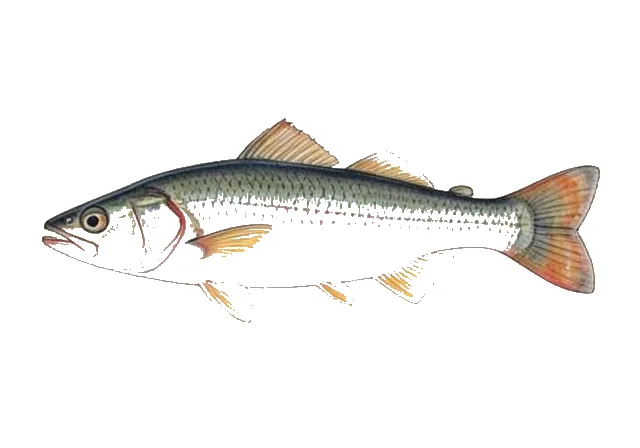
Hitch field guide illustration

About Hitch

Lavinia exilicauda, the hitch, is a species of freshwater ray-finned fish belonging to the family Leuciscidae, which includes the daces, chubs, Eurasian minnows and related fishes. This species is endemic to central California, and was once very common. The common name may derive from a Pomoan word for this species. It is the only species in the monospecific genus Lavinia.

Taxonomy

Lavinia exilicauda was first formally described in 1854 by Spencer Fullerton Baird and Charles Frédéric Girard with its type locality given as the Sacramento River in California. While the hitch is closely related to the California roach (Hesperoleucus symmetricus), and the two species can hybridize, leading some authorities to place H. symmetricus in Lavinia, genomic data appear to support the fishes' separate lineages. This taxon is classified in the subfamily Laviniinae, the "Western chubs", of the family Leuciscidae.

Three distinct population segments (DPS) or subspecies of the hitch are recognized:

These common names or DPS correspond to the subspecies Lavinia exilicauda chi Hopkirk, 1974, Lavinia exilicauda harengus Girard, 1856 and Lavinia exilicauda exilicauda Baird and Girard in Girard, 1854, respectively.

The hitch is the only extant member of Lavinia, but two fossil species are also known from the Interior West, both from well-preserved specimens. † Lavinia lugaskii Kelly, 2010 has been described from multiple complete skeletons recovered from the Middle Miocene -aged Aldrich Station Formation of Nevada. † Lavinia stuwilliamsi McClellan & Smith, 2020 is known from multiple complete skeletons from the Late Miocene -aged Salt Lake Formation of Utah.

Description

Lavinia exilicauda has a deep and laterally compressed body, with a small head, and a terminal mouth pointing upwards. They are generally silver all over; younger fish have a black spot at the base of the tail, losing it as they age, and becoming generally darker as well. The anal fin is noticeably longer than for other California minnows, with 11–14 rays, while the dorsal fin has 10–13 rays, and is placed further back, the base being positioned between pelvic and anal fins. The tail fin is large and deeply forked. They can get large for minnows, with lengths of up to 36 centimetres (14 in) total length. All of these features make them look much like the golden shiner. The hitch is closely related to the California roach (Hesperoleucus symmetricus complex), and these taxa can hybridize with each other.

Hitch are omnivores of the open water, eating a combination of filamentous algae, insects, and zooplankton. They can be found in lakes, sloughs, and slow-moving sections of rivers and streams. With the highest temperature tolerance among the native fish of the Central Valley, they can be found in both warm and cool water; they also have considerable salt tolerance, for instance occurring in Suisun Marsh (7–8 ppt salinity), and Salinas River lagoon (9 ppt).

Distribution

Lavinia exilicauda has a range which includes the Sacramento River – San Joaquin River System of the Central Valley, the Russian River, Clear Lake, Pajaro River, and Salinas River. Although once abundant, but no longer commercially fished in Clear Lake, populations have been declining. The most likely cause appears to be loss of springtime spawning water flows due to water diversion and damming.

Conservation

The Clear Lake hitch was listed as threatened under the California Endangered Species Act in 2014.

Article text: Wikipedia contributors, Lavinia exilicauda (source revision). Licensed under CC BY-SA 4.0. Retrieved 2026-10-11.


Diet and feeding

The FishTraits compilation records these diet categories for this species: algae or phytoplankton; invertebrates or larval fish. These are broad categories, not a claim that every individual consumes every example in a category.

Reported feeding positions include surface or water-column feeding. The compilation combines published observations; diets can vary with age, locality, and available food.

Habitat preferences

Reported habitat associations include medium to large rivers, streams and small rivers, creeks, still-water habitats.

The source records associations with clay or silt, sand, gravel, vegetation. An association indicates reported use, rather than an exclusive requirement.

Reproduction and parental care

The compilation reports a representative maturity age of 2.5 years. Its maturity field summarizes mean, median, or modal estimates, usually for females; male estimates can be used when female data are unavailable. It is not a fixed age at which every fish first breeds.

Recorded spawning months are May, Jun, Jul for the source’s reporting region (CA). This is a regional calendar, not a range-wide schedule.

The reproductive-guild classification includes spawning on open substrates without guarding the brood.

Size and recorded longevity

FishTraits reports a maximum total length of 36 centimetres. Some entries use an estimated asymptotic length; this value should not be treated as a certified record catch.

Recorded longevity in the compilation is 6 years. Wild observations were preferred, but captive records were accepted where wild records were unavailable, and unspecified records were assumed wild. The value is not a guaranteed wild lifespan or an aquarium life expectancy.

Spawning movements

The compilation records significant spawning-related movement. Its combined migration flag covers movements within fresh water as well as between rivers and the sea; this flag alone does not establish which migration pattern applies.

Native range

Clear Lake, Russian River, Sacramento-San Joaquin, San Francisco, and Monterey Bay drainages, California (Page and Burr 1991).

Introduction history

Some records may represent regular immigrants from central California (Swift et al. 1993). Some records may be the result of bait bucket releases. The species was reportedly sold as bait in the lower Colorado River (Miller 1952). Kimsey and Fisk (1960) suggested that it was one of several species in California widely transported as bait. They reported that it was collected in 1954 from Ramer Lake, Imperial County, about 320 road miles south of its regular range.

Ecological impacts

Unknown. Possibly in reference to introduced populations, Moyle (1976a) stated that the species is largely regarded as a nuisance by fisheries managers.

Range

Where it lives

Share of 533 GBIF observation records with a state location, across 3 states.
0%
99.4%
Share of 533 GBIF observation records with a state location, across 3 states.

Share of records by state

Habitat

Water and movement

Water
WoRMS records this species in fresh water.
USGS NAS habitat
Freshwater
US status
Native transplant — native to part of the United States, moved to other waters inside it.
Migration
Migratory
Pattern

Classification

Taxonomy

Kingdom
Animalia
Phylum
Chordata
Superclass
Actinopterygii
Class
Teleostei
Order
Cypriniformes
Genus
Lavinia
Species
Lavinia exilicauda
ITIS TSN
163569
WoRMS AphiaID
1017386
GBIF key
5206009

Common questions about Hitch

What is the scientific name of Hitch?
The scientific name is Lavinia exilicauda, in the family Leuciscidae. Classification follows ITIS.
Does Hitch live in fresh water or salt water?
WoRMS records this species in fresh water.
Where has Hitch been recorded in the United States?
GBIF has observations in 3 states, with the most records in California, Nevada, Wyoming. The map shows observation records, which do not establish the complete natural range.

Same family

More Leuciscidae

Alabama Shiner4 states
Cyprinella callistiaLeuciscidaeNativeFresh
Allegheny Pearl Dace19 states
Margariscus margaritaLeuciscidaeNative and introducedFresh
Altamaha Shiner1 states
Cyprinella xaenuraLeuciscidaeNativeFresh
Alvord Chub2 states
Siphateles alvordensisLeuciscidaeNativeFresh
Apalachee Shiner3 states
Pteronotropis grandipinnisLeuciscidaeNativeFresh
Arkansas River Shiner5 states
Notropis girardiLeuciscidaeNative and introducedFresh
Arroyo Chub1 states
Gila orcuttiiLeuciscidaeNative and introducedFresh
Bandfin Shiner5 states
Luxilus zonistiusLeuciscidaeNative and introducedFresh
Bannerfin Shiner5 states
Cyprinella leedsiLeuciscidaeNativeFresh
Beautiful Shiner3 states
Cyprinella formosaLeuciscidaeNativeFresh
Bedrock Shiner3 states
Notropis rupestrisLeuciscidaeNativeFresh
Bigeye Chub25 states
Hybopsis amblopsLeuciscidaeNative and introducedFresh
Bigeye Shiner17 states
Notropis boopsLeuciscidaeNative and introducedFresh
Bigmouth Chub3 states
Nocomis platyrhynchusLeuciscidaeNativeFresh
Bigmouth Shiner21 states
Notropis dorsalisLeuciscidaeNative and introducedFresh
Blackchin Shiner13 states
Notropis heterodonLeuciscidaeNativeFresh
Blackmouth Shiner3 states
Notropis melanostomusLeuciscidaeNativeFresh
Blacknose Shiner21 states
Notropis heterolepisLeuciscidaeNative and introducedFresh
Blackside Dace2 states
Chrosomus cumberlandensisLeuciscidaeNativeFresh
Blackspot Shiner5 states
Notropis atrocaudalisLeuciscidaeNativeFresh
Blacktail Shiner14 states
Cyprinella venustaLeuciscidaeNative and introducedFresh
Blacktip Shiner4 states
Lythrurus atrapiculusLeuciscidaeNative and introducedFresh
Bleeding Shiner8 states
Luxilus zonatusLeuciscidaeNativeFresh
Blotched Chub6 states
Erimystax insignisLeuciscidaeNativeFresh

All 267 species in Leuciscidae





















