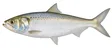
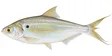
Common names

Types of shad

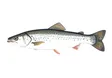
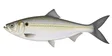
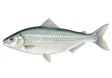
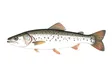
7 species carry shad in an English common name. They sit in 1 family, so the group is a name, not a scientific rank.

About shad

Alosa is a genus of fish, the river herrings, in the family Alosidae. Along with other genera in the subfamily Alosinae, they are generally known as shads. They are distinct from other herrings by having a deeper body and spawning in rivers. Several species can be found on both sides of the Atlantic Ocean and the Mediterranean Sea. Also, several taxa occur in the brackish-water Caspian Sea and the Black Sea basin. Many are found in fresh water during spawning and some are only found in landlocked fresh water.

Appearance

Alosa species are generally dark on the back and top of the head, with blue, violet, or greenish tints. Some can be identified as having a grey or green back. Spots are commonly found behind the head, and the fins may vary from species to species or individually. Most species of Alosa weigh 300 g (11 oz) or less, with A. pontica and A. fallax weighing up to 2 kg, and A. alosa can exceed 3–4 kg.

Biology

Shads are thought to be unique among the fishes in having evolved an ability to detect ultrasound (at frequencies above 20 kHz, which is the limit of human hearing). This was first discovered by fisheries biologists studying a type of shad known as blueback herring, and was later verified in laboratory studies of hearing in American shad. This ability is thought to help them avoid dolphins that find prey using echolocation. Alosa species are generally pelagic. They are mostly anadromous or semianadromous with the exception of strictly freshwater landlocked species. Alosa species are generally migratory and schooling fish. Males usually mature about a year before females; they spawn in the late spring to summer. Most individuals die shortly after spawning. Alosa species seemingly can change readily to adapt to their environments, as species are found in a wide range of temperatures and waters.

Lifecycle and reproduction

As Alosa species are generally anadromous, they face various obstacles to survival. They may have to pass through numerous barriers and waters to get to either their spawning grounds or normal habitats (the sea in most cases). Estuaries are a major factor in numerous Alosa species' migrations. Estuaries can be highly variable and complex environments contributing to fluctuating biological interactions, with shifts in osmolarity, food sources, predators, etc. Since many adult Alosa species die after spawning, only the young generally migrate to the sea from the spawning grounds. Duration of migration varies among fish, but can greatly affect survival.

Reproduction varies by species. Studies done on Alosa in Iranian waters have shown that spawning varies in time, place, and temperature of the waters they inhabit. Species are known to spawn as early as April or as late as August. Temperatures range from about 11 to 27 °C. Fecundity can range from 20,000 to 312,000 eggs. Eggs are pelagic. Geography and temperature are important environmental factors in egg and young-of-year development.

The lifespan of Alosa species can be up to 10 years, but this is generally uncommon, as many die after spawning.

Systematics

The systematics and distribution of Alosa shads are complex. The genus inhabits a wide range of habitats, and many taxa are migratory. A few forms are landlocked, including one from Killarney in Ireland, two from lakes in northern Italy, and two in Greece. Several species are native to the Black and Caspian Seas. Alosa species of the Caspian are systemically characterized by the number of rakers on the first gill arch. They are classified as being "multirakered", "medium-rakered", or "oligorakered". The multirakered are primarily plankton feeders, the oligorakered have large rakers and are predators, and the medium-rakered generally consume a mixed diet. Most current species of the genus Alosa in North America can be found in Florida, whereas the distribution of most of them is broader.

Morphology is notoriously liable to adapt to changing food availability in these fish. Several taxa seem to have evolved quite recently, making molecular analyses difficult. In addition, hybridization may be a factor in shad phylogeny. Nonetheless, some trends are emerging. The North American species except the American shad A. sapidissima can probably be separated in a subgenus Pomolobus. Conversely, the proposed genus (or subgenus) Caspialosa for the Caspian Sea forms is rejected due to paraphyly.

Fossil species

The following fossil Alosa species are known. An especially high diversity of fossil Alosa species is known from a mid-late Miocene -aged deposit in Pınarhisar District, Turkey:

The former fossil species A. ovalis Rückert-Ulkümen, 1965 is now placed in Clupeonella as Clupeonella ovalis. The taxonomy of some of these other fossil species is also uncertain; A. fortipinnata appears most closely related to Brevoortia, while A. crassa and A. sculptata cannot be reliably placed in the genus either. However, A. elongata appears to be a definitive member of the genus.

Recreational fishing

Shad is a type of fish, much valued as a sport fish. The male shad is an excellent game fish, showing multiple jumps and an occasional end-over-end; it has been called a "freshwater tarpon ". The gravid female does not fight much, but is often kept for the roe.

American shad exhibit complex and little-understood feeding behavior while spawning. Unlike salmon, shad retain the ability to digest and assimilate food during the anadromous migration. Like other fish, their feeding instinct can be triggered by a variety of factors such as turbidity and water temperature.

Management

Shad populations have been in decline for years due to spawning areas blocked by dams, habitat destruction, pollution, and overfishing. Management of shad has called for more conservative regulations, and policies to help the species have lower fishing mortality.

Political significance

Shad serve a peculiar symbolic role in Virginia state politics. On the year of every gubernatorial election, would-be candidates, lobbyists, campaign workers, and reporters gather in the town of Wakefield, Virginia, for shad planking. American shad served as the focal point of John McPhee's book The Founding Fish.

Culinary use

The American shad’s egg sacs, known as shad roe, are a seasonal springtime ingredient usually sautéed in butter and served with lemon and parsley. Due to their short availability and unique, rich texture, they are considered a specialty, commanding higher prices in early spring when the female fish migrate up rivers to spawn. These delicate, lobe-shaped, or ribbon-like, sets are typically cooked carefully to maintain their structure, resulting in a savory, mild flavor that is often paired with bacon or other rich ingredients.
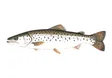
Shad species in focus

These species profiles show how members of the group differ. Their biology describes each named species, rather than every fish in the group.

American Shad

The American shad (Alosa sapidissima) is a species of anadromous clupeid fish naturally distributed on the North American coast of the North Atlantic, from Newfoundland to Florida, and as an introduced species on the North Pacific coast. The American shad is not closely related to the other North American shads. Rather, it seems to form a lineage that diverged from a common ancestor of the European taxa before these diversified.

The American shad has been described as "the fish that fed the (American) nation's founders". Adult shad weigh between 1.5 and 3.5 kg (3 and 8 lb), and they have a delicate flavor when cooked. It is considered flavorful enough not to require sauces, herbs, or spices. It can be boiled, filleted and fried in butter, or baked. Traditionally, a little vinegar is sprinkled over it on the plate. In the Eastern United States, roe shads (females) are prized because the eggs are considered a delicacy.

Life history

The shad spends most of its life in the Atlantic Ocean but after three to six years they become sexually mature and swim up freshwater rivers to spawn. Northern populations are iteroparous. Thus, they may survive breeding, return to the sea, and then return to fresh waters to spawn several more times. However, southern populations exhibit semelparity, similar to Pacific salmon. In the marine environment, shad are schooling fish. Thousands are often seen at the surface in spring, summer, and autumn. They are hard to find in the winter, as they tend to go deeper before spawning season in the range 13–18 °C (55–64 °F); they have been pulled up in nets as deep as 120 metres (65 fathoms).

Like other herrings, the American shad is primarily a plankton feeder but eats small shrimp and fish eggs. Occasionally, they eat small fish, but these are only a minor item in their general diet.

Ecology and diet

As adults, shad filter feed at sea and during their return journey to spawn. They are pursued and hunted primarily by striped bass and, at times, harbor seals. They may not actively feed on their return and are caught with special 'dart' lures instead of typical bait.

Specialist hearing

While the hearing of most fishes is limited in frequency to less than 1 kHz, American shad demonstrate an unusual ability to detect very high frequency sound (ultrasound) above 50 kHz

Read the full species guide.

Blueback Herring

The blueback herring, blueback shad, or summer shad (Alosa aestivalis) is an anadromous species of herring from the east coast of North America, with a range from Nova Scotia to Florida. Blueback herring form schools and are believed to migrate offshore to overwinter near the bottom.

These fish are silvery in color, have a series of scutes (modified, spiny and keeled scales) along their bellies, and are characterized by deep bluish-green backs. They reach a maximum size of approximately 40 centimetres (16 in) and are believed to live up to 8 years. The most distinguishing characteristic of this species is the black to dusky color of its peritoneum (the lining of the abdominal cavity). It is one of the "typical"North American shads. They are often confused with alewifes because blueback shad and alewives are difficult to distinguish from one another, and together these two species are often regarded collectively as"river herring". Alewives have larger eyes, greater body depth, and pearly to white peritoneal linings.

Range

The native range of this fish is found along the Atlantic Coast from Cape Breton, Nova Scotia, to the St. Johns River, Florida. During spawning season, it migrates into coastal rivers.

Non-indigenous occurrences

Blueback shad were first collected in Lake Ontario in 1995, and have been collected from the Tennessee River in Georgia and Tennessee; Oneida Lake, the Oswego River, and Lake Champlain in New York. In North Carolina, blueback shad were introduced into the Savannah, Broad, and Yadkin River basins, and into non-native areas of the Cape Fear and Roanoke River basins. It has been introduced to an unspecified location in the Chesapeake Bay basin in Pennsylvania. They have been collected in Lake Jocassee, Lake Keowee, Picalet River, Broad River, and Lake Murray in South Carolina. Stock obtained from the Cooper River, South Carolina, was released in Texas by the Texas Parks and Wildlife Department in Lake Theo, Briscoe County, and at an unidentified research site in North Texas in 1982 (and in the upper Red River drainage). Bluebacks have been collected from Lake Champlain, Vermont, and have been stocked in several inland reservoirs in Virginia, including Smith Mountain Lake, Occoquan Reservoir, Kerr Reservoir, and Lakes Anna, Brittle, and Chesdin. It is established as a species in Texas, New York, North Carolina, Vermont, and Virginia.

Ecology

This fish is anadromous, living in marine systems and spawning in deep, swift freshwater rivers with hard substrates. It migrates to spawning grounds in the spring. In Connecticut, blueback shad spawn in 14 to 17 °C (57 to 63 °F) water, usually later in the spring than the alewife. During spawning, many eggs are deposited over the stream bottom, where they stick to gravel, stones, logs, or other objects. Juveniles spend three to seven months in fresh water, then migrate to the ocean. The blueback shad is a planktivorous forage species.

Read the full species guide.

Hickory Shad

The hickory shad (Alosa mediocris), fall herring, mattowacca, freshwater taylor or bonejack is a member of the family Alosidae, ranging along the East Coast of the United States from Florida to the Gulf of Maine. It is an anadromous fish species, meaning that it spawns in freshwater portions of rivers, but spends most of its life at sea. It is subject to fishing, both historic and current, but it is often confused with or simply grouped together with American shad (A. sapidissima) in catch statistics.

Description

Hickory shad are elongate, laterally compressed fish with a tapering cross section. The scales on the belly are serrated. The fish is green-gray on its upper surface, becoming iridescent silver on the sides and white below. The scales bear small dark markings. A humeral spot is present and is frequently followed by a short series of fainter spots. The hickory shad can be distinguished from American shad by its lower jaw, which will project beyond the snout in the hickory shad.

Distribution, habitat, and life history

Hickory shad range from northern Florida to the Gulf of Maine. The largest populations occur in Chesapeake Bay and coastal North Carolina. It is a schooling anadromous species that inhabits marine waters, probably never far from land. Adults enter estuaries and freshwater tributaries from the St. John's River, Florida, to the Patuxent River, Maryland, to spawn during the spring. Their oceanic movements are poorly documented.

Spawning occurs from December to June, earliest in Florida and later with increasing latitude. The slightly adhesive and demersal eggs, about 1 mm in diameter, appear to be dispersed at random over gravel bars in moderate current. After water hardening, the eggs become semibuoyant and develop as they drift along the bottom. Fecundity ranges from 43,000 – 475,000 eggs per female, and although the developmental stages of eggs, larvae, and juveniles have been described, little is known concerning the distribution, ecology, and growth rates of these early life stages.

Recreational fishery

Hickory shad have a relatively low commercial value, but an increasingly popular recreational fishery exists throughout the mid-Atlantic states. By the late 1980s and early 1990s, hickory shad articles appeared in sport-fishing magazines. Headlines such as "the tough fighting hickory shad swarm near the rock-studded fall line…"and"feast on Rappahannock River hickory shad action" brought attention to the fishery. Subsequently, specialty magazines and sports sections in national newspapers began proclaiming the excitement of hickory shad fishing ("HICKORY SHAD ARE RUNNING!") and the recovery of the fishery. In the two most recent years of a North Carolina creel survey (2004–2005), hickory shad – a fish only present for two months of the year – moved from sixth- to the fourth-most targeted fish by coastal anglers. They are also taken by recreational fishing for use as bait to catch larger fish.

Read the full species guide.

Range

Where shad live

How many of the 7 species are recorded in each state.
0
7
How many of the 7 species are recorded in each state.

Species

All 7 shad species