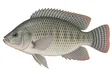
Spotted Tilapia

Tilapia mariae

Cichlidae · freshwater and brackish water fish

9 minute read · Species guide

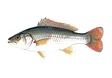
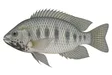
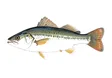
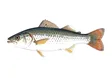
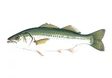
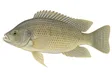
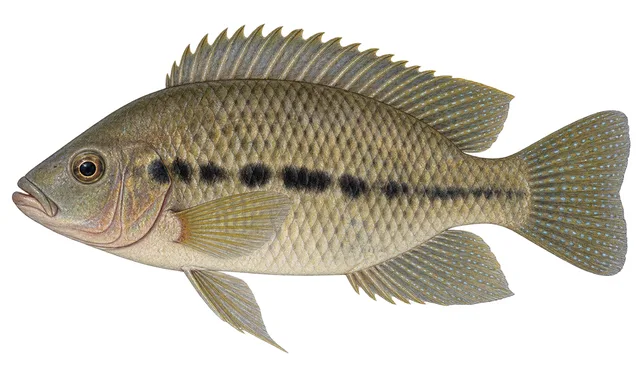
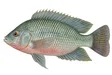
Spotted Tilapia field guide illustration

About Spotted Tilapia

The spotted tilapia (Pelmatolapia mariae), also known as the spotted mangrove cichlid or black mangrove cichlid, is a species of fish of the cichlid family. It is native to fresh and brackish water in West and Central Africa, but has been introduced to other regions where it is considered invasive.

Spotted tilapia have high fecundity, simple food requirements and extensive tolerance of environmental variables such as water temperature, salinity, and pollution. These characteristics allow spotted cichlids to rapidly populate many areas that have an appropriate habitat. Typically spotted tilapia tend to be an aggressive and territorial species, and research has found that internal reproductive androgenic factors can overrule the effect of size on dominance encounters in this species.

Appearance

Spotted tilapia have a short rounded snout and three anal spines. They are dark olive green to light yellowish in colour and have eight or nine dark bars on their sides which are more evident in young spotted tilapia than adults. They also have two to six dark spots between the bars on the middle of their side and they reach a maximum standard length of 32.3 cm (1.1 ft). Spotted tilapia have a rapid growth rate and maturation time.

Habitat

Spotted tilapia are native to Africa from the Côte d'Ivoire to Ghana, and Benin to Cameroon. They have also established large feral populations outside of their native ranges, such as in Florida and Australia. Spotted tilapia live in a variety of habitats. They have been found in both still and flowing waters, in shallow and deep water, in places where there is both little or no coverage and in rocky and debris-strewn areas.

Breeding and parental care

Like several other tilapiine cichlids, the spotted tilapia is notable for its adaptability and prolific breeding. spotted tilapia breed when they are about 15 cm (6 in) long and generally breed year long with peaks in November, March–April and July–September. They lay up to 1800 eggs usually on submerged logs, rocks or plants and the eggs hatch after approximately three days.

Spotted tilapia are monogamous fish who engage in biparental care, and research has found that the size of the eggs tend to increase with the amount of parental care. The males and females both have very specific roles in parenting and work together to ensure the well being of their offspring. The females prepare the nest by clearing an area on rocky substrate. After spawning, the females take care of all embryo tending while males stay about 2 to 3 m (6.6–9.8 ft) away and remain mostly inactive except for an occasional feeding or chasing away of predators. When the offspring become two to three days old they rise off the nest and form a school. This causes a dramatic change in parental role as the male becomes active and the female begins to spend more time away from the young, guarding ahead of the school by chasing away predators. Parental care continues until the fish are about 2.5 to 3 cm (1.0–1.2 in). This biparental behaviour could help explain why black tilapia are able to live in many different habitats and become dominant over other fish populations in the same area.

Ecology

Spotted tilapia feed mainly on plant matter and males and females never feed at the same time. Instead, one will feed while the other stays close by and then they will switch. There are a number of factors that contribute to the natural mortality of spotted tilapia. Their predators include the electric catfish Malapterurus electricus which preys on the eggs of spotted tilapia, and African pike and obscure snakehead which prey on the adults. Spotted tilapia are also prone to heavy intestinal infection caused by nematode parasites which causes death. Also, they sometimes get swept away from their streams by flooding caused by rain into small residual pools over the banks of the stream where they become stranded. Then, when the rain stops the pools dry out they die. Spotted tilapia are important ecologically as well as commercially and as a result are commonly exploited and cultured.

As an invasive species

In the regions where the spotted tilapia has been introduced it is considered invasive. One main problem with spotted tilapia in their introduced range is that they tend to become the dominant fish in many lakes, rivers and canals. They have even been found to at times comprise over half of the total fish biomass and therefore, they cause other previously dominant fish populations to decrease. Spotted tilapia are strong, aggressive and very territorial and have the ability to disturb the habitat of other fish populations.

In Australia

It is believed that spotted tilapia got to Australia through a series of events. First it is thought that all tilapia populations derived from the importation of small numbers of individuals for the freshwater aquarium industry from Singapore or Indonesia. Captive individuals were then dispersed throughout Australia by the industry of fish fanciers. Then, some spotted tilapia escaped or were released and self-sustaining populations arose. The expansion of the spotted tilapia species in Australia has potential adverse effects on the native fish faunas that currently exist in Australia. Since they tend to become the dominant fish where they live, their expansion into Australia could be harmful to the other existing fish populations. Another way in which spotted tilapia have become a pest in Australia is that they have been found living in the cooling pondage of the Hazelwood Power Station in Victoria, Australia as well as in the creek just below the pondage. The water temperature in Victoria is far too low for them to survive outside this habitat they have created, however it is a nuisance for the power station that they live here.

Reaction in Australia

Since spotted tilapia are considered to be a class 3 noxious fish in Australia it is illegal to possess, sell or buy this species in New South Wales, Australia without a permit. NSW fisheries are closely monitoring the populations of spotted tilapia and heavy fines of up to AU$ 11,000 apply for being in possession or caught buying or selling this species. The NSW fisheries have the right to seize the fish and destroy them if necessary.

Etymology

The specific name honours the English writer and explorer Mary Henrietta Kingsley (1862-1900), who had gained possession of the type of this cichlid.

Article text: Wikipedia contributors, Spotted tilapia (source revision). Licensed under CC BY-SA 4.0. Retrieved 2026-10-12.
Diet and feeding

The FishTraits compilation records these diet categories for this species: algae or phytoplankton; detritus or unidentified plant material. These are broad categories, not a claim that every individual consumes every example in a category.

Reported feeding positions include bottom feeding and surface or water-column feeding. The compilation combines published observations; diets can vary with age, locality, and available food.

Habitat preferences

Reported habitat associations include medium to large rivers, streams and small rivers, still-water habitats.

The source records associations with muck, clay or silt, sand. An association indicates reported use, rather than an exclusive requirement.

Reproduction and parental care

The compilation reports a representative maturity age of 1 years. Its maturity field summarizes mean, median, or modal estimates, usually for females; male estimates can be used when female data are unavailable. It is not a fixed age at which every fish first breeds.

Batch or serial spawning has been reported somewhere in the species’ range. This does not establish the same spawning pattern for every population.

Recorded spawning months are Jan, Feb, Mar, Apr, May, Jun, Jul, Aug, Sep, Oct, Nov, Dec for the source’s reporting region (FL). This is a regional calendar, not a range-wide schedule.

The reproductive-guild classification includes guarding eggs or young at a spawning substrate or nest.

Size and recorded longevity

FishTraits reports a maximum total length of 39.4 centimetres. Some entries use an estimated asymptotic length; this value should not be treated as a certified record catch.

Recorded longevity in the compilation is 8 years. Wild observations were preferred, but captive records were accepted where wild records were unavailable, and unspecified records were assumed wild. The value is not a guaranteed wild lifespan or an aquarium life expectancy.

Identification and appearance

In general, cichlids (Cichlidae) are superficially similar to sunfishes and black basses (Lepomis and Micropterus; family Centrarchidae). Cichlids can be distinguished from centrarchids by a single nostril opening on each side of the head (vs. two openings in centrarchids) and the presence of a discontinuous or two-part lateral line (vs. a continuous lateral line in centrarchids). Distinguishing characteristics of spotted tilapia were presented in Taylor et al. (1986) and Page and Burr (1991). Photographs were given by Axelrod et al. (1985), Taylor et al. (1986), and Axelrod (1993). Illustrations were provided by Courtenay and Hensley (1979b), Lee et al. (1980 et seq.), and Page and Burr (1991). Spotted tilapia is similar to another North American introduced cichlid, redbelly tilapia Tilapia zillii: spotted tilapia lacks the deep red ventral coloration present in T. zillii, has lateral vertical stripes that extend onto the dorsal fin, and 5-6 square black blotches along the side (lacking in T. zillii).

Native range

Tropical Africa. West Africa from middle Ivory Coast to southwestern Ghana and from southeastern Benin to southwestern Cameroon (Thys van den Audenaerde 1966; Philippart and Ruwet 1982).

Habitat and ecology

This species is generally a benthic herbivore, with algae, diatoms, detritus, and aquatic macrophytes representing the major portion of its diet (~85%) and terrestrial insects and benthic invertebrates comprising a small fraction (~5%) (Fagade 1971; Ikomi and Jessa 2003). However, in southern Florida, anglers also take it using worms and small shrimps. Spotted tilapia are substrate spawners that exhibit biparental care of offspring (Whitehead and Trewavas 1963; Schwanck 1989), with reproduction in tropical areas occurring year round with seasonal peaks dependent on local climate (Ikomi and Jessa 2003; King and Etim 2004).

Introduction history

Spotted tilapia was introduced into Florida as a result of escapes or intentional releases from one or several aquarium fish farms in Dade County, probably between 1972 and 1974 (Hogg 1974, 1976a, b; Courtenay and Hensley 1979b; Courtenay and Stauffer 1990). The Nevada introduction was reportedly due to an aquarium release (Courtenay and Deacon 1982, 1983; Courtenay and Stauffer 1990).

Ecological impacts

Summary of species impacts derived from literature review. Click on an icon to find out more... This apparently aggressive species is the dominant fish in many canal systems of southeastern Florida and has the potential to affect other introduced and native fishes (Courtenay and Hensley 1979b). Spotted tilapia is bolder and more aggressive than Lepomis sunfishes, which can reduce potential spawning habitat for native sunfishes and likely enhances the tilapia's invasion potential and establishment success (Brooks and Jordan 2010). In Nevada, T. mariae was reportedly the dominant fish in Rogers Spring and there was concern that this omnivorous cichlid competed with endemic spring fishes for food and also preyed on smaller fishes (Courtenay and Deacon 1982, 1983). Bradford et al. (2011) reviewed the biology and management of this species in native and introduced regions.

Range

Where it lives

Share of 1,273 GBIF observation records with a state location, across 4 states.
0%
99.6%
Share of 1,273 GBIF observation records with a state location, across 4 states.

Habitat

Water and movement

Water
WoRMS records this species in fresh water and brackish water.
USGS NAS habitat
Freshwater
US status
Exotic — the USGS Nonindigenous Aquatic Species database lists it as introduced from outside North America.
Migration
Not migratory

Classification

Taxonomy

Kingdom
Animalia
Phylum
Chordata
Superclass
Actinopterygii
Class
Teleostei
Order
Perciformes
Family
Cichlidae
Genus
Tilapia
Species
Tilapia mariae
ITIS TSN
169811
WoRMS AphiaID
282978
GBIF key
9552432

Common questions about Spotted Tilapia

What is the scientific name of Spotted Tilapia?
The scientific name is Tilapia mariae, in the family Cichlidae. Classification follows ITIS.
Does Spotted Tilapia live in fresh water or salt water?
WoRMS records this species in fresh water and brackish water.
Where has Spotted Tilapia been recorded in the United States?
GBIF has observations in 4 states, with the most records in Florida, Nevada, Alabama. The map shows observation records, which do not establish the complete natural range.

Closest relatives

Other Tilapia species

Same family

More Cichlidae