Blue Tilapia

Oreochromis aureus

Cichlidae · freshwater and brackish water fish

6 minute read · Species guide

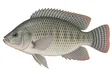
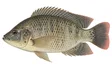
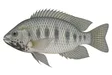
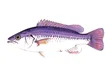
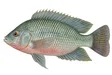
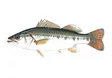
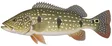
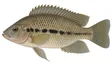
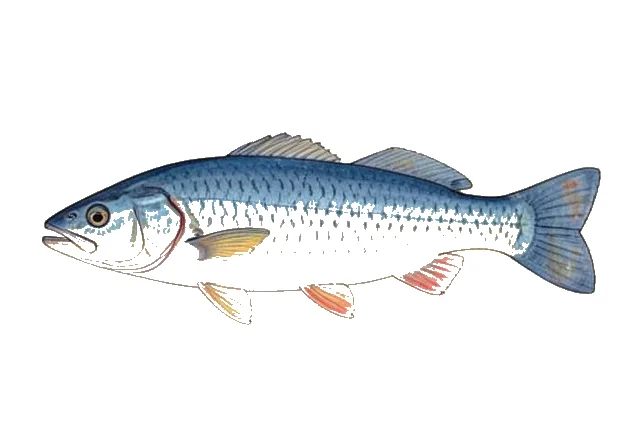
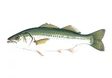
Blue Tilapia field guide illustration

About Blue Tilapia

The blue tilapia (Oreochromis aureus) is a species of tilapia, a fish in the family Cichlidae. Native to Northern and Western Africa, and the Middle East, through introductions it is now also established elsewhere, including parts of the United States, where it has been declared an invasive species and has caused significant environmental damage. It is known as the blue kurper in South Africa.

Description

In their introduced US range, blue tilapia are usually 120 to 200 millimetres (4 + 3 ⁄ 4 to 7 + 3 ⁄ 4 in) in length, and reach weights up to 5 to 6 lb (2.3 to 2.7 kg). The largest recorded specimen was more than 21 in (53 cm) long and weighed more than 10 lb (4.5 kg). Blue tilapia are mouthbrooders, and broods range from 160 to 1600 eggs per female. O. aureus is primarily herbivorous, but occasionally consumes zooplankton; the young include small invertebrates in their diet.

Range and habitat

The blue tilapia is native to Northern and Western Africa, and the Middle East. In Africa, it is native to the Senegal, Niger, Benue and lower Nile Rivers. In the Middle East, it is native to the Jordan River. Through introductions, the fish can be found in the United States in Texas, Alabama, Florida, and Nevada. It has also been established in Central and South America, and Southeast Asia. The original stocks of O. aureus in the United States were from Israel.

The blue tilapia is primarily a fresh and brackish water fish that occurs in a wide range of habitats such as streams, rivers, lakes and ponds, but it has a high tolerance for salt water and even hypersaline conditions at up to 4.5% salinity (seawater is about 3.5%). It primarily occurs in waters that range from 12 to 32 °C (54–90 °F), but tolerates between 8 and 40 °C (46–104 °F).

Israel

In Israel, Oreochromis aureus is also known as Jordan St. Peter's fish and was traditionally coming down the Jordan River from Lake Huleh to the Sea of Galilee. It is black and larger than the white "Common St. Peter's fish"or simply"St. Peter's fish", the redbelly tilapia (Arabic: مشط, romanized: musht, lit. ' comb ', adopted into Modern Hebrew).

Another "St. Peter's fish"is the"Galilee St. Peter's fish" (mango tilapia, Sarotherodon galileus; Arabic: مشط أبيض, romanized: musht abyaḍ), which is white and also larger than C. zillii.

Invasive species

Oreochromis aureus has been introduced in many places around the world for use as a food fish, and frequently in order to control aquatic vegetation. Its presence may have in many cases been mis-documented as Oreochromis niloticus, because the two species were only recently distinguished.

In the United States

Since its introduction into Florida in 1961, the fish has increased its range and frequency of occurrence. It is now the most widespread foreign species in Florida, with established populations as far north as Lake Alice, in Gainesville. It is a major management problem for the National Park Service due to its predominance in Taylor Slough in Everglades National Park, where it has changed the fish community structure. The species is also expanding its range in Texas. It was at one time responsible for inhibition of the population of largemouth bass in Lake Trinidad (in Henderson County) until it was extirpated, and is implicated in the unionid mussel declines in two bodies of water in Texas. It is also blamed for a severe decline in native fish populations in Warm Springs Natural Area, Nevada.

In Russia

A self-sustaining population has been reliably recorded in the Volga River basin (Russia) in the area of heated water discharge from a local power plant, demonstrating its ability to survive in localized warm-water refuges.

Article text: Wikipedia contributors, Oreochromis aureus (source revision). Licensed under CC BY-SA 4.0. Retrieved 2026-10-11.
Diet and feeding

The FishTraits compilation records these diet categories for this species: algae or phytoplankton; aquatic or other vascular plants; detritus or unidentified plant material; invertebrates or larval fish. These are broad categories, not a claim that every individual consumes every example in a category.

Reported feeding positions include bottom feeding and surface or water-column feeding. The compilation combines published observations; diets can vary with age, locality, and available food.

Habitat preferences

Reported habitat associations include medium to large rivers, streams and small rivers, still-water habitats.

The source records associations with muck, clay or silt, sand, vegetation, organic debris, large woody material. An association indicates reported use, rather than an exclusive requirement.

Reproduction and parental care

The compilation reports a representative maturity age of 1 years. Its maturity field summarizes mean, median, or modal estimates, usually for females; male estimates can be used when female data are unavailable. It is not a fixed age at which every fish first breeds.

Batch or serial spawning has been reported somewhere in the species’ range. This does not establish the same spawning pattern for every population.

Recorded spawning months are Apr, May, Jun, Jul, Aug, Sep, Oct for the source’s reporting region (FL). This is a regional calendar, not a range-wide schedule.

Size and recorded longevity

FishTraits reports a maximum total length of 45.7 centimetres. Some entries use an estimated asymptotic length; this value should not be treated as a certified record catch.

Recorded longevity in the compilation is 6 years. Wild observations were preferred, but captive records were accepted where wild records were unavailable, and unspecified records were assumed wild. The value is not a guaranteed wild lifespan or an aquarium life expectancy.

Identification and appearance

Distinguishing characteristics, synonyms, photographs, keys, and discussion of hybrids were provided in Trewavas (1983); for identification also see Page and Burr (1991), and Skelton (1993). Illustrations and diagnoses of larval and small juveniles of introduced populations were given by McGowan (1988). Color photographs were presented in Axelrod et al. (1985) and Axelrod (1993). Many or most accounts of "Tilapia nilotica" in U.S. ponds probably refer to O. aureus, likely imported from Israel, before the two species were shown to be distinct (Trewavas 1983).

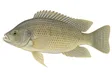
Blue Tilapia is closely related to, and often confused with, Nile Tilapia (O. niloticus). These two species can generally be distinguished by the following characteristics (Trewavas 1983):

Native range

Tropical and subtropical Africa, and Middle East. Native range includes Senegal, Niger, and many smaller drainages and lakes in Africa and Middle East (Trewavas 1983; Skelton 1993).

Introduction history

This species has been introduced through a combination of means, including stocking and experimental work by states and private companies (e.g., the electric power industry), and release by individuals seeking to use the species as a sport fish, as forage for warmwater predatory fish, as a food source, and as a means of aquatic plant control. Introductions and spread have resulted by way of escapes or releases from aquaculture facilities and experimental control areas, and from various other holding sites (e.g., zoological parks); through aquarium and bait bucket releases; and by intentional transport by anglers and private individuals (Courtenay and Hensley 1979a; Lee et al. 1980 et seq.; Courtenay et al. 1984, 1986; Muoneke 1988; Courtenay and Williams 1992). The exact reasons for and sources of some introductions are uncertain (e.g., Texas) (Hubbs et al. 1978; Courtenay and Hensley 1979a). Apparently, power companies became interested in using so-called "tropical fishes" for food or sport in heated effluent ponds used to cool effluents from both fossil fuel fired and nuclear generating plants, where temperatures often became too high to support populations of native fishes (Courtenay and Hensley 1979a). Blue tilapia and redbelly tilapia were inadvertently introduced into Hyco Reservoir in North Carolina in 1984 after a small number of fish escaped from a holding cage located in the heated discharge area during an on-site agricultural study (Crutchfield 1995).

Ecological impacts

Blue tilapia have also been implicated as the cause for unionid mussel declines in two Texas water bodies, Tradinghouse Creek and Fairfield reservoirs (Howells 1995).

Range

Where it lives

Share of 2,888 GBIF observation records with a state location, across 16 states.
0%
54.1%
Share of 2,888 GBIF observation records with a state location, across 16 states.

Habitat

Water and movement

Water
WoRMS records this species in fresh water and brackish water.
USGS NAS habitat
Freshwater
US status
Exotic — the USGS Nonindigenous Aquatic Species database lists it as introduced from outside North America.
Migration
Migratory
Pattern

Classification

Taxonomy

Kingdom
Animalia
Phylum
Chordata
Superclass
Actinopterygii
Class
Teleostei
Order
Perciformes
Family
Cichlidae
Genus
Oreochromis
Species
Oreochromis aureus
ITIS TSN
553308
WoRMS AphiaID
279196
GBIF key
2372367
Outside the US
ITIS also files it in Caribbean Territories.

Common questions about Blue Tilapia

What is the scientific name of Blue Tilapia?
The scientific name is Oreochromis aureus, in the family Cichlidae. Classification follows ITIS.
Does Blue Tilapia live in fresh water or salt water?
WoRMS records this species in fresh water and brackish water.
Where has Blue Tilapia been recorded in the United States?
GBIF has observations in 16 states, with the most records in Florida, Texas, Arizona. The map shows observation records, which do not establish the complete natural range.

Closest relatives

Other Oreochromis species

Same family

More Cichlidae