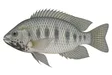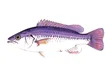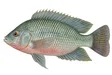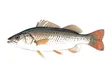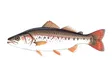
Salvin's Cichlid

Cichlasoma salvini

Cichlidae · freshwater water fish

3 minute read · Species guide

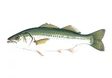
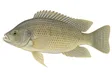
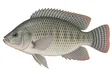
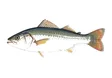
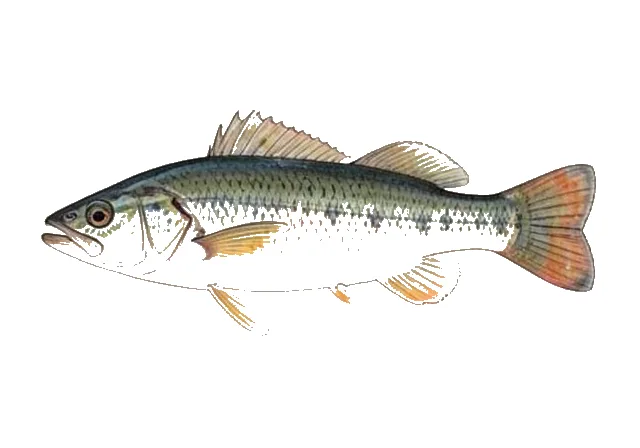
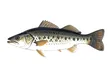
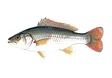
Salvin's Cichlid field guide illustration

About Salvin's Cichlid

The Salvin's cichlid (Trichromis salvini), also known as the yellow-belly cichlid or tricolored cichlid, is a species of the family Cichlidae. It is found in rivers of the Atlantic slope of southern Mexico, Belize, and Guatemala. It is the only species in the genus Trichromis.

Taxonomy

In 2015, McMahan et al. published a paper placing this species in the genus Trichromis. The relationship of Salvin's cichlid to other Central American cichlid had long been debated. Genetic research by Říčan et al. revealed that the closest relatives to Trichromis are the firemouth cichlid and its congeners in the genus Thorichthys.

Description

The Salvin's cichlid is oblong in shape and has a rather pointed mouth compared to other Central American cichlids. The body is yellow with two lines of black "flowers" along the side and upper half of the back of the fish. These flowers have a blue pearl outline. It has black bars that cross the face, and both sexes have red bellies, which is more pronounced in females, especially when ready to spawn. Females also have a patch in the center of the dorsal fin and a spot on the lower part of the gill cover. Females are smaller than males. Males are duller in color and have longer, more pointed fins. Both male and female become more vibrant during breeding.

Distribution

Salvin's cichlid is found along the eastern coastal rivers and lagoons at lower elevations of Central America, from Mexico south to Honduras. This species is introduced in South Florida. The species prefers moderate to fast flowing currents.

Dietary habits

Salvin's cichlid is a piscivore. It uses slight jaw protrusion to exploit prey located near riverbeds. Their 8.2% jaw protrusion only allows them to consume 48% of evasive prey.

Reproduction

The female takes a more active role in initiating breeding and caring for fry than the male.

Care requirements

Salvin's cichlid is a very hardy fish, preferring temperatures between 22–27 °C (72–81 °F). They prefer a higher pH of around 8.0, and require the space of at least a 150 litres (33 imp gal; 40 US gal) tank. They grow to approximately 15 centimetres (5.9 in) in length and are quite aggressive toward other fish, but moderate aggressive towards same species. They require rocks and logs to hide in, and open swimming space.

Article text: Wikipedia contributors, Salvin's cichlid (source revision). Licensed under CC BY-SA 4.0. Retrieved 2026-10-12.
Identification and appearance

In general, cichlids (Cichlidae) are superficially similar to sunfishes and black basses (Centrarchidae: Lepomis and Micropterus). Cichlids can be distinguished from centrarchids by a single nostril opening on each side of the head (vs. two openings in centrarchids) and the presence of a discontinuous or two-part lateral line (vs. a continuous lateral line in centrarchids). The species is included in keys in Greenfield and Thomerson (1997) and MIller et al. (2005), and distinguishing characteristics were given by Meek (1904) and Conkel (1993). Photographs were provided by Koenings (1989), Axelrod (1993; as Herichthys salvini), Conkel (1993), and Miller et al. (2005).

Native range

Tropical America. Atlantic Slope drainages of Middle America from Río Papaloapan, Mexico, south to Sulphur River, Guatemala (Conkel 1993; Greenfield and Thomerson 1997).

Habitat and ecology

Inhabits lagoons, swamps, pools, river margins, and other slow-moving, slightly brackish to fresh water. Can be found over a variety of substrate types, including sandy, muddy, or rocky sediments with or without submerged or emergent aquatic vegetation and mangroves. In southern Mexico and Belize, it is common in freshwater marshes (Zambrano et al. 2006; W. Loftus, pers. comm.) Considered a generalist omnivore, with diet composition reflecting local abundance of food items (Miller et al. 2005)

Introduction history

Probable aquarium release (Courtenay and Stauffer 1990). Shafland (1996) speculated the South New River Canal population could be derived from the rock pit population eliminated in 1981, or it could be the result of a recent illegal introduction.

Range

Where it lives

Share of 101 GBIF observation records with a state location, across 1 states.
0%
100%
Share of 101 GBIF observation records with a state location, across 1 states.

Share of records by state

Habitat

Water and movement

Water
WoRMS records this species in fresh water.
USGS NAS habitat
Freshwater
US status
Exotic — the USGS Nonindigenous Aquatic Species database lists it as introduced from outside North America.
Migration
Not migratory

Classification

Taxonomy

Kingdom
Animalia
Phylum
Chordata
Superclass
Actinopterygii
Class
Teleostei
Order
Perciformes
Family
Cichlidae
Genus
Cichlasoma
Species
Cichlasoma salvini
ITIS TSN
169788
WoRMS AphiaID
1535727
GBIF key
9321404
Outside the US
ITIS also files it in Central Pacific Territories.

Common questions about Salvin's Cichlid

What is the scientific name of Salvin's Cichlid?
The scientific name is Cichlasoma salvini, in the family Cichlidae. Classification follows ITIS.
Does Salvin's Cichlid live in fresh water or salt water?
WoRMS records this species in fresh water.
Where has Salvin's Cichlid been recorded in the United States?
GBIF has observations in 1 states, with the most records in Florida. The map shows observation records, which do not establish the complete natural range.

Closest relatives

Other Cichlasoma species

Same family

More Cichlidae