African Jewelfish

Hemichromis letourneuxi

Cichlidae · freshwater and brackish water fish

6 minute read · Species guide

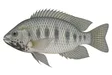
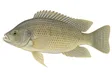
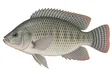
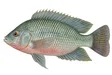
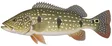
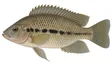
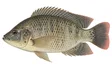
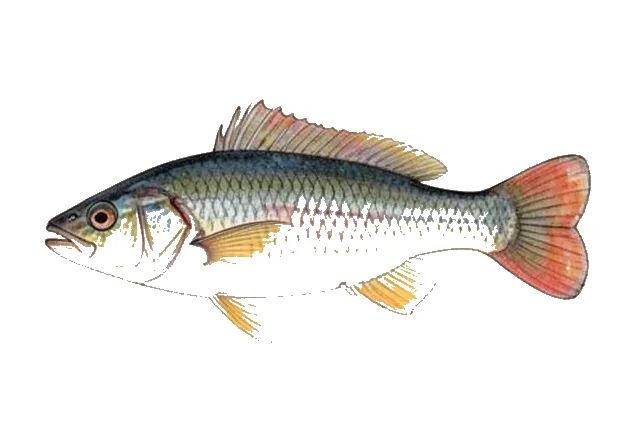
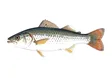
African Jewelfish field guide illustration

About African Jewelfish

Hemichromis letourneuxi is a species of cichlid native to West Africa and is popular in the aquarium hobby, and it has been introduced to the Caribbean and the Southeastern United States, where it is invasive.

Description

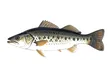
H. letourneuxi, a small species, has quite a long, thin body and a rounded tail, with 13–15 spines in the dorsal fin and three in the anal fin. It has a highly variable background colour to the body, which may be green-yellow to red-brown or even almost black, dependent on various factors, such as the sex of the fish, the season, the nature of the fish's habitat, and stress. Breeding males may develop red colouration over the gills and underside. Both sexes have a limited number of small, brilliant blue, iridescent spots on the head, body, and fins, and these may be more obvious in breeding adults. They have a dark black spot situated above the lateral line on the flanks and smaller blotches on gill covers and base of the tail. They can reach a standard length of 12 cm (4.7 in), although a length of 7 cm (2.8 in) is more usual.

Distribution

H. letourneuxi is found across the northern half of Africa from the River Nile, and has been recorded in the Gambia River and Senegal River, as well as oases in Algeria. It has been recorded as an introduced species in the Philippines, Hawaii, Europe, and Puerto Rico, as well as in Florida. It is only known to have been established in Florida and Puerto Rico, while in other areas, they do not seem to have become established or have been misidentified. In Florida, they were introduced prior to 1965 and were introduced by the aquarium trade, either by releases or by escapes. They were originally confined to the Miami Canal, but have begun to spread northwards and westwards, with their wide habitat tolerance aiding their dispersal.

Habitat and biology

H. letourneuxi is found in the savannah zone and is known to thrive in a variety of still, freshwater habitats, and it is able to tolerate a wide range of water types from very soft waters through to highly saline waterbodies. It has been recorded from brackish lagoons, large lakes, and riverine flood plains. It prefers to live near vegetation beds and the margins of larger areas of aquatic habitats. Within its introduced range, this habitat tolerance has allowed it to spread, and it can be found in estuaries and other coastal waters adjacent to the freshwater habitats where it occurs.

Fishes of the genus Hemichromis are monogamous, biparental, substrate spawners that demonstrate advanced parental care of their offspring. Congeners of H. letourneuxi, H. bimaculatus and H. lifalili, have had their breeding behaviour studied in aquaria, and it is thought to be typical of the genus. The males and females form monogamous pairs, which are thought to be permanent. When breeding, the colours of both sexes become more intense and they choose a spawning site, normally a flat rock. The male then chases the female, quite vigorously, to induce her to spawn. Spawning is similar to many other cichlids; the female lays a line of eggs and the male fertilises them. The female may lay up to 600 eggs and the male defends the spawning site as the female looks after the eggs. After around 72 hours, the eggs hatch and the fry are shifted into a shallow depression in the substrate close to the spawning site. The fry are able to swim freely after 24 hours, but the parents care for them for some time after that. Reproductive activity in Africa likely coincides with the onset of the flood season.

Studies on the diet of H. letourneuxi have shown that it is an omnivore, but that it mainly eats larger invertebrates and small fish, including smaller specimens of its own species and other cichlids. Algae and other plant material have also been found in the stomachs of this species. In Florida, this species is preyed upon by the Florida green watersnakes, as well as by the fishes common snook, Florida gar, largemouth bass, longnose gar, and bowfin. In the Senegal River, the gills of this species were found to be parasitized by the monogenean Cichlidogyrus dracolemma.

Etymology

The specific name of this fish honours the collector of the type specimen, botanist Aristide-Horace Letourneux (1820-1890).

Article text: Wikipedia contributors, Hemichromis letourneuxi (source revision). Licensed under CC BY-SA 4.0. Retrieved 2026-10-11.
Diet and feeding

The FishTraits compilation records these diet categories for this species: detritus or unidentified plant material; invertebrates or larval fish. These are broad categories, not a claim that every individual consumes every example in a category.

Habitat preferences

Reported habitat associations include streams and small rivers, creeks, still-water habitats.

The source records associations with muck, vegetation, organic debris. An association indicates reported use, rather than an exclusive requirement.

The species is classified as tolerant of a broad range of salinities. This flag does not specify a salinity range for aquarium care.

Size and recorded longevity

FishTraits reports a maximum total length of 12 centimetres. Some entries use an estimated asymptotic length; this value should not be treated as a certified record catch.

Spawning movements

The compilation records significant spawning-related movement. Its combined migration flag covers movements within fresh water as well as between rivers and the sea; this flag alone does not establish which migration pattern applies.

Identification and appearance

Loiselle (1979) revised the genus and provided diagnoses, photographs, and synonyms for the species. An updated key to the genus was given in Loiselle (1992). Color photographs were provided by Linke and Staeck (1994). Prior to the 1990s, most published references to introduced populations of this species taken in Florida were incorrectly identified or listed as Hemichromis bimaculatus (Smith-Vaniz, personal communication).

Native range

Tropical Africa. Widespread in northern, central, and west Africa (Loiselle 1979, 1992; Linke and Staeck 1994) in savannah and oasis habitats. Occurs in fresh and brackish waters (Loiselle 1979).

Habitat and ecology

Hemichromis letourneuxi inhabits shallow, vegetated or rocky areas of canals, tidal creeks, culverts, rivers, and marshes. This species is an opportunistic carnivore, consuming small fishes and invertebrates (Hickley and Bailey 1987; Loftus et al. 2006). This species can tolerate a wide range of salinities (up to 50‰; Langston et al. 2010), and is extremely tolerant of hypoxia (Schofield et al. 2007).

Introduction history

This species was possibly introduced into Florida through aquarium release, perhaps in combination with escapes or releases from fish farms.

Ecological impacts

Summary of species impacts derived from literature review. Click on an icon to find out more... According to a study by Loftus et al. (2006), this species was shown to suppress the spawning of dollar sunfish in mesocosm tanks because of strong agonistic behavior by the cichlid. Schofield et al. (2014), found this species to have detrimental impacts on snail and shrimp species in a mesocosm experiment.

Range

Where it lives

Share of 35 GBIF observation records with a state location, across 1 states.
0%
100%
Share of 35 GBIF observation records with a state location, across 1 states.

Share of records by state

Habitat

Water and movement

Water
WoRMS records this species in fresh water and brackish water.
USGS NAS habitat
Freshwater;Brackish
US status
Exotic — the USGS Nonindigenous Aquatic Species database lists it as introduced from outside North America.
Migration
Not migratory

Classification

Taxonomy

Kingdom
Animalia
Phylum
Chordata
Superclass
Actinopterygii
Class
Teleostei
Order
Perciformes
Family
Cichlidae
Genus
Hemichromis
Species
Hemichromis letourneuxi
ITIS TSN
553306
WoRMS AphiaID
281020
GBIF key
2371363

Common questions about African Jewelfish

What is the scientific name of African Jewelfish?
The scientific name is Hemichromis letourneuxi, in the family Cichlidae. Classification follows ITIS.
Does African Jewelfish live in fresh water or salt water?
WoRMS records this species in fresh water and brackish water.
Where has African Jewelfish been recorded in the United States?
GBIF has observations in 1 states, with the most records in Florida. The map shows observation records, which do not establish the complete natural range.

Closest relatives

Other Hemichromis species

Same family

More Cichlidae