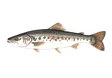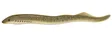
Silver Lamprey

Ichthyomyzon unicuspis

Petromyzontidae · freshwater water fish

5 minute read · Species guide

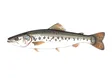
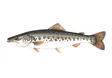
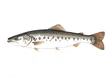
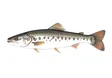
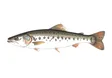
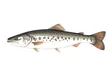
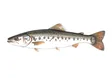
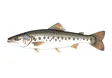
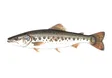
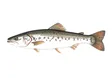
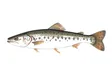
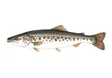
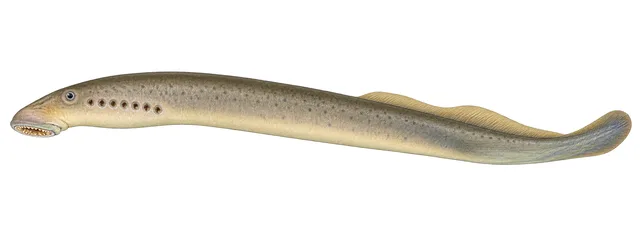
Silver Lamprey field guide illustration

About Silver Lamprey

The silver lamprey (Ichthyomyzon unicuspis) is a lamprey commonly found in the Northern and Central United States, as well as a large part of southern Canada. Its genus name means "sucking fish"in Greek and the species name means"one-pointed" in Latin. The silver lamprey is a member of the class Agnatha, sometimes referred to as cyclostomes (round-mouths). The silver lamprey should not be confused with the sea lamprey (Petromyzon marinus), which has caused considerable damage to native fish populations in the Great Lakes region.

Distribution

The silver lamprey is commonly found along the Great Lakes and in the Mississippi River and Ohio River and their tributaries from Minnesota to Nebraska, Tennessee, and West Virginia. There have also been a small number of isolated encounters around the Hudson Bay and in the Mississippi River in Mississippi.

Identification

The silver lamprey is an eel -like fish with an attenuate body composed of 49–52 clearly defined segments (i.e. myomeres, between the last gill slit and the anus). Silver lampreys possess a cartilaginous skeleton, and adults generally grow to a length of 12 inches and are silvery or bluish in color when spawning. Prior to spawning adults are often a dull brown or tan color. The dorsal fin is continuous, though it may be notched. The mouth is a jawless, sucking disc, with unicuspid teeth arranged in circular rows and is in the inferior position. When expanded, the mouth is wider than the lamprey's body. The lamprey's gills are arranged in a straight line immediately behind the eye, and a single nostril is located between the eyes. Larvae are a brown to tan all over have no eyes (instead they have eyespots) and are called ammocoetes. They also have seven gill openings and do not have any paired fins, they have only a long continuous fin runs from the dorsal to the ventral side. Ammocoetes also have no teeth and instead have an oral hood which houses skin extensions that help them filter particles out of the water as they draw it into their oral cavity.

Habitat

Adult silver lampreys prefer the clear waters of large streams, rivers, and lakes. Adults migrate to nest in flowing water that has stoney or gravelly bottom material. When they hatch, the larvae move to slowly flowing areas initially with thick organic layers. As they grow in size, they begin to migrate to sandy environments where they will reside until they reach metamorphosis.

Diet

Adult silver lampreys are parasitic, feeding on the blood of other fishes. Most non-parasitic lamprey feed only as larvae, then die. Silver lampreys use their oral discs to attach to their hosts, then cut through the skin and scales with their teeth. The lamprey will remain attached to the host over a long period of time, but they seldom kill their host (which have coevolved with these lampreys). Adults feed on a variety of fishes, including trout, whitefish, smelt, pike, white sucker, brown bullhead, rock bass, walleye, and the armored lake sturgeon. The silver lamprey's larval young feed on drifting plankton, algae, and detritus.

Reproduction and life cycle

Adult silver lampreys move upstream to spawn in May and June, when the water temperature reaches 50 °F. Using their mouths to move sand and gravel, they dig a nest in the stream bed. Once the nest is completed, the female attaches herself to a rock and the male attaches to her head, wrapping his tail around hers to bring the genitals close together. Eggs and sperm are released, then the pair separates. Once spawning is completed and the eggs are deposited in the nest, the adults die. Upon hatching, the larvae (called ammocoetes) are blind, toothless, and provided with a fine-mesh tissue sieve. They drift downstream and burrow in the sand, mud, and organic material for 4–7 years. During this time, the ammocoetes feed mostly on detritus and algae. When they are approximately four to five inches long, the ammocoetes metamorphose into parasitic adults and migrate downstream to search for hosts. After one to two years feeding as a parasite, adult silver lampreys move upstream to spawn and die.

Article text: Wikipedia contributors, Silver lamprey (source revision). Licensed under CC BY-SA 4.0. Retrieved 2026-10-11.
Diet and feeding

The FishTraits compilation records these diet categories for this species: blood. These are broad categories, not a claim that every individual consumes every example in a category.

Reported feeding positions include surface or water-column feeding. The compilation combines published observations; diets can vary with age, locality, and available food.

Habitat preferences

Reported habitat associations include medium to large rivers, still-water habitats.

The source records associations with muck, clay or silt, sand, gravel. An association indicates reported use, rather than an exclusive requirement.

Reproduction and parental care

The compilation reports a representative maturity age of 6 years. Its maturity field summarizes mean, median, or modal estimates, usually for females; male estimates can be used when female data are unavailable. It is not a fixed age at which every fish first breeds.

Recorded spawning months are Apr, May, Jun for the source’s reporting region (WI). This is a regional calendar, not a range-wide schedule.

The reproductive-guild classification includes hiding a brood without subsequent guarding.

Size and recorded longevity

FishTraits reports a maximum total length of 39 centimetres. Some entries use an estimated asymptotic length; this value should not be treated as a certified record catch.

Recorded longevity in the compilation is 7 years. Wild observations were preferred, but captive records were accepted where wild records were unavailable, and unspecified records were assumed wild. The value is not a guaranteed wild lifespan or an aquarium life expectancy.

Native range

St. Lawrence-Great Lakes basin from Quebec to southwestern Ontario and south through upper Mississippi and Ohio River basins to central Tennessee. Nelson River, Manitoba; Missouri River, Nebraska; and Mississippi River, Mississippi (Page and Burr 1991). Not reported from Arkansas (Robison and Buchanan 1988).

Habitat and ecology

Silver Lamprey inhabit large streams and lakes, where the parasitic adults can find large fish hosts upon which to attach and feed. Spawining in Silver Lamprey occurs in May-June, when water temperatures reach 50°F, in shallow streams and tributaries on gravel riffles (Smith 1985). After hatching, ammocoetes burrow into mud or loose sediments and remain there for 4-7 years, feeding on zooplankton and detritus (Smith 1985). After emergence and transformation Silver Lampreys travel downstream to larger rivers or lakes to enter parastic adult stage, which lasts for 1-2 years (Smith 1985; Ross 2001).

Introduction history

Canal connection. Probably gained access from Lake Champlain to the Hudson River via the Champlain-Hudson Canal (Smith 1985; Mills et al. 1997).

Ecological impacts

Unknown, however, this species is parasitic and feeds on trout, whitefish, smelt, pike, white sucker, black buffalo, brown bullhead, carp, rock bass, walleye, paddlefish, sturgeons, and gars (Smith 1985).

Range

Where it lives

Share of 574 GBIF observation records with a state location, across 18 states. The orange dots are USGS stream-survey sites where this species was caught.
0%
26.8%
Share of 574 GBIF observation records with a state location, across 18 states. The orange dots are USGS stream-survey sites where this species was caught.

A blank area on the dot layer usually means nobody sampled there, not that the fish is absent. Turn on “every survey site” to see where the survey looked.

The USGS stream survey caught it at 38 of its sites, in 8 states. That survey and the GBIF records are two different counts of two different things, so the site keeps them apart.

Habitat

Water and movement

Water
WoRMS records this species in fresh water.
USGS NAS habitat
Freshwater
US status
Native transplant — native to part of the United States, moved to other waters inside it.
Migration
Migratory
Pattern

Classification

Taxonomy

Kingdom
Animalia
Phylum
Chordata
Class
Cephalaspidomorphi
Order
Petromyzontiformes
Genus
Ichthyomyzon
Species
Ichthyomyzon unicuspis
ITIS TSN
159730
WoRMS AphiaID
158538
GBIF key
2421247
Outside the US
ITIS also files it in Canada.

Common questions about Silver Lamprey

What is the scientific name of Silver Lamprey?
The scientific name is Ichthyomyzon unicuspis, in the family Petromyzontidae. Classification follows ITIS.
Does Silver Lamprey live in fresh water or salt water?
WoRMS records this species in fresh water.
Where has Silver Lamprey been recorded in the United States?
GBIF has observations in 18 states, with the most records in Ohio, Minnesota, Michigan. The map shows observation records, which do not establish the complete natural range.

Closest relatives

Other Ichthyomyzon species

Same family

More Petromyzontidae