Least Brook Lamprey

Lampetra aepyptera

Petromyzontidae · freshwater water fish

3 minute read · Species guide

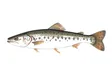
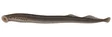
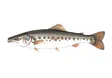
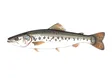
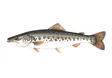
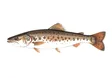
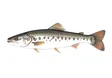
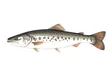
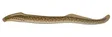
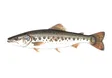
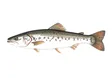
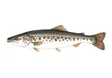
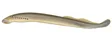
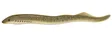
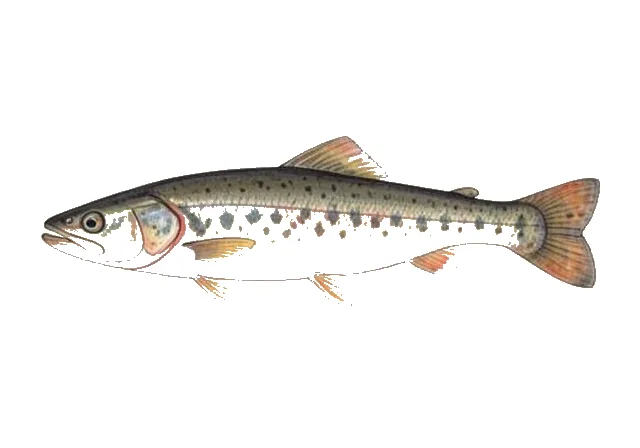
Least Brook Lamprey field guide illustration

About Least Brook Lamprey

The least brook lamprey (Lampetra aepyptera) is a common, non-parasitic lamprey distributed in the Mississippi River watershed, and a limited range along the Atlantic coast.

Description

As with all lamprey species, the least brook lamprey spends the majority of its life as a worm-like ammocoete. The ammocoete (5 mm–20 cm) is clear with a pigmented head when small (<5 cm), but becomes a dark/golden brown as it matures. Ammocoetes have pigmented eye spots located in the head that can detect light and dark. After metamorphosis from the ammocoete into the juvenile stage, the lamprey becomes a golden color with yellow-tinged fins. Teeth (often used to identify lamprey to species) develop on the oral disk, and the eyes develop from the eye spots at metamorphosis. Least brook lamprey do not have a juvenile period (see life cycle), and maturation continues directly into the adult stage, at which point the body swells as the gonads are developed. Populations are likely physically distinct depending on the locality where they are captured. Therefore, the physical description provided herein is only a general description. Instead, the tooth arrangements in adults, which do not vary as much between populations, should be used to identify this species positively. Ammocoetes should be tentatively identified based on prior collection history for the area in which they were found unless they are positively identified by an expert.

Life cycle

Adults spawn in the spring in the headwaters of streams. The males (aided by females) construct small nests by picking up pebbles with their oral disks and moving them to form the rims of shallow depressions. The sticky eggs are deposited in the nest and adhere to the sand and gravel. Multiple adults may spawn in the same nest, and multiple males may spawn with the same female. As with all lamprey species, adults die after spawning.

When they first hatch, embryos remain in the nest for up to one month before they mature into ammocoetes. Ammocoetes leave the nest and seek out slow-flowing water in sandy areas, where they burrow and begin feeding. Ammocoetes live burrowed for 3–7 yr, feeding on microscopic plant and animal life and detritus (decaying matter). Mature ammocoetes will begin metamorphosis in the late summer through the fall in preparation for spawning the following year. Metamorphosing and adult brook lampreys cannot eat, since they have nonfunctional intestines, and only live for four to six months.

Article text: Wikipedia contributors, Least brook lamprey (source revision). Licensed under CC BY-SA 4.0. Retrieved 2026-10-11.
Diet and feeding

FishTraits classifies the adult stage of this species as nonfeeding.

Habitat preferences

Reported habitat associations include streams and small rivers, creeks.

The source records associations with muck, clay or silt, sand, organic debris. An association indicates reported use, rather than an exclusive requirement.

Reproduction and parental care

The compilation reports a representative maturity age of 5 years. Its maturity field summarizes mean, median, or modal estimates, usually for females; male estimates can be used when female data are unavailable. It is not a fixed age at which every fish first breeds.

Recorded spawning months are Mar, Apr for the source’s reporting region (NC). This is a regional calendar, not a range-wide schedule.

The reproductive-guild classification includes hiding a brood without subsequent guarding.

Size and recorded longevity

FishTraits reports a maximum total length of 18 centimetres. Some entries use an estimated asymptotic length; this value should not be treated as a certified record catch.

Recorded longevity in the compilation is 6 years. Wild observations were preferred, but captive records were accepted where wild records were unavailable, and unspecified records were assumed wild. The value is not a guaranteed wild lifespan or an aquarium life expectancy.

Range

Where it lives

Share of 1,743 GBIF observation records with a state location, across 19 states. The orange dots are USGS stream-survey sites where this species was caught.
0%
26.3%
Share of 1,743 GBIF observation records with a state location, across 19 states. The orange dots are USGS stream-survey sites where this species was caught.

A blank area on the dot layer usually means nobody sampled there, not that the fish is absent. Turn on “every survey site” to see where the survey looked.

The USGS stream survey caught it at 495 of its sites, in 14 states. That survey and the GBIF records are two different counts of two different things, so the site keeps them apart.

Habitat

Water and movement

Water
WoRMS records this species in fresh water.
Migration
Migratory
Pattern

Classification

Taxonomy

Kingdom
Animalia
Phylum
Chordata
Class
Cephalaspidomorphi
Order
Petromyzontiformes
Genus
Lampetra
Species
Lampetra aepyptera
ITIS TSN
159705
WoRMS AphiaID
1026288
GBIF key
5216490

Common questions about Least Brook Lamprey

What is the scientific name of Least Brook Lamprey?
The scientific name is Lampetra aepyptera, in the family Petromyzontidae. Classification follows ITIS.
Does Least Brook Lamprey live in fresh water or salt water?
WoRMS records this species in fresh water.
Where has Least Brook Lamprey been recorded in the United States?
GBIF has observations in 19 states, with the most records in Ohio, Alabama, Kentucky. The map shows observation records, which do not establish the complete natural range.

Closest relatives

Other Lampetra species

Same family

More Petromyzontidae