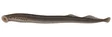
Chestnut Lamprey

Ichthyomyzon castaneus

Petromyzontidae · freshwater water fish

4 minute read · Species guide

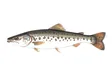
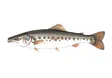
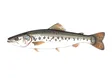
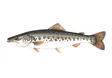
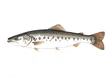
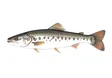
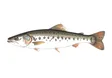
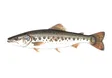
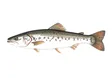
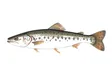
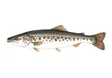
Chestnut Lamprey field guide illustration

About Chestnut Lamprey

The chestnut lamprey (Ichthyomyzon castaneus) is a species of lamprey.

Description

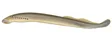
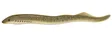
The chestnut lamprey has a maximum length of around 38 centimetres (15 in), with a tan to yellowish-olive hue above, the sides, belly, and fin lighter. They are blue-black just after spawning. The jawless mouth expands wider than the head, with many firm slender teeth, typically 4 lateral bicuspids on both sides of the innermost row, in front of which are 6–11 sharp cusps, and 2–3 anterior to the mouth. It has a long dorsal fin and no paired fins.

Life cycle

During the egg stage of the lamprey's life, it is vulnerable to predators that prefer to eat fish eggs. Predation by other fish helps keep lamprey numbers under control. When the lamprey has hatched from its egg into the larvae stage, it is limited to pools or backwater areas with a sand or sandy mud bottom. The young lampreys filter feed for food for around five to seven years until they are large enough to attach themselves to a host species. Spawning of this species of lamprey occurs from June to July when the animals are around seven to nine years old and migrate to tributaries to protect the young from predators, though most spawning activity has been observed in mid-June. During the mating process, one female would begin moving rocks from a suitable area for eggs; afterward she attaches herself to a rock while hopeful males attach to her and stroke her tail attempting to mate. The eggs are then covered with a rock, presumably to shade the young lampreys at birth and to keep any predators from devouring the young. As with most lampreys, the chestnut lamprey only mates once during its entire life and dies shortly after.

Similar species

The chestnut lamprey is closely related to the nonparasitic southern brook lamprey, and the two have been termed a paired species.

Similar species include the parasitic relatives Ichthyomyzon bdellium, I. greeleyi, and I. unicuspis.

Distribution and habitat

The range of the chestnut lamprey extends from Lake Winnipeg and the Hudson Bay down the Mississippi River to the Central and Eastern United States; this includes any large lakes or reservoirs where large host fish are present. In Canada, the chestnut lamprey has been found in Saskatchewan, Manitoba, Ontario, and Quebec. Larvae can be found in pools and backwater over sand and sandy mud.

Ecology

Adults are parasitic and feed on other fish by clamping to their side with their suctorial mouths and creating a wound with their teeth to obtain body fluids. It was widely presumed that this fish did not feed during the winter, but recent research in Wisconsin has revealed some lampreys remain attached to their host during the winter months; one fisherman caught a sturgeon with a chestnut lamprey still attached. Observation of this species has revealed that they are primarily a nocturnal animal and they seek out shade during daylight. These lampreys may be beneficial to the rivers and lakes, due to their natural control of local fish populations. Human populations can pose threats to these animals through pollution, siltation, and dredging. Larval lamprey must filter feed for numerous years and are vulnerable to changes in their environment during this time. For instance, larval lampreys will starve if large particulate matter regularly block their mouths.

Article text: Wikipedia contributors, Chestnut lamprey (source revision). Licensed under CC BY-SA 4.0. Retrieved 2026-10-11.
Diet and feeding

The FishTraits compilation records these diet categories for this species: blood. These are broad categories, not a claim that every individual consumes every example in a category.

Reported feeding positions include surface or water-column feeding. The compilation combines published observations; diets can vary with age, locality, and available food.

Habitat preferences

Reported habitat associations include medium to large rivers, streams and small rivers.

The source records associations with clay or silt, sand, gravel. An association indicates reported use, rather than an exclusive requirement.

Reproduction and parental care

The compilation reports a representative maturity age of 6 years. Its maturity field summarizes mean, median, or modal estimates, usually for females; male estimates can be used when female data are unavailable. It is not a fixed age at which every fish first breeds.

Recorded spawning months are May for the source’s reporting region (NC). This is a regional calendar, not a range-wide schedule.

The reproductive-guild classification includes hiding a brood without subsequent guarding.

Size and recorded longevity

FishTraits reports a maximum total length of 38 centimetres. Some entries use an estimated asymptotic length; this value should not be treated as a certified record catch.

Recorded longevity in the compilation is 8 years. Wild observations were preferred, but captive records were accepted where wild records were unavailable, and unspecified records were assumed wild. The value is not a guaranteed wild lifespan or an aquarium life expectancy.

Range

Where it lives

Share of 875 GBIF observation records with a state location, across 21 states. The orange dots are USGS stream-survey sites where this species was caught.
0%
14.4%
Share of 875 GBIF observation records with a state location, across 21 states. The orange dots are USGS stream-survey sites where this species was caught.

A blank area on the dot layer usually means nobody sampled there, not that the fish is absent. Turn on “every survey site” to see where the survey looked.

The USGS stream survey caught it at 168 of its sites, in 17 states. That survey and the GBIF records are two different counts of two different things, so the site keeps them apart.

Habitat

Water and movement

Water
WoRMS records this species in fresh water.
Migration
Migratory
Pattern

Classification

Taxonomy

Kingdom
Animalia
Phylum
Chordata
Class
Cephalaspidomorphi
Order
Petromyzontiformes
Genus
Ichthyomyzon
Species
Ichthyomyzon castaneus
ITIS TSN
159725
WoRMS AphiaID
1021311
GBIF key
2421240
Outside the US
ITIS also files it in Canada.

Common questions about Chestnut Lamprey

What is the scientific name of Chestnut Lamprey?
The scientific name is Ichthyomyzon castaneus, in the family Petromyzontidae. Classification follows ITIS.
Does Chestnut Lamprey live in fresh water or salt water?
WoRMS records this species in fresh water.
Where has Chestnut Lamprey been recorded in the United States?
GBIF has observations in 21 states, with the most records in Minnesota, Alabama, Illinois. The map shows observation records, which do not establish the complete natural range.

Closest relatives

Other Ichthyomyzon species

Same family

More Petromyzontidae