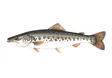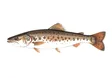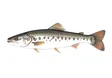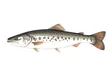
Western Brook Lamprey

Lampetra richardsoni

Petromyzontidae · freshwater water fish

3 minute read · Species guide

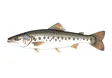
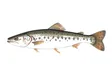
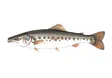
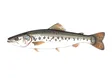
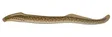
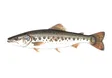
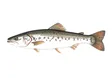
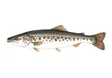
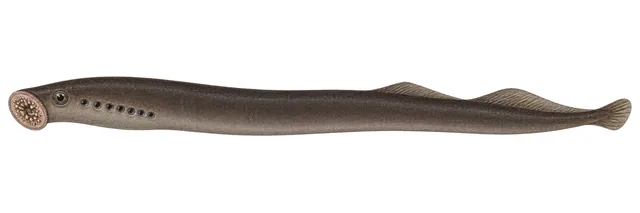
Western Brook Lamprey field guide illustration

About Western Brook Lamprey

The western brook lamprey (Lampetra richardsoni) is a small (<18 cm), widely distributed, non-parasitic species of jawless fish endemic to the freshwater coastal waterways of the Western United States and Canada. Its range extends from the North American Pacific coast from Taku River, southern Alaska, Haida Gwaii, to central California, including Vancouver Island, with major inland distributions in the Columbia and Sacramento-San Joaquin watersheds.

One endangered parasitic variety, the Morrison Creek lamprey (Lampetra richardsoni var. marifuga), is unique to Morrison Creek, Vancouver Island, British Columbia. Which is larger in size (15 – 18 cm). The Morrison Creek lamprey is able to feed after it becomes an adult unlike the western brook lamprey which can only feed in its larval stage.

The western brook lamprey is Not at Risk (Yellow List) and does not have a Species at Risk Act.

It spawns in spring until mid-summer when the water temperature is over 10 degrees Celsius. They create nests made out of gravel, and after hatching they are swept downstream into quieter parts of the stream and burrow into the ground. They stay in these quiet areas for about four years until eventually turning into adults. When they become adults in late summer to late fall they do not eat. After the lamprey spawns it dies.

Additional field notes

Larvae and transformed western brook lampreys use different foods and parts of a stream.

Sources: Lampetra richardsoni species summary

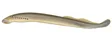
A feeding larva and nonfeeding adult

The larval stage, called an ammocoete, occupies sandy or muddy backwaters and pools. FishBase records diatoms and other microscopic plant and animal material in its food. After transformation, the typical western brook lamprey stops feeding. Adults use gravel riffles and runs in clear, cool streams, so protecting adult spawning gravel alone would leave out the quiet sediment habitat used earlier in life.

Sources: Lampetra richardsoni species summary

Guide sources

Research reviewed 2026-10-19.

Article text: Wikipedia contributors, Western brook lamprey (source revision). Licensed under CC BY-SA 4.0. Retrieved 2026-10-11.
Diet and feeding

FishTraits classifies the adult stage of this species as nonfeeding.

Habitat preferences

Reported habitat associations include streams and small rivers, creeks.

The source records associations with clay or silt, sand, gravel. An association indicates reported use, rather than an exclusive requirement.

Reproduction and parental care

The compilation reports a representative maturity age of 6 years. Its maturity field summarizes mean, median, or modal estimates, usually for females; male estimates can be used when female data are unavailable. It is not a fixed age at which every fish first breeds.

Recorded spawning months are Mar, Apr for the source’s reporting region (CA). This is a regional calendar, not a range-wide schedule.

The reproductive-guild classification includes hiding a brood without subsequent guarding.

Size and recorded longevity

FishTraits reports a maximum total length of 15 centimetres. Some entries use an estimated asymptotic length; this value should not be treated as a certified record catch.

Recorded longevity in the compilation is 7 years. Wild observations were preferred, but captive records were accepted where wild records were unavailable, and unspecified records were assumed wild. The value is not a guaranteed wild lifespan or an aquarium life expectancy.

Range

Where it lives

Share of 162 GBIF observation records with a state location, across 4 states. The orange dots are USGS stream-survey sites where this species was caught.
0%
77.2%
Share of 162 GBIF observation records with a state location, across 4 states. The orange dots are USGS stream-survey sites where this species was caught.

A blank area on the dot layer usually means nobody sampled there, not that the fish is absent. Turn on “every survey site” to see where the survey looked.

The USGS stream survey caught it at 28 of its sites, in 2 states. That survey and the GBIF records are two different counts of two different things, so the site keeps them apart.

Habitat

Water and movement

Water
WoRMS records this species in fresh water.
Migration
Migratory
Pattern

Classification

Taxonomy

Kingdom
Animalia
Phylum
Chordata
Class
Cephalaspidomorphi
Order
Petromyzontiformes
Genus
Lampetra
Species
Lampetra richardsoni
ITIS TSN
159707
WoRMS AphiaID
592841
GBIF key
5216507
Outside the US
ITIS also files it in Canada.

Common questions about Western Brook Lamprey

What is the scientific name of Western Brook Lamprey?
The scientific name is Lampetra richardsoni, in the family Petromyzontidae. Classification follows ITIS.
Does Western Brook Lamprey live in fresh water or salt water?
WoRMS records this species in fresh water.
Where has Western Brook Lamprey been recorded in the United States?
GBIF has observations in 4 states, with the most records in Oregon, Washington, California. The map shows observation records, which do not establish the complete natural range.

Closest relatives

Other Lampetra species

Same family

More Petromyzontidae