Ohio Lamprey

Ichthyomyzon bdellium

Petromyzontidae · freshwater water fish

3 minute read · Species guide

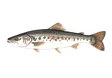
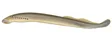
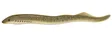
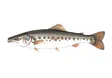
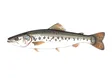
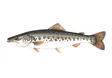
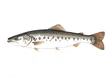
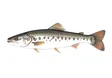
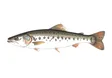
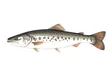
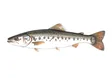
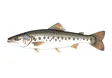
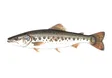
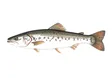
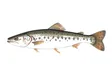
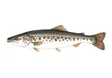
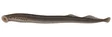
Ohio Lamprey field guide illustration

About Ohio Lamprey

The Ohio lamprey (Ichthyomyzon bdellium) is a lamprey found in the Ohio River drainage basin in the United States and is a parasitic species of lampreys. They are considered to be an endangered /rare species in some states, due to siltation, pollution, and construction of dams.

Description

All lampreys have a long, almost eel-like, body with no scales. Lampreys have segments of muscles that are visible along their body called myomeres, and a jawless mouth. In larval lampreys, called ammocoetes, their mouth is not fully developed, very small, and hidden between folds of skin. Adults have a disk shaped mouth with varying amounts of teeth depending on the species. The Ohio lamprey has a single, continuous dorsal fin. Fully grown, Ohio lampreys reach 10–14 inches, but may get to 15 inches.

Diet

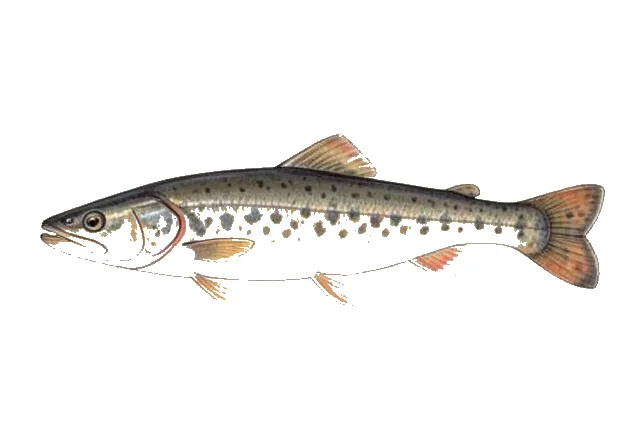
As ammocoetes, Ohio lamprey filter plankton, algae, and other small organic matter. As adults, they attach onto larger prey, such as smallmouth bass, walleyes, redhorse suckers, and trout, feeding on blood and body fluids. Ohio lampreys do not appear to kill the host fish, as they evolved with other fishes in their range. As a result, they do not appear to have a significant effect on populations of their host fishes.

Reproduction

As a sexually mature adult, Ohio lamprey will seek out suitable breeding sites. They likely do not return to their natal site to spawn, but this remains untested. Spawning occurs in late May or early June, with adults working together or in pairs to create a pit in riffles of moderate currents. They use their suction cup-like mouth to move rocks from these riffles, and then the female lamprey deposits eggs into this pit after mating. All adults will die after spawning.

Distribution

The Ohio lamprey is found throughout the Ohio River basin in 11 states: Alabama, Georgia, Indiana, Kentucky, New York, North Carolina, Ohio, Pennsylvania, Tennessee, Virginia, and West Virginia. The Ohio lamprey used to be found in Illinois, but is now considered to be extirpated; the last sighting was in 1918.

Article text: Wikipedia contributors, Ohio lamprey (source revision). Licensed under CC BY-SA 4.0. Retrieved 2026-10-11.
Diet and feeding

The FishTraits compilation records these diet categories for this species: blood. These are broad categories, not a claim that every individual consumes every example in a category.

Reported feeding positions include surface or water-column feeding. The compilation combines published observations; diets can vary with age, locality, and available food.

Habitat preferences

Reported habitat associations include medium to large rivers, streams and small rivers.

The source records associations with muck, clay or silt, sand, gravel, cobble, organic debris. An association indicates reported use, rather than an exclusive requirement.

Reproduction and parental care

The compilation reports a representative maturity age of 6 years. Its maturity field summarizes mean, median, or modal estimates, usually for females; male estimates can be used when female data are unavailable. It is not a fixed age at which every fish first breeds.

Recorded spawning months are Jun, Jul for the source’s reporting region (NC). This is a regional calendar, not a range-wide schedule.

The reproductive-guild classification includes hiding a brood without subsequent guarding.

Size and recorded longevity

FishTraits reports a maximum total length of 30 centimetres. Some entries use an estimated asymptotic length; this value should not be treated as a certified record catch.

Recorded longevity in the compilation is 7 years. Wild observations were preferred, but captive records were accepted where wild records were unavailable, and unspecified records were assumed wild. The value is not a guaranteed wild lifespan or an aquarium life expectancy.

Range

Where it lives

Share of 309 GBIF observation records with a state location, across 12 states. The orange dots are USGS stream-survey sites where this species was caught.
0%
21.4%
Share of 309 GBIF observation records with a state location, across 12 states. The orange dots are USGS stream-survey sites where this species was caught.

A blank area on the dot layer usually means nobody sampled there, not that the fish is absent. Turn on “every survey site” to see where the survey looked.

The USGS stream survey caught it at 31 of its sites, in 8 states. That survey and the GBIF records are two different counts of two different things, so the site keeps them apart.

Habitat

Water and movement

Water
WoRMS records this species in fresh water.
Migration
Migratory
Pattern

Classification

Taxonomy

Kingdom
Animalia
Phylum
Chordata
Class
Cephalaspidomorphi
Order
Petromyzontiformes
Genus
Ichthyomyzon
Species
Ichthyomyzon bdellium
ITIS TSN
159724
WoRMS AphiaID
1019850
GBIF key
2421242

Common questions about Ohio Lamprey

What is the scientific name of Ohio Lamprey?
The scientific name is Ichthyomyzon bdellium, in the family Petromyzontidae. Classification follows ITIS.
Does Ohio Lamprey live in fresh water or salt water?
WoRMS records this species in fresh water.
Where has Ohio Lamprey been recorded in the United States?
GBIF has observations in 12 states, with the most records in Kentucky, Tennessee, New York. The map shows observation records, which do not establish the complete natural range.

Closest relatives

Other Ichthyomyzon species

Same family

More Petromyzontidae