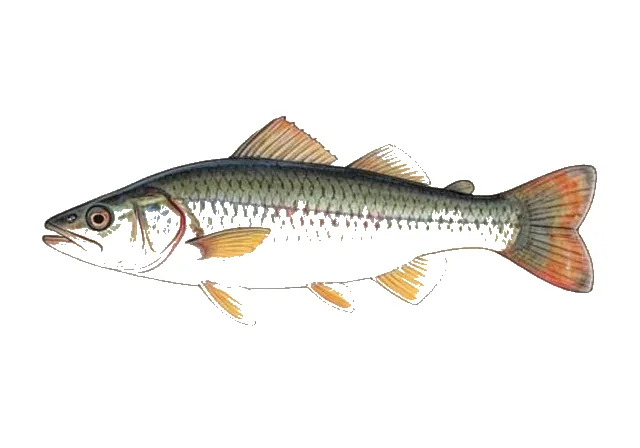
Dwarf Livebearer

Heterandria formosa

Poeciliidae · freshwater and brackish water fish

4 minute read · Species guide

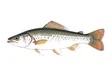
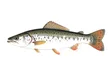
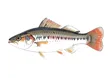
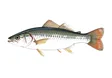
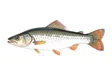
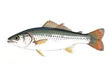
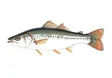
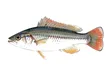
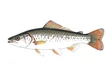
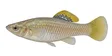
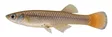
Dwarf Livebearer field guide illustration

About Dwarf Livebearer

Heterandria formosa (known as the least killifish, dwarf topminnow, mosqu or midget livebearer) is a species of livebearing fish within the family Poeciliidae. This is the same family that includes familiar aquarium fishes such as guppies and mollies. Heterandria formosa is not as commonly kept in aquaria as these species. Despite the common name "least killifish", it belongs to the family Poeciliidae and not to one of the killifish families. H. formosa is one of the smallest fish species; the 1991 Baensch Aquarium Atlas listed it as the seventh smallest fish in the world, and as of 2006 it remains the smallest fish species found in North America.

Range and habitat

Heterandria formosa is the only member of its genus found in the United States. Its geographical range spans the southeastern United States, from North Carolina south to Georgia and Florida, and westward across the Florida Gulf Coast to Louisiana. In recent years, this species has been collected in eastern Texas. It is recorded to occur along the western portion of the Sabine River basin, according to North American Native Fishes (NANFA). It has also been collected as far west as Humble, TX in small sand pit ponds after the 2017 floods associated with Hurricane Harvey. It is one of the few aquarium fishes that is endemic to North America.

Heterandria formosa live primarily in vegetated, slow moving or standing freshwater habitats, but this species also occurs in brackish waters.

Description

Heterandria formosa is one of the smallest fish and smallest vertebrates known to science. Males grow to about 2 centimeters (0.8 inches), while females grow a little larger, to about 3 centimeters (1.2 inches).

The fish is generally an olive color, with a dark horizontal stripe through the center of the body. There is also a dark spot on the dorsal fin and females also have a dark spot on their anal fin. Like most poeciliids, male anal fins are modified into a gonopodium (intromittent organ) that is used to deliver sperm and impregnate females during mating.

Diet

Heterandria formosa primarily eats aquatic invertebrates such as worms and crustaceans. They also eat plant matter.

Breeding

Like most poeciliids, H. formosa is a livebearer. The male uses his modified anal fin, or gonopodium, to deliver sperm to the female. The fertilized eggs grow within the female until they hatch, and the free-swimming young are released into the water. Heterandria formosa has an uncommon breeding strategy even among livebearers: rather than all of the young being released at once, as many as 40 fry are released over a 10- to 14-day period, but occasionally over a longer period.

Inbreeding depression

The effect of inbreeding on reproductive behavior was studied in H. formosa in at least one published work. One generation of full-sib mating was found to decrease reproductive performance and likely reproductive success of male progeny. Other traits that displayed inbreeding depression were offspring viability and maturation time of both males and females.

Article text: Wikipedia contributors, Heterandria formosa (source revision). Licensed under CC BY-SA 4.0. Retrieved 2026-10-11.
Diet and feeding

The FishTraits compilation records these diet categories for this species: algae or phytoplankton; invertebrates or larval fish. These are broad categories, not a claim that every individual consumes every example in a category.

Reported feeding positions include surface or water-column feeding. The compilation combines published observations; diets can vary with age, locality, and available food.

Habitat preferences

Reported habitat associations include streams and small rivers, creeks, still-water habitats.

The source records associations with muck, clay or silt, sand, vegetation. An association indicates reported use, rather than an exclusive requirement.

The species is classified as tolerant of a broad range of salinities. This flag does not specify a salinity range for aquarium care.

Reproduction and parental care

The compilation reports a representative maturity age of 0.3 years. Its maturity field summarizes mean, median, or modal estimates, usually for females; male estimates can be used when female data are unavailable. It is not a fixed age at which every fish first breeds.

Batch or serial spawning has been reported somewhere in the species’ range. This does not establish the same spawning pattern for every population.

Recorded spawning months are Jan, Feb, Mar, Apr, May, Jun, Jul, Aug, Sep, Oct, Nov, Dec for the source’s reporting region (AL). This is a regional calendar, not a range-wide schedule.

Size and recorded longevity

FishTraits reports a maximum total length of 3.6 centimetres. Some entries use an estimated asymptotic length; this value should not be treated as a certified record catch.

Recorded longevity in the compilation is 2.5 years. Wild observations were preferred, but captive records were accepted where wild records were unavailable, and unspecified records were assumed wild. The value is not a guaranteed wild lifespan or an aquarium life expectancy.

Native range

Lower Coastal Plain from South Carolina to southern Louisiana (Rosen 1979; Page and Burr 1991).

Habitat and ecology

Heterandria formosa is one of the smallest freshwater fish species in North America, with females maturing at 15 mm SL (Bennett and Conway 2010). Inhabits still waters of pools and slow-moving streams in areas of dense vegetation (Boschung and Mayden 2004). Dwarf killifish are omnivorous, generally consuming aquatic invertebrates (ostracods, copepods, and cladocerans) but will also consume plant materal as well (Boschung and Mayden 2004).

Introduction history

In 1905 about 10,000 Heterandria and Gambusia were stocked into New Jersey for mosquito control purposes (Seal 1910). The reason for the North Carolina stocking is not known.

Range

Where it lives

Share of 3,510 GBIF observation records with a state location, across 8 states. The orange dots are USGS stream-survey sites where this species was caught.
0%
78.5%
Share of 3,510 GBIF observation records with a state location, across 8 states. The orange dots are USGS stream-survey sites where this species was caught.

A blank area on the dot layer usually means nobody sampled there, not that the fish is absent. Turn on “every survey site” to see where the survey looked.

The USGS stream survey caught it at 37 of its sites, in 4 states. That survey and the GBIF records are two different counts of two different things, so the site keeps them apart.

Habitat

Water and movement

Water
WoRMS records this species in fresh water and brackish water.
USGS NAS habitat
Freshwater
US status
Native transplant — native to part of the United States, moved to other waters inside it.
Migration
Not migratory

Classification

Taxonomy

Kingdom
Animalia
Phylum
Chordata
Superclass
Actinopterygii
Class
Teleostei
Order
Cyprinodontiformes
Genus
Heterandria
Species
Heterandria formosa
ITIS TSN
165915
WoRMS AphiaID
281052
GBIF key
2349968

Common questions about Dwarf Livebearer

What is the scientific name of Dwarf Livebearer?
The scientific name is Heterandria formosa, in the family Poeciliidae. Classification follows ITIS.
Does Dwarf Livebearer live in fresh water or salt water?
WoRMS records this species in fresh water and brackish water.
Where has Dwarf Livebearer been recorded in the United States?
GBIF has observations in 8 states, with the most records in Florida, Louisiana, South Carolina. The map shows observation records, which do not establish the complete natural range.

Same family

More Poeciliidae

Amazon Molly1 states
Poecilia formosaPoeciliidaeNative and introducedFreshBrackish
Amistad Gambusia2 states
Gambusia amistadensisPoeciliidaeNativeFresh
Big Bend Gambusia2 states
Gambusia gaigeiPoeciliidaeNativeFresh
Blotched Gambusia1 states
Gambusia senilisPoeciliidaeNativeFresh
Clear Creek Gambusia1 states
Gambusia heterochirPoeciliidaeNativeFreshBrackish
Cuban Limia1 states
Limia vittataPoeciliidaeIntroducedFreshBrackish
Gila Topminnow3 states
Poeciliopsis occidentalisPoeciliidaeNative and introducedFresh
Guppy15 states
Poecilia reticulataPoeciliidaeIntroducedFreshBrackish
Largespring Gambusia2 states
Gambusia geiseriPoeciliidaeNative and introducedFresh
Mangrove Gambusia1 states
Gambusia rhizophoraePoeciliidaeNativeFreshBrackish
Mexican Molly7 states
Poecilia sphenopsPoeciliidaeIntroducedFreshBrackish
Mosquitofish41 states
Gambusia affinisPoeciliidaeNative and introducedFreshBrackish
Pecos Gambusia3 states
Gambusia nobilisPoeciliidaeNative and introducedFresh
Piketop Minnow3 states
Belonesox belizanusPoeciliidaeIntroducedFreshBrackish
Poeciliopsis sonoriensis1 states
PoeciliidaeNativeFresh
Porthole Livebearer1 states
Poeciliopsis gracilisPoeciliidaeIntroducedFresh
Sailfin Molly15 states
Poecilia latipinnaPoeciliidaeNative and introducedFreshSaltBrackish
San Marcos Gambusia3 states
Gambusia georgeiPoeciliidaeNativeFresh
Shortfin Molly9 states
Poecilia mexicanaPoeciliidaeIntroducedFreshBrackish
Southern Platyfish7 states
Xiphophorus maculatusPoeciliidaeIntroducedFresh
Tex-mex Gambusia1 states
Gambusia speciosaPoeciliidaeNativeFresh
Variable Platyfish5 states
Xiphophorus variatusPoeciliidaeIntroducedFresh