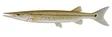
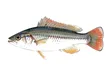
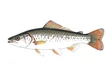
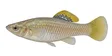
Description
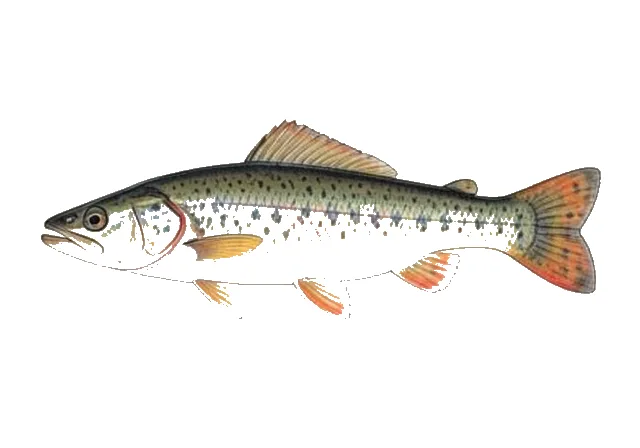
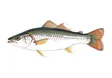
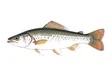
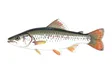
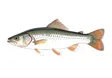
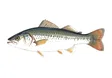
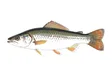
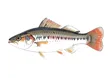
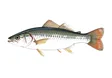
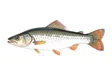
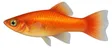
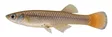
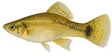
The Gila topminnow has an elongated, curved body. Males are rarely over 25 mm (0.98 in) and they are smaller than females, which can sometimes be 50 mm (2.0 in). The belly is often white with darker body above, has scales with dark outlines, and a lateral dark band on the side.
Distribution
Gila topminnow once occupied in the Gila River drainage in Arizona, New Mexico, and Mexico. Currently, they are known to be in Gila River drainage in Arizona and Mexico, having been extirpated from New Mexico due to the introduction of Gambusia affinis.
Biology
Gila topminnow was once the most common fish found in the Gila River drainage. They are fertilized internally; reproduction season usually is from April to November. The female gives birth from 10 to 15 young per brood. These young brood reach maturity in a few weeks to several months. Gila topminnows are omnivorous, and eat food such as detritus and amphipod crustaceans, but feed mostly on aquatic insect larvae, especially mosquitos.
Habitat
This species of fish prefers to live in shallow, warm water in headwater springs. They can survive in water with temperatures ranging from near freezing to near 100 °F (38 °C). They can also live in water with a pH range from 6.6 – 8.9 and salinity from fresh water to sea water.
Conservation
Gila topminnows are endangered due to predation and competition from the introduced mosquitofish. Threats also come from continued habitat loss due to water development, habitat degradation due to erosion from roads, and drought. Gila topminnows from Sharp Spring currently are being held and bred at Southwestern Native Aquatic Resources and Recovery Center at Dexter, New Mexico, for reintroduction to wild habitats.
Article text: Wikipedia contributors, Gila topminnow (source revision). Licensed under CC BY-SA 4.0. Retrieved 2026-10-11.
Diet and feeding
The FishTraits compilation records these diet categories for this species: algae or phytoplankton; detritus or unidentified plant material; invertebrates or larval fish. These are broad categories, not a claim that every individual consumes every example in a category.
Reported feeding positions include bottom feeding and surface or water-column feeding. The compilation combines published observations; diets can vary with age, locality, and available food.
Habitat preferences
Reported habitat associations include medium to large rivers, streams and small rivers, creeks, springs or subterranean waters.
The source records associations with muck, clay or silt, sand, gravel, vegetation. An association indicates reported use, rather than an exclusive requirement.
Reproduction and parental care
The compilation reports a representative maturity age of 0.3 years. Its maturity field summarizes mean, median, or modal estimates, usually for females; male estimates can be used when female data are unavailable. It is not a fixed age at which every fish first breeds.
Batch or serial spawning has been reported somewhere in the species’ range. This does not establish the same spawning pattern for every population.
Recorded spawning months are Jan, Feb, Mar, Apr, May, Jun, Jul, Aug, Sep, Oct, Nov, Dec for the source’s reporting region (AZ). This is a regional calendar, not a range-wide schedule.
Size and recorded longevity
FishTraits reports a maximum total length of 6 centimetres. Some entries use an estimated asymptotic length; this value should not be treated as a certified record catch.
Recorded longevity in the compilation is 1 years. Wild observations were preferred, but captive records were accepted where wild records were unavailable, and unspecified records were assumed wild. The value is not a guaranteed wild lifespan or an aquarium life expectancy.